
- 1999
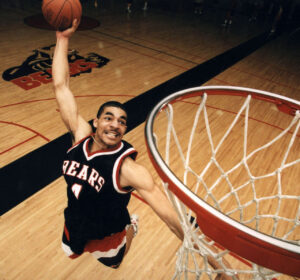
Carlos Boozer making his signature dunk shot as a JDHS Crimson Bears standout player (read more below). photo credit: alaskasportshall.org – inductee – carlos-boozer.
Tourism’s continued growth and resulting impacts made headlines much of the year, with stories of not only increased visitation but helicopter crashes, ship groundings, admissions of pollution, and approval of a local visitor head tax all focusing in on Juneau’s largest growth industry. As cruise ship visitor numbers increased steadily each year from 250,000 at the start of the decade to over 600,000 passengers this season, concerns also grew about impacts such as area congestion, aircraft noise, and air and water pollution. A visitor head tax, voted down several years earlier, was an idea whose time had come as residents voted to enact a $5 surcharge on most cruise line visitors to be applied to improving support infrastructure and paying for cost of increased services. Expected to raise around $3 million annually, cruise industry spokespeople indicated that they might sue if the passenger fee was diverted away from tourism-related improvements and services, and several companies said they would limit their future scheduled stops in town or reduce contributions to benefit local non-profits or arts groups.
show more
Part of the support for approving the head tax arose from Royal Cruise Line’s admission to having dumped polluted ship drainages into the channel and other southeast waters, which caught up with them when they pleaded guilty to 21 felony counts of illegal discharges and were fined $18 million in federal penalties. The company president also offered a formal apology to Juneau residents during a public meeting concerning tourism issues.
Tourism incidents during the season also shook up the industry, with several helicopter crashes, (one fatal) and ship groundings, two of which experienced serious damage and subsequent loss of revenue for operators. Poor weather conditions apparently contributed to the crash and deaths of the pilot and all six passengers in a June flight to Herbert Glacier. Three months later flat light visibility resulted in the crashes of three copters near the same area, two of which were attempting rescue of the first flight group. No one suffered injury, but 18 people were stranded overnight on the glacier before a next-day rescue by Coast Guard helicopter. On the water, three Juneau-based small tour vessels grounded or hit rocks in Glacier Bay, Idaho Inlet, and Tracy Arm. No passengers were injured, but two of boats suffered serious damage and were out for the rest of the season, while one was re-floated without damage.
Tragic local accidents took lives in several separate incidents. Two snow board enthusiasts were lost on Mt. McGinnis when a slab avalanche fell upon them as they were gliding downward. An alleged drunk driver sideswiped a resident as he excited his car alongside the Back Loop Road. The victim died shortly afterwards from resulting injuries. The driver was charged with manslaughter, but the incident provoked enough controversy that the defendant’s attorney requested an out-of-town trial venue, yet to be tried at year’s end. Two couples were killed in a small private plane accident as they flew from Echo Ranch Bible Camp back to Juneau, but crashed into a North Douglas mountainside in poor visibility weather.
The weather also caused various reactions throughout the year, depending on one’s perspective. Heavy snowfall gave great delight to skiers and an extended season at Eaglecrest and other cross-country tracks around town. Eaglecrest had a record sale for lift tickets, helping to replenish its depleted reserve fund. Gardeners and hikers, however, were less than pleased with the rainy spring, summer, and fall. Late in September, the area set a new record of 49 straight days of measurable precipitation, and overall, it was also the third wettest year on record (72.3 inches) since records were started at the airport in 1943.
A drop of oil revenues forced cutbacks in state positions and services. Although the oil prices had increased, North Slope oil production had dropped enough to offset any revenue increases, leaving the state’s coffers short and employees wondering about their jobs. The legislature also refused to fund increases in labor contracts, and unions, in turn, threatened strikes. Smaller state revenue-sharing with the city also reduced its level of services dependent on those funds, leaving a fiscal outlook as gloomy as Juneau weather.
Despite the darker economic forecast, Juneau residents approved sale of nearly $63 million in bonds for construction of a new high school at Dimond Park in the Mendenhall Valley and for renovations at Juneau-Douglas High. The old Juneau High School (and later Capital Elementary School) building was turned into legislative offices and renamed the Terry Miller Legislative Office Building after being donated to the state in 1997.
Juneau athletes young and old excelled in various competitions. Although the boys high school basketball team failed to add a third-time-in-a -row state varsity championship, the girls stepped up and the Crimson Bears softball team won its first-ever state championship. The girls volleyball team also advanced to the state tournament championship match but fell short of the final goal. Senior JDHS student Carlos Boozer graduated and his basketball jersey was framed and hung permanently in the JDHS gym; Carlos was on the McDonald’s High School All-American Basketball team. That fall he joined the Duke University Blue Devils, nationally-ranked in Division I basketball, and made his mark early on. (He later starred at Duke and then went on to win Olympic medals and all-star status in pro NBA basketball).
In other sports, the annual Gold Medal spring basketball tournament opened up a new women’s bracket, the first time in its 53-year history. After 23 years, the annual April Ski-to-Sea race, featuring skiing at Eaglecrest, running down the Eaglecrest road, and finishing with a bicycle race along North Douglas highway ended; organizers cited dwindling participation, increased expenses, and controversy over race rules. Juneau’s Gastineau Channel Little League Juniors captured Southeast, state, and divisional championships and advanced to the Western Regional tournament series. They fell one game short to enter the Little League World Series after losing the critical game to a southern California team. They had, however, advanced further than any other little league team in Alaskan little league history. In December, Joe Thompkins became the first person to win a gold medal in a Disabled World Cup downhill ski race for sit-down skiers in Breckenridge, Colorado, adding it to several silver and bronze medals in those competitions.
And at year’s end, officials from the Mayor’s Y2K Task Force professed reasonable assurance to the public that the striking of midnight on New Year’s Eve, announcing not only a new year but a new century, would not cause apocalyptic chaos. As the new century had been approaching, fear grew around the world that computers would not automatically change dates from the 1900s to 2000s (Y2K =Year2Kilo or thousand), and would shut down everything that by now normally relies on computer automation, from communications to commerce to utilities and everything else imaginable. To forestall such eventualities, a niche business boomed to reprogram computers to make the date switch seamless for private and government sectors alike. In Juneau, the city task force had spent much of the year investigating scenarios for disaster and worked to plug any gaps that could occur. Just in case things did go south, however, city, state, federal, and private groups had technicians standing by for the midnight hour…. (no problems were subsequently encountered)
show less