
- 1998
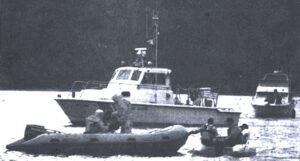
Searchers comb waters to recover victims, wreakage after a tragic helicopter-airplane mid-air collision (read more below.) Michael Penn photo, Juneau Empire 5-31-1998.
This year was big for arts in Juneau, particularly with the filming of “Limbo” by Oscar-nominated director John Sayles. Over 500 locals were involved in the filming of the $3 million production in the summer to tell the story of a former commercial fisherman and his mis-adventures in a drug deal gone south. Playwright Paula Vogel, long-associated with Juneau’s Perseverance Theatre, received a Pulitzer Prize for her play “How I learned to Drive,” written largely around a Juneau setting. It was the last play put on at the Perseverance by founder-director Molly Smith, who had received the Governor’s Award in the Arts in February. Smith stepped into a new position in the prestigious Arena Stage in Washington, D.C., and Vogel returned to her Rhode Island home after the Douglas production.
show more
Juneau shoppers lost out with the closure of two large national chain stores here when the parent corporations downsized their retail outlets. J. C. Penney closed its Mendenhall Mall store, laying off 45 workers, while Nugget Mall’s Rite Aid drug store released 15 employees. It wasn’t just Juneau, however, as Rite Aid shuttered all 10 of its Alaska stores, and Penneys closed 75 stores nation-wide. Juneau visitors had one new attraction to check out when Glacier Gardens Rainforest Adventures botanical park opened in June, which featured a unique and beautiful hanging garden and a ride up the mountainside to an expansive area vista. The Juneau Empire spun off a regional shopper/newspaper with the inauguration of the Southeast Empire in January, which was mailed out to over 16,000 households outside Juneau from Yakutat to Metlakatla.
Mining development continued on an uneven course when Coeur Alaska received the permits needed to re-open the Kensington mine workings at Berner’s Bay. Low gold prices, however, forced a change of plans, curtailing construction, while the company developed new plans designed to operate in lower-priced market conditions. The change of plans, though, which included a deep slurry line for tailings disposal into prime fishing areas in Lynn Canal and use of cyanide for gold recovery, drew the ire of an already sensitive coalition of fishermen, environmentalists, and Native groups. It was almost back to square one for Coeur, as their new plans would require a new round of permit reviews, without any guarantee of final approvals.
Meanwhile the cleanup and closure of the AJ mine by Kvaerner Environmental, after Echo Bay pulled out of its plan to reopen the mine, also faced another obstacle when Echo Bay opponents appealed an EPA pumping permit needed for the cleanup, based on an earlier federal criminal investigation of Echo Bay’s discharge of pollution when operating. A compromise was achieved and Kvaerner could begin dewatering about 400 million gallons of water from the old mine.
October municipal elections once again revealed strong opinions of the voters about spending priorities. Voters approved of adding a temporary 1 cent sales tax to their purchases that was projected to raise $10 million over the next three-year period to pay for more than 20 recreation and harbor projects. This followed the sunsetting of an earlier-approved 1 cent sale tax raise, which raised the $9 million needed to build a new police station. The total sales tax continued to remain at 5 cents total with the new proposition.
Another issue on the ballot was strongly rejected when voters quashed a $55.6 million bond proposition for a new high school in the Mendenhall valley. After a 65% no vote was counted, a post-election poll revealed a multitude of objections including the price tag, desire to have two smaller schools, and the perception that too little information had been provided for informed decisions. With that, the school board rolled up their sleeves to revise the plan for another try for another election as early as the next spring.
The school board also faced the issue of replacing experienced teachers and staff as thirty- nine teachers and nine administrators left in an early retirement incentive program. Over the three-year period the option was open, about 138 teachers and administrators had left, over a third of the district’s 370 employees. This caused concern from some whether that much talent and experience could soon be replaced.
Multiple tragedies struck families and friends in the Juneau area in summer months as people were killed in boating, aircraft, and auto accidents. In two separate small craft accidents between Juneau, Skagway, and Hoonah, two persons survived, but drowning claimed four other victims. A mid-air collision between a small plane and a helicopter above Sheep Creek claimed the lives of the plane’s pilot and passenger, while the helicopter landed safety, but with injuries to all four aboard. Three separate car accidents claimed four lives, while drivers in two of the three cases were charged with negligent homicide and manslaughter. In other court news, longtime Juneau Superior Court Judge Walter “Bud” Carpeneti was appointed to the Alaska Supreme Court.
The Crimson Bears boys basketball team claimed their second straight 4A basketball championship this season after beating the fiercely competitive East Anchorage High Thunderbirds. Though a complete team effort produced the win, a clutch bank shot in the last three seconds by 6-foot-9 junior Carlos Boozer broke the tie to ice the win. Boozer had already drawn the attention of national sports writers and college scouts as one of the nation’s top basketball prospects, but declared that he’d finish school in Juneau rather than at an Outside high school, and said that “I’d like to be the first player from Juneau to make it big,” which he did.
show less