
- 1990
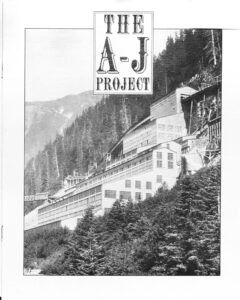
The A-J Project, ca. 1990. booklet by Echo Bay Alaska, Inc. Juneau AK
U.S. Census estimated the area population at 26,751 residents, a 26 percent increase over the past decade; but the city, feeling the number was too low, forced a recount, which was corrected to be 28,881. Juneau’s economy continued to grow healthier, boosted by a record tourist season and an upswing in the housing market. Cruise ships brought in more visitors than ever, and with others visiting by air and ferry, over 375,000 folks came through the area.
Population growth in the Mendenhall valley gave rise to a new telephone prefix (790), property values increased by 10 percent and transformed home sales from a buyers’ to a sellers’ market; meanwhile, low-income housing was becoming extremely scare. Construction increased over the last few years with several mall expansions, demolitions of several long-time land marks to be replaced by new buildings, and expanded facilities constructed or started to provide homeless and family shelters by the Glory Hole and St. Vincent de Paul Society.
show more
Downtown at the federal building, between 200-250 federal employees began moving out in September to new temporary offices at an expanded Mendenhall Mall due to a $24.7 million, three-year asbestos removal project to update the building’s safety requirements. At the airport, the FAA was in the process of opening a new updated and automated flight services center in December to consolidate smaller centers between Ketchikan and Cordova into a larger regional one for improved communications and efficiency.
The University of Alaska Southeast opened its new Egan Library January 15, a $10.6 million project, providing 56,000 sq. ft. of space and capacity for 150,000 volumes. It also serves as a depository for Alaska state and federal documents and receives a broad range of government publications. The school district faced increased enrollments and overcrowding, and continued to study the need for a new elementary school and plan for a new middle school in the Switzer Creek area. The city assembly faced its most contentious debate when it proposed a charter amendment to prohibit municipal employment discrimination on the basis of “sexual orientation.” The issue was finally defused by simply prohibiting discrimination in hiring for any reason.
Mining developments, which promised a return to Juneau’s historic economic base and to increase its economic diversity, also engendered a year-long debate between supporters and opponents. Echo Bay mining company planned to dam up Sheep Creek valley to use both as a tailings deposit and a source for hydropower in its continued planning for re-opening the AJ mine workings. It requested the state Dept. of Natural Resources to select the area as part of its statehood land selections, transferring it out of federal oversight in obtaining a hydropower permit, one of 17 permits the company must obtain to begin its mining operations. Alaskans for Juneau, a local citizens group opposed to the mine re-opening, objected, claiming the move violated federal power regulation law. Both Echo Bay and the Kensington venture, which proposed to re-open historic workings at Berners Bay, began applying for borough permits late in the year, which promised further contentious debate. Together, both operations could open up 800 new jobs for the area. Echo Bay estimated 4.5 million ounces of gold were potentially available in the AJ claims. In other mining news, the new Greens Creek silver mine at Hawk Inlet now ranked as the largest underground silver lode mine in North America and produced an estimated 8 million ounces of silver in its first full year of production, as well as lead, zinc, and gold as by-products.
Crime and punishment, accidents, and a few suicides also captured headlines in amidst what otherwise was normally a peaceful and prosperous year. The 1989 random murder of a Juneau accountant by a transient Colorado couple resulted in the conviction of the man, who was given a 99-year sentence without parole, while his girlfriend was given a lighter conviction, but yet to be sentenced. Four young men, including a grandson of the victim, were convicted of a 1988 murder and robbery of an elderly man and pleaded no contest to reduced charges, then sentenced to prison. A bank robbery in July, a stabbing murder and an arson case in August, and a double shooting murder in December were included in the violent crime cases, while several drownings, accidental shootings (two of which were fatal), three traffic fatalities, and an increase in suicides added to local area tragedies.
Recreational opportunities expanded for residents when Riverside Rotary Park debuted in the Mendenhall Valley, the Richard Marriot nature trail opened by Switzer Creek, and the historic Gruening cabin at Amalga Harbor was designated a state historical park. One popular recreational site, however, was temporarily closed in the summer when city officials determined that Twin Lakes was contaminated with animal wastes. Gold Rush Days began with a mining competition and picnic in June, which eventually turned into a community-wide celebration of mining and logging events.
Record snow and record heat made for an interesting year. February had double the normal snowfall with several severe storms and November set a new snow record with 49 inches, beating out a previous record in 1975. The summer was drier than normal with the third warmest months on record for July and August. A four-day stretch of 80+ degree weather in July set a new record for an over 80-degree temperature period.
Juneau residents continued to broaden and strengthen U.S-Soviet relationships on a personal level. In December a delegation of 102 Alaskans, mainly Juneauites, led by Juneau Mayor Bruce Botelho, visited Vladivostok to formalize an agreement for the municipalities to become sister cities and to exchange information, ideas, and visits in such areas as education, science, culture, sports, arts, and commerce. Their mission was basic: to form friendships with their Russian neighbors. By all accounts, their visit was a big success. Whitehorse Yukon also joined Juneau as a sister city; Chia-Yi, Taiwan and Camiling, Philippines already had such designations.
On the lighter side, former U.S. President Gerald Ford dropped by Juneau in June on his vacation to play golf at the nine-hole Mendenhall Golf Course. Nimbus, the infamous blue-green sculpture hated by many Juneauites, quietly resurfaced from a state storage yard to grace the lawn at the state museum here. And Juneau was awarded the “Fog-Capital of the Pacific Coast” designation in September by the town of Pacifica, California, for reasons not clearly known.
show less