
- 1997
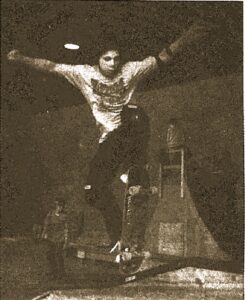
Teen ‘catching some air’ at the Skateboard Park (read more below.) Brian Wallace photo, Juneau Empire May 24, 1998, p. 1.
Echo Bay Mines dropped AJ Mine re-opening plans after spending $110 million and 12 years in Juneau, after the ore body was determined to be unprofitable and environmental regulations could not be economically met. Closing up the mine was turned over to Norwegian company Kvarner Environmental, ending a prolonged community debate over economic benefits vs. environmental and social impacts. Meanwhile Coeur-Alaska succeeded in obtaining city approval for its Kensington mine project, but still needed several state and federal permits before getting the operational go-ahead.
show more
Juneau’s booming tourism economy just keeps growing as this year’s total of 513,000 cruise ship passengers set a new record again, up 9 percent from last season. But increased visitation didn’t always translate into significantly more money for associated businesses. Economy tickets offered by the cruise lines to lure more passengers at the beginning and end of the season tended to appeal to more budget-minded persons who spent less on shore attractions. Expansion of shops further out on South Franklin Street and increased number of tours offered by more operators also tended to splinter the overall receipts into smaller portions for everyone. The new Goldbelt Mt. Roberts tram, however, reported a successful first full year of operation after opening late in the 1996 season. More than 160,000 people rode the tram up the mountain, averaging over 1,000 riders a day.
Ridership on the Alaska state ferry system, however, took a downturn after the ferry M/V Malaspina was blockaded in its berth in Prince Rupert, B.C. by Canadian fishermen protesting interception of Canadian-bound salmon by Alaska fishing fleets. The three-day blockade in mid-July occurred as a publicity stunt during U.S.-Canada salmon treaty negotiations, but Alaska retaliated by cutting off ferry service to the northern B.C. port until December when the state received assurances that this type action would not re-occur. The loss of tourism and other ferry-supported income caused a major economic hit to the area and loss of millions to the ferry system, with the ripple effect felt up and down the whole system. The state also sued the fishermen for the losses and disruption to the tour season.
The state transportation department released a draft plan for improving access in northern southeast Alaska, including a road option for a highway from Juneau along Lynn Canal to Skagway and another option to increase ferry service between Juneau, Haines, and Skagway from either Juneau’s existing Auke Bay terminal or a new one to be constructed in Berners Bay. The region split over the road option, with Haines and Skagway opposing it and Juneau and Sitka officials approving it. For the next step, the state will review the plethora of comments received to release a single alternative plan for the next phase.
Air transport in and out of the capital city got a bit easier when Juneau airport officials received word Christmas eve that the FAA had granted their request to lower minimum flight ceilings and visibility standards for the airport. This would allow airliners equipped with new global positioning satellite (GPS) technology improved access to the area during bad weather and reduce flight delays and cancelations. The FAA would monitor the changes and could possibly reduce the standards further if warranted. City officials noted that it should also improve winter access during the legislative sessions, a point often used in justifying arguments for a capital move.
Juneau officials were concerned after learning about a plan from the Alaska congressional delegation to move the U.S. Forest Service regional headquarters to Ketchikan, ostensibly to bring them closer to the major center of the region’s forest industry. The potential loss of 200 jobs mobilized great opposition from community leaders and the plan was eventually dropped.
Sealaska Corporation expanded into the global marketplace with acquisition of an international Washington-based plastics manufacturing company. It was the first step in an aggressive acquisitions program designed to potentially increase dividends for its Native shareholders and provide employment opportunities as well.
Riverbend Elementary School opened in the Mendenhall Valley in August, while the seventy-year-old Capital School downtown closed in May and was turned over to the State Legislative Affairs for an office building. Riverbend was finished within budget, despite delays after petroleum-contaminated soil was found on the site and had to be cleaned up before construction could continue. Riverbend also joined a national program to provide automated weather tracking equipment for students to use and report local conditions to the public. A small group of older students signed up and began providing daily weather reports on the school’s internet website.
The school district, in a move to cut budget costs, offered an early retirement program to teachers and qualified staff and, by year’s end, 42 had signed up. Savings would come by replacing higher pay positions with lower-pay-level entrants which could enable adding support staff positions, such as nurses and librarians, which had been cut out in earlier budget cuts. District administrators, however, were shocked to find out that this year’s oil and electric bills had unexpectedly increased significantly. Investigation revealed that much electrical usage increase was due to the acquisition of over 700 computers last year for district classrooms, and electric and oil costs for the new Riverbend school were seriously underestimated. These increased utility costs weren’t expected to reduce other programs this year though, as the district had received additional funding overall.
Juneau’s 51st Golden North Salmon Derby became the focus of a threatened boycott by the Alaska Native Brotherhood, which accused the derby’s sponsor, Territorial Sportsmen, of using derby earnings to lobby anti-Native, even racist, stances on fish and game management. Their spokesman denied the claims, but agreed to seek mediation between the two groups with Catholic Bishop Michael Warfel as facilitator. Apologies were made and agreement reached to continue discussion of their differences, from which point the boycott was dropped.
The JDHS boys basketball team won the State Championship for the first time since 1983, after beating long-time rival East Anchorage High and overcoming Palmer’s Colony High after three straight in-season loses to them earlier. Hometown athlete Hilary Lindh ended her skiing career at her peak, with an Olympic silver medal (1992 – downhill), a World Cup Championship gold medal (1997 – downhill), three World Cup victories, 27 Top 10 World Cup victories and winning gold, bronze and silver medals.
A grassroots project by organized and led by local teenagers and young adults resulted in the opening of Juneau’s first skateboard park. Donations of materials and labor by community businesses and volunteers were put to good use in the two-year construction period to create a safe, covered venue open year-round to be managed as a city park. Another community project to commemorate sacrifices of Juneau’s commercial fisherman was completed when the Commercial Fishermen’s Memorial on the Juneau Waterfront was unveiled in the spring.
show less