
- 1983
With the threat of a potential capital move removed in last year’s state election, Juneau’s economy boomed, fed by oil dollars. New businesses sprung up and Juneau’s two valley malls expanded by 30 and 40 percent. The city reported a sizable increase in its sales tax revenues, driven in part by the boom (but the assembly had also passed new regulations to require quarterly sales tax reports from merchants to better capture seasonal sales tax receipts and to help enforce delinquent returns). In June area voters also approved a sales tax increase to fund a long-debated and studied area-wide water system expansion that set the new rate at a uniform 4 percent (it had varied by locale as much as 2.5 percent).
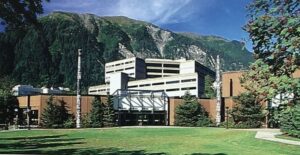
Juneau’s Centennial Hall civic center. photo courtesy of Mark Kelley in Juneau Portraits II, p. 93.
Downtown new construction included the opening of the long-planned Juneau Centennial Hall, which hosted the inaugural ball in January for newly-elected governor, Bill Sheffield, an Anchorage hotelier (while the building was still under construction). On May 18 a fire destroyed a third of the ballroom flooring but repairs were made in time for the gala week of celebration activities, starting with the building dedication June 11.
Sheffield himself hosted the traditional annual Christmas open house for the public to see the newly-remodeled governor’s mansion. The 71-year-old building had undergone a multi-million dollar rebuild to repair decaying structural components and update electrical, plumbing, and security systems. It was also re-furnished and decorated to restore the 1912-era-look when it was first constructed. Out by the airport area a new state trooper building opened up in the fall, and work also progressed on building a new Fred Meyer department store and the Jordan Creek mall in the airport area.
show more
Governor Sheffield’s proposal to require state employees in Southeast Alaska to shift their office hours to an hour later to provide more time to communicate with offices in the Alaska Time zone of central Alaska went into effect January 10 and received plaudits from the Anchorage Daily News as common-sense approach. Later the The U.S. Department of Transportation shifted time zones to establish a wider Alaska Time zone, which now included Southeast with the rest of Alaska, except for the western Aleutians. The shift was made October 30, the day daylight savings time ended for the season, and central Alaska didn’t need to change their clocks at all. The shift now put Juneau and southeast Alaska one hour earlier than Seattle and the rest of the Pacific time zone, and in sync with the rest of the state’s population centers.
Juneau once again had two major airlines for intra- and inter-state connections when Western Airlines received federal approval in January to add Juneau back onto its Alaskan routes. It had pulled out its service in 1972, due to an adverse CAB ruling. Wien Alaska airlines had dropped its Juneau route a year earlier, leaving the capital city with only Alaska Airlines service until early this year. The FAA also took the airport to task when two joggers crossed over the runway just as a jet was making an approach, forcing it make a second approach. The joggers were apprehended and lectured about the danger they caused, and the airport subsequently restricted all unauthorized access and locked all access gates.
UAJ received its first 4-year accreditation in January following a six-year process with several earlier rejections. The school’s follow-up of the accreditation board’s earlier recommendations led to earning this year’s approval, including the expansion of its library. Recommendations by the board for the school to keep its accreditation in the next round in 1988 included increasing its student enrollment and providing more student housing. It offered 300 courses for its spring semester and its coordinators were registering students from 14 villages in Southeast, who could receive instruction through electronic delivery, including computers, television, and audio means.
Mendenhall River Community School was constructed and opened late in the fall term, to reduce earlier overcrowding at the Auke Bay and Glacier Valley elementary schools. The school board was also considering closing Capital Elementary School, due to low enrollment and a shift in demographics to the Harborview school area. The high school was in the midst of a large renovation project, which included a new library, classrooms, commons area, gym and locker rooms, administrative offices, and a renovated and enlarged gymnasium. The high school girls’ basketball team captured the 1982-83 season state championship and extended the run to chalk up 38 straight wins in two years, before losing their first game this fall. Savikko Park, which included four new ballfields, opened in Douglas by the Sandy Beach recreation area.
Juneau residents were shocked by the strangulation death of a young women and then two murder-suicides in the course of a couple months’ time in the fall. A 21-year-old man was convicted of a violent beating and stabbing death of an elderly couple in 1982 after a long and costly first-degree murder trial, while his co-defendant was acquitted in that trial. The co-defendant later was shot to death in a local café by a friend of the victims. Downtown, four separate attacks on different women by men were reported late in the year, but unsolved by year’s end. On a more positive note, the non-profit organization Juneau Crime Line Inc. reported in early January that in its first year of operation information called into to it helped solve ten burglaries and it helped recover $15,700 of $27,000 reported taken in burglaries and thefts. Three rewards were given out to callers whose tips helped solve the cases, but twelve callers refused the rewards offered for their services.
Area commercial fishermen lost a long-time market and processor with the closing of the historic Juneau Cold Storage in early December, first opened in 1913. The announcement by owner Kodiak King Crab, Inc. was followed quickly by a proposal from the International Warehousemen’s and Longshoremen’s Union to purchase the 85,000 square-foot plant and convert it into a center for small-scale fish processing and retail shops (never happened.)
show less