
- 1984
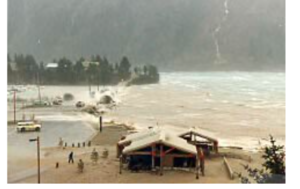
Thanksgiving Day storm waves crashing over Mayflower Island causeway in Douglas, November 22, 1984. photo from mustreadalaska.com story Remembering Southeast’s 1984 Thanksgiving Day Storm by Suzanne Downing, 12-3-2020.
A Thanksgiving Day storm, which combined high tides and hurricane-force winds, caused widespread destruction to waterfront property and damaged several roadways, including a section of Egan Drive. An estimated $3 million damage occurred in the Juneau area, with another $1 million in damage elsewhere in southeast Alaska. Governor Sheffield declared various areas disaster zones, and affected residents soon lined up for state and federal relief loans and grants.
A disgruntled employee set the Gold Room of the Baranof Hotel on fire April 27, its third blaze within a decade; the damage was $1.5 million with another $500,000 to $1 million in destroyed artwork. No one was injured, however, and hotel officials quickly proceeded on a $5 million renovation project to rebuild the property to open the following season. The perpetrator was convicted of arson and sentenced to fifteen years in prison. At the Chevron bulk storage tank farm along Willoughby Avenue, a tank overflowed in February while being filled and 3,700 gallons of gasoline spilled out. Nearby homes and buildings were evacuated as fire-fighters mopped up the spill, but no real damage was done as the spill was contained within the yard’s retaining walls. It did raise concerns about its location in a heavily populated area, however, as the area had been built up around it since its initial construction.
show more
AEL&P renovated its historic lower Salmon Creek powerhouse in a $6 million project to replace two diesel generators with newer, more efficient hydropower generation units. It was the largest capital project to date for the local utility; it added about two megawatts of power to their system and significantly reduced dependence on expensive fuel oil. The city-owned Capital Transit bus system reported increasing ridership for its new park-and-ride and shuttle services from the valley to downtown. Federal grants helped initiate the services and also provided funding for new buses, a bus maintenance facility, and new bus stop shelters. The city’s plan to build a new four-story parking garage along the downtown waterfront was stalled as citizen activist Betty “Belle Blue” Breck brought suit against the project, claiming the awarded bid for the project was illegal according to the borough’s charter. She also thought the project would create too much car pollution and recommended building an aquarium instead. At year’s end the case continued up to the state Supreme Court, without a final decision. If decided in favor of the plaintiff, the borough faced changing its charter or way of awarding contracts.
Crime in Juneau was dominated by three cases – a large cocaine “sting” bust, in which 17 people, including several state officials (who later resigned), were arrested, but no jail time was served; a murder trial that included alleged jury misconduct; and several prison escapes in July, after which a number of state Dept. of Corrections officers resigned. Those prisoners were quickly recaptured, as was a convicted murderer escapee from a Michigan women’s prison in a separate incident in the summer. In that case, a U.S. Deputy Marshal and a Juneau policeman posed as plumbers to approach the suspect and make the arrest.
Juneau’s phenomenal growth continued as major new offices and retail malls were opened, providing increased competition within local markets. Downtown, the Court Plaza opened on Main Street to house state offices; and other non-governmental office space increased by 50 percent, including new offices along Willoughby Avenue, Franklin Street, and the new Tlingit-Haida and Alaska Native Brotherhood offices. Several office complexes were also opened in the valley/airport area, all of which temporarily created a glut on the market.
In the retail sector, Oregon-based major chain retailer Fred Meyer opened its large department store near the airport in June, competing against the rest of Juneau retailers. The Nugget and Mendenhall malls underwent major expansion and the new Jordan Creek mall opened nearby in the summer, featuring 31 stores and Juneau’s first escalator. However, a long-time Juneau fisheries processor, the Juneau Cold Storage, closed, ending over seventy years as a major fish processor in along the Juneau waterfront and an important market for the Juneau and northern Southeast Alaska fishing fleets. Two new FM radio stations entered the audio media market as old rivals on the AM band, KINY and KJNO, continued their competition. KJNO added KTKU first, followed by KINY adding sister station KSUP, both with rock ‘n roll formats.
The school district re-grouped the junior high grades (7th – 9th grade students) to middle schools (6th – 8th grade students), and began an extensive facility expansion and renovation program for Floyd Dryden and Marie Drake middle schools. The high school, with a new 9th grade freshman class and a renovated building, hosted the largest group of students in its history, and prompted serious discussion by the school board to open a second high school in the valley.
UAJ inaugurated its first college basketball season, culminating a four-year effort to bring organized basketball to the campus. Its 14-man squad, playing as the Humpback Whales, opened its first game just before the new year (it lost). “Only Fools Run at Midnight” occurred for the first time in late June. (Now an annual event, it raises funds for SAIL [Southeast Alaska Independent Living] which provides local services for those with disabilities.) In December up at Eaglecrest, employees were trying to get their new half-million dollar snow-making equipment fired up for the season while Mother Nature was supplying plenty of the white stuff for free.
On the local art scene, the controversial “Nimbus” green metal sculpture, funded as part of the state’s requirement one percent for art for public buildings, entered a new chapter of its life. Created in 1978 to adorn the plaza of the Dimond Courthouse, it immediately provoked strong feelings pro and con, finally reaching the ears of legislators, who passed a resolution in this year’s session to remove it. It now sat in the back of the state transportation shop until a new home might be found for it. (Six years later it was quietly resurrected to find a home in front of the state museum building.)
show less