
- 1982
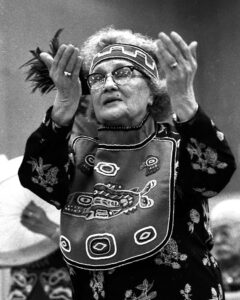
Áak’w Ḵwáan Elder Bessie Visaya sharing Tlingit tribal culture during Celebration 1982. photo credit: Áak’w Ḵwáan Elder Bessie Visaya, Celebration 1982. Courtesy of Sealaska Heritage Institute.
Celebration ’82, a gathering of some of Southeast Alaska’s active Native dance troupes, attracted hundreds of participants to Juneau February 24-26 for its inauguration; held every other year since then in early summer, the cultural event is a celebration of Alaska Native traditions and ceremonies. Juneauites also joined in celebration earlier in the season when the boys high school basketball team not only won the annual Southeast basketball tourney, but went on to capture the state championship, capping a 30-1 near-perfect season.
After learning that the estimated cost to establish a new capital city at Willow was nearly $2.9 billion, Alaskan voters rejected the move November 2, and Juneau breathed more easily as it celebrated and rang the victory bell downtown. This vote also repealed previously approved capital move laws and initiatives, wiping the slate clean (for the time being). Coupled with a subsequent severe economic downturn, the issue lay dormant before resurfacing again over a decade later.
To help legislators keep up with communication needs, the state wired their offices here in January for computer and cable TV, although some saw the need for a TV for each legislator as a “ridiculous waste” as they weren’t there “to watch TV.” The new system was also justified as a way to provide live legislative coverage for the whole state in the future.
show more
Newly-elected Governor Bill Sheffield, hoping to put the capital move fight at rest, also proposed a time change into help bring closer communication between Juneau and southeastern state offices to the Railbelt and western Alaska communities. Starting early next year, southeastern state offices would start and end working hours an hour later. Although billed as “flex-time,” this was not very popular with many Juneau employees.
Area residents were shocked by a sudden upsurge of violent crime, including at least five murders or unexplained deaths. The perpetrator of a shooting death on a trail along Fish Creek was convicted April 4 and later sentenced to 40 years imprisonment, the first first-degree murder conviction here since statehood. An unexplained drug-related death, a strangling, and two stabbing murders rounded out this grisly list, along with a death in March of a person held at Lemon Creek, under watch for drug withdrawal throes during a “12-hour cooling off period.”
The 153 ft. tour ship, the Majestic Alaska Explorer, went aground September 10 at Pybus Bay, about 60 miles south of Juneau, resulting in the death of one passenger and several other injured persons during the ship’s evacuation. The shaken passengers were transported to Juneau, and later departed on an altered continuation of the trip. The ship was later successfully re-floated.
Traffic lights were to be added to several intersections on Egan Drive in response to an increasing rate of accidents there. Construction of a large, $4 million floating breakwater complex at Auke Bay, which would provide 360 new berthing slips, was put on delay after a coalition of local residents objected for environmental reasons and brought suit against the project. The resulting U.S. District Court decision required the U.S. Army Corps of Engineers to prepare an approved Environmental Impact Statement before the project could proceed, adding several million dollars and several more years to the project’s hopeful completion. Woodsmoke emissions in the Mendenhall Valley from residents’ woodstove use well exceeded state and federal air-quality standards during winter air temperature inversions, resulting in state-ordered burn bans on at least three occasions, and continued discussions on the problem.
University of Alaska Juneau (UAJ) estimated that 1 in 10 Juneau residents had enrolled in at least one credit hour course there in the last year. Enrollment had been steadily increasing over the past decade, and new construction was underway for several large additions, including expansion of the Bill Ray Center downtown (named after a longtime local state senator), the fisheries center, a new marine and technology center; a student services building, and planning for a new forestry sciences lab. Now, the top priority for the coming year would be to add student housing.
Alaska’s salmon industry suffered a major setback for the season after a man in Belgium died from botulism in February after eating from a can of Alaska-packed salmon. A subsequent European embargo on all U.S. salmon imports rocked the whole industry, including Juneau-based Sealaska Corporation, which owned several canneries in the state. The corporation sustained heavy losses from its fisheries investments this season and led to abandonment of plans to invest in more processor acquisitions.
Juneau residents, along with all other qualified Alaskans, began planning how to spend their first state Permanent Fund Dividend checks after the U.S. Supreme Court struck down a previous legislative plan for distributions based on length of residency. A legislative back-up plan immediately went into effect and residents received their first $1,000 checks. McDonald’s opened in the Mendenhall Valley with its first week of sales setting a U.S. record. (Skagway residents chartered a small plane for a “Big Mac Medivac” of food available at McDonald’s because of their excitement of having McDonald’s so close). Biggest annual art event of the year, the Gallery Walk, premiered on the first Friday of December (and has continued on to this day.)
show less