
- 1966
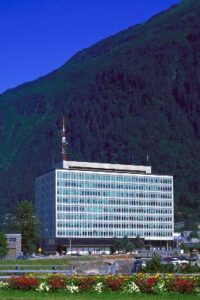
Hurff A.Saunders Federal Building and Robert Boochever US Courthouse. photo credit: https://www.gsa.gov/photos/hurff-ackerman-saunders-federal-building-and-robert-boochever-us-courthouse
The $10 million, nine-story Federal Building was finished and opened by the end of December. Thirty-one federal agencies were represented in offices there, including the post office, U.S. District Court, and offices for Alaska’s congressional delegation. Building features included six elevators, 500 clocks operated in a master time system, a cafeteria seating 175 employees, and an electrical generator system for emergency power and heating. In wake of federal offices moving from various venues downtown to the new building, many of the vacant office spaces were quickly snapped up by state agencies to consolidate their often-widespread former office locations. One somewhat controversial art addition outside the new building was a 17-foot-high bronze statue and fountain created by an Oregon artist, that featured pelicans, rather than Alaskan birds. A local urban myth later developed that the statue was mistakenly shipped to Alaska, rather than a Florida location as intended. [not so, according to the artist and the General Services Administration, which commissioned and paid for it].
Local civic boosters were heartened to hear that Congress appropriated $750,000 for preparatory construction to begin at the Snettisham power project this coming spring, as a start for the project to initially provide 60,000KW of hydroelectric power as early as 1970. The new power source would be connected with a 48-mile transmission line from Port Snettisham north to Juneau, with an underwater cable connection across Taku Inlet. It would ensure power for the area’s increasing growth and be an important consideration in attracting new industry.
In other local federal agency news items, the Forest Service announced that it was hosting a new television series it developed on “Forest and Man” featuring eight half-hour programs about the Tongass National Forest to be aired on KINY-TV early in the winter. Topics ranged from forest development after the ice age to modern recreation in the forest. In June a trailer load of cement shipped up from Seattle for a local contractor came off the ferry and was held up for “constructive seizure” by the U.S. Bureau of Customs to check for possible violation of American shipping laws. At issue was that the shipment was carried part of the distance on a Canadian ferry, probably violating the Jones Act, which bans American shippers from using foreign vessels between American ports. The Post Office got positive press near Christmas, when the Associated Press began a delivery test by posting more than 500 letters being flown all over the US. Mail arrived in Juneau in two days from the East Coast via the air route.
A positive outcome resulted from the help local musician Rebecca Stuart received from Alaska Senator, E.L. “Bob” Bartlett. While in Juneau, she had found molted eagle feathers worked perfectly for cleaning her oboe. After moving to Anchorage, she couldn’t find a supply of said feathers and also found out that even possessing the feathers was a violation of the federal bald eagle act. Persuaded by a fellow oboist from the Chicago Symphony visiting there, she wrote Senator Bartlett for help. His letter of help worked its way up through the bureaucracy to finally get a special permit from Secretary of the Interior, Stuart Udall, who was swayed by Barlett’s missive to “Let oboe players have their day. Let oboe players clean their oboes with eagle feathers.” Now she can possess and clean her oboe with eagle feathers, and furthermore, she could send feathers to the Chicago Symphony as well.
show more
Commercial developments included a new department store in downtown Juneau, the new modern Medical-Dental Building along Glacier Avenue, the new 44-room Breakwater Motel across from Aurora Harbor, and a new National Bank of Alaska building by the airport. In October the International Motor Hotel Corp., which operates Travel Lodges around the country, announced plans for a 75-room hotel, to be constructed downtown early next year. The Baranof-Western Hotel also announced expansion plans to add 24 rooms onto its upper floors, starting late in the year. In total, these developments will add 143 new first-class rooms by the time tourist season peaks next summer. Pioneer B.M. Behrends Company replaced its old store built in 1898 at Third and Seward Streets with a modern concrete and steel structure to continue offering quality merchandise and service to Juneau area shoppers. Juneau merchants and offices could now ply their customers and workers with the world-wide ubiquitous MuZak music after owners of KJNO radio acquired a local franchise. Besides providing background music, news bulletins, local fire and emergency alerts could also be broadcast through the system for franchise clients.
Financing for new multi-level parking garages downtown was secured through a plan for the federal Community Facilities Administration to issue bonds that would be paid off through a special assessment on downtown merchants. The garages would be located on Franklin near the Baranof Hotel, Front and Main Streets, and on South Franklin Street. By fall, work had begun on engineering and design for the parking garages, with bidding and construction slated to begin next spring. The plan would also fulfill a requirement for the city to meet for the state’s Outer Drive project. Outer Drive work continued on phase I with property acquisition between Norway Point and 10th Street.
Transportation developments had both positive and negative affects for the area, as well as for other southeastern towns. Upgrades in airline service strengthened Juneau’s connections around the state. In January, Cordova Airlines announced it was introducing the Convair 240 40-passenger aircraft to its Juneau-Anchorage run for improved and additional service to Anchorage and points westward. Alaska-Coastal Airlines also inaugurated Convair service to Sitka in December, the first wheel plane scheduled airline service to the island community. In March, Coastal’s new upgraded turboprop “Super Goose” amphibian aircraft successfully passed its initial trial flights, with regular service to be announced later in the year. Western Airlines and Pacific Northern Airlines announced in late October that they were in the process of affecting a merger of the two, with PNA retaining all its employees and would be operated as the Alaska Division of Western. The merged system would stretch from Mexico to Anchorage, and would have all-jet service.
On the waterfront, developments were mixed. Alaska Steamship Company had applied to the Federal Maritime Commission for a 15% increase for its freight rates for Southeast Alaska shipping, citing operating losses in previous years. Initially it was granted, then a suit was filed claiming onerous cost of living increases for Southeast residents and businesses. The commission agreed, and a restraining order against the increase was enjoined by the Anchorage federal court. The company then threatened to sharply curtail southeastern service, until the judgment was overruled by the 9th Circuit Court of Appeals and the rate increase upheld for the company. By the summer the company went ahead to construct a new freight yard at the old lumber mill site, while demolishing its historic old warehouse closer to downtown. In the process, a large underwater slide in October dumped 4-6000 yards of new fill and several pieces of heavy equipment at the construction site into the channel.
In May, the Yukon Star, the first cruise ship of the season for Alaska Cruise Lines, was unable to dock for its visitors to land in Juneau, because of a labor dispute between the company and the local longshoremen’s union. Citing a 1962 port agreement the union had signed earlier that required more dock workers, the longshoremen refused to tie up the vessel, which then left for Skagway. A resolution was eventually obtained through a NLRB ruling allowing the ships to land at the port. In early November, the state ferry MV Taku was hit by a gust of wind while approaching the downtown terminal dock and ‘nudged’ a dolphin and dock pilings to cause considerable damage to the structure. Ferry officials were quoted as saying that the old dock “was held up by termites” and that they had been requesting the city to repair the structure for a long time. The ferry system had also threatened to bypass the terminal in favor of Auke Bay because of docking problems.
Planning for the 1967 Alaska’s Purchase Centennial kicked into high gear this year, with a mix of small and large projects and events throughout the area. The annual spring-cleanups in Juneau and Douglas took on a larger urgency and the Douglas Island Women’s Club canvassed the town to offer gardening kits with nasturtium seed packets in hopes to turn Douglas into the “Nasturtium City’, taking a page from Portland, Oregon as the City of Roses. The club and the Douglas Lions Club also were in midst of constructing picnic shelters and playground facilities at Sandy Beach for their special centennial project. The local area centennial committee chose construction of a new Alaska State Museum as its major celebration project and received a large federal grant to match for the $1,105,000 building. Juneau voters approved a one percent sales tax in August to help provide the matching funds for it to be built in the next year. Local, state, and national representatives’ broke ground for the project in October.
Starting in September, residents were urged to get special Centennial Trade Dollars now available at any local bank, worth a dollar in trade at area businesses through October 1967. They could also be cashed in at the banks in that period. Charlotte Rudolph, 21, was crowned in October as Juneau’s candidate for the Alaska Centennial Queen contest. The chosen queen and her court will open the A-67 Centennial Park in May in Fairbanks. Meanwhile Juneau’s exhibit for the park was being put together, which included a large 3-D topo map of the Greater Juneau area [now on display at the Juneau-Douglas City Museum]. Juneau efforts for area beautification and civic improvements won a first prize in their population category for “Operation Big Sweep” launched last year by the Alaska Centennial Commission to promote the centennial. Local committees received special citations signed by Gov. William A. Egan on Alaska Day, October 18th. The year’s planning culminated with a Centennial Gala kick-off the end of December with a big round of dances, dinners, and exhibits around town.
Continued population growth in the area, as well as changes in school facilities, had translated into considerable school crowding and need for more facilities. In February, the old Mt. Jumbo school building in Douglas closed and the junior high students there moved into other temporary facilities including a couple of churches, a school library, and other non-classroom spaces in schools. In May St. Ann’s parochial school announced that it was discontinuing its 7th and 8th grade classes in the fall, leaving about 45 students to be absorbed into the public school system. However, the new Marie Drake Junior High School building construction was proceeding on schedule and was due to open in January 1967. The Seventh Day Adventist Church was also constructing a new two-room school building near Lemon Creek, due to open the fall term this year. Responding to the need for more school facilities, voters approved bonds in October to build Auke Bay Elementary School and the newly named Floyd Dryden Junior High School in the valley, as well as provide more classrooms and a vocational ed building at the high school. Opening the new schools was anticipated for 1968. The Juneau-Douglas Community College gained ownership and moved into the old Fifth Street School, and the fall course offering increased to 47 courses and had the extra benefit of now having its own advisory board of local citizens.
Reflecting the nation’s new era of social protest, about 200 J-D High students gathered at the Subport in April to burn their identification and student activity cards to protest the school’s ban on beard-growing. An informant claimed the practice had become “traditional” and that students were “teed-off” because Principal Harvey King had banned it because “beards look sloppy”. To add to student discontent, the administration and the school board agreed in August that the school’s dress code would remain in effect in the fall, prohibiting girls from wearing mini-skirts and that boys’ hair may not drop below the ears. Beards, mustaches, and goatees were similarly banned for boys. “We want the girls to look like girls and the boys to look like boys,” one school official declared.
One student wasn’t protesting, however. Fifteen-year-old Anna Kardinoff was taking a bath in May when she received word that she was one of five persons who won this year’s payoff for guessing the closest time for the Nenana Ice Classic, the time when the river ice starts breaking up and moving downstream. Her father had bought a ticket in her name, so she would get about $22,500 of the $112,500 pot, and planned to bank her net proceeds of about $15,000 to save for her goal to go into medical school and eventually go into obstetrics.
Vehicle accidents claimed several lives this year in tragic circumstances. In May a car crashed at high speed into the south end bridge railings over Lawson Creek, skewering the vehicle, killing two persons and injuring two other passengers. In July a nine-year-old boy was crushed under a road maintenance truck wheel after the boy attempted to jump onto the truck after being refused a ride. In October a high school student’s body was recovered from a station wagon that apparently was traveling at high speed when it hit parking lot curbing and was hurled into a pond by the glacier visitor center.
Earlier in July a four-year-old Juneau girl fell off a dock at Hawk Inlet and drowned before rescue. Two Juneau area residents died in August, plus seven other passengers, when their Alaska Coastal Airlines Gruman Goose aircraft crashed into the Horn Spire, a steep promontory overlooking Eagle Glacier, 30 miles north of Juneau. It was the first ACA fatal plane accident in eight years. The plane was southbound from Skagway and was purportedly giving a flight-seeing excursion over the Juneau icefield while on route. Two Juneau prospectors survived a helicopter crash in wilderness 50 miles from the interior village of Northway in November. Lacking sleeping bags, but supplied with other survival gear, they endured minus 27 degree and below temperatures for four days, until being spotted and rescued while attempting to trek out to safety.
Fires this year not only deprived residents of their homes but claimed irreplaceable artwork at the state museum’s temporary storage building and the last structure of Juneau’s historic Perseverance Mine up Gold Creek. In February, a fire in the Masonic Temple building damaged beyond repair a collection of highly-valued paintings by Alaskan artists Nina Crumrine and her daughter Josephine Crumrine Liddell, as well as some historic photographs. In July the “new” boarding house on a hillside overlooking Silverbow Basin was reduced to charred timbers, the last standing building of the Perseverance mine. Juveniles were suspected of setting the blaze. Several apartment, house, and trailer fires were reported over the year, but no fatalities occurred, although in several cases, residents escaped with only the clothes on their backs. A fire in the Juneau Empire building in July damaged two second-story apartments and caused a delay in the next day’s paper edition, but the printing equipment escaped damage.
The largest fire of the year, however, was intentionally set in August when AJ Industries put the torch to 13 houses at Thane to end another era of Juneau’s mining history. Built in 1918 when the Alaska Gastineau Gold Mine was at its peak operating its milling facilities at Thane, the company town housed many of its employees there. After operations ceased in 1921, the houses were continued as rentals for the successor property owner, Alaska Juneau Gold Mining Company, which continued to rent the houses to employees and others up until this spring. The houses, however, had deteriorated to the point that the company felt that it was too expensive to maintain them compared to their assessed value and gave notice to the 13 families still living there to vacate. Thane then became an instant ghost town in July and the company then razed the properties the following month.
Severe winds bookended the year to rip off roofs and damage property. On New Year’s Day, at least one home and an apartment suffered extensive damage as rampaging Taku winds tore through Douglas, while residents there suffered through an eight-hour power outage that threatened freeze-ups in their homes. Roofs were torn off the home of Douglas Mayor Guy Russo and an apartment owned by Borough Chairman Claude Millsap, as well as off the old Douglas Cannery building. State troopers cautioned motorists to be very careful when passing children during the Taku winds, as the bundled-up youngsters were probably too busy trying to stay on the ground to note traffic. People under 180 pounds were advised to load their pockets with rocks to stay earthbound. Winds gave a repeat performance late in November when gusts up to 90 miles an hour blew off roofs along both Juneau and Douglas waterfronts, breaking boats loose from moorings, upending the ballfield concession stand in Douglas, and plunging the area into darkness and cold with an accompanying power outage.
Douglas also suffered a water shortage during the January cold snap when a pipe break and heavier than normal water use drained the city’s 800,000-gallon reservoir on Bear Creek. City crews were able to set up pumps and divert water from Lawson Creek over to the reservoir, but in the meantime the schools were closed, residents sought out friends in Juneau for showers and cleaning, and Juneau water trucks supplied drinking and cooking water for residents. It took over a week to locate the broken pipe and to refill the reservoir, but Douglas breathed a sight of relief as things returned back to normal, although some homes suffered frozen water connections to the mains in the interim period.
Attention to water and sewer system concerns for the airport, valley, and Auke Bay areas ramped up in April when state health department officials contacted the borough and reported that their studies indicated that “at least 25% of the private water supplies now being used in these areas (noted above) are unsafe for human use”, based on area sampling from last year. The borough responded by applying for federal grants to design an area wide water supply system, and both municipalities provided resolutions to cooperate in that effort.
The other big health issue was planning for a new hospital to be built and operated by the borough, after the Sisters of St. Anns announced last year that they could no longer financially support and operate the St. Ann’s Hospital, Juneau’s historic long-time health service provider. The borough’s hospital planning committee selected two possible sites for a new hospital, Salmon Creek and Sunny Point, but the primary issue was to get ball rolling with a financial commitment to begin the design process. For that, voters approved a $1.8 million bond issue in October, which will allow access to matching federal funds and start engineering and design for the project.
Law enforcement personnel definitely experienced a different year, with offences ranging from garden-variety beer busts, liquor sale violations, and burglaries to air piracy and jail riots. The most bizarre incident happened to pilot Ken Loken, owner of Channel Flying Service, in an air piracy attempt in June. First his plane was stolen by persons unknown who took off with his float plane from the company’s mooring on the channel. Apparently worried about the low fuel level, the thieves set the plane down on the beach by Thane and abandoned it, which was soon recovered undamaged. A couple of days later, Loken was hired by two men (the thieves) to fly them to Sitka and instructed to wait at the dock until they returned for a return flight back to Juneau. Unbeknownst to Loken, the pair went uptown, robbed a bar, and returned back to the dock. Once in the air, the two pulled out guns on Loken and commanded him to fly to Canada. Loken told them that he didn’t have enough fuel to do so, so they told him to go to Seattle. By this time, authorities were alerted, a Coast Guard plane and others picked up the trail to follow him. Pleading low fuel again, he landed at beach about 15 miles north of Ketchikan and the robbers fled into the woods heading to Ketchikan. The pair were apprehended shortly afterwards and later charged with robbery and air piracy.
In lesser actions, a grand jury in April recommended that city police forces in Southeast Alaska be upgraded in pay and benefits to match state troopers and that the old state jail in Juneau, which the city managed, was antiquated and should be replaced, but complimented the city in providing good care and food there. In August two trustees tried to escape but were quickly stopped before leaving the grounds. Two months later, however, one of the escapees filed a $1.125 billion suit against the state and the jail warden for “psychological damages” and “punitive consolation” apparently inflicted during his unsuccessful break for freedom. The suit was later thrown out. In December the jail prisoners banded together and caused two separate riots on the same day and completely trashed their holding tanks, apparently complaining about cold food on the second attempt (brought about by the delay in serving caused by quelling the first riot). Just before Christmas two Juneau boys were caught after attempting to bomb the roof of the First National Bank building downtown. A resident in a nearby apartment heard the explosion, called the police, who investigated the rooftop scene. Following tracks in the snow led them to the window of another apartment, where they observed the boys constructing another bomb. After photographing the scene, the officers gained entrance and apprehended the busy pair.
The Greater Juneau Borough celebrated its third anniversary in September as a first-class borough, having stepped up to administer its mandatory functions of area-wide assessment and collection, education, and planning, platting, and zoning. In addition, it had added area-wide dog control and responsibility for three service districts for fire protection and road maintenance, plus non-area wide responsibilities including recreation, building inspection, and sanitation. At its anniversary it had a staff of 16 and was overseeing 16 construction projects totaling about $8 million. Claude Millsap, the Assembly Chairman was strongly favoring a move up to a one area-wide government by the borough, reducing the municipalities to service districts. A subsequent informal public opinion poll by the Empire indicated overall satisfaction with the borough by area residents, although Juneau residents preferred the city to take overall charge, Douglas seemed to favor the borough, and rural districts definitely preferred the borough form vs. a city take-over.
An interesting perspective was noted by Dr. Ron Cease, outgoing head of the state’s Community Affairs Agency in addressing the local Democratic Club in August when he declared that there was a general lack of cooperation between the borough and city (of Juneau), with a general attitude that “the public be damned”. The public seemed to be “more and more interested in one unit, more and more tired of overlapping”. He recommended that powers must be transferred from the city to the borough. Juneau, however, was already starting a study to determine how the city might extend its boundaries and become the one area government.
This year the biggest point of contention between the borough and Juneau erupted over zoning. A parcel of land just north of the high school was zoned by the city for a commercial motel development, whose developers proceeded with a city permit. When a separate cocktail lounge permit was requested for the motel restaurant, suddenly the school board objected (no liquor establishments within 500 feet of a school) and said they needed the land for an athletic field and a parking lot (a rather hilly section). The borough stepped in to reverse the city’s zoning ruling and declared that the borough was the only one to control and enforce zoning – to Juneau’s howl of disbelief. To make things more interesting, a parcel of land between the school and the developers’ motel property was to be taken by the state to extend a street down to connect to the Outer Drive project as an access route. All said and done, the motel was built, the street extended, and the high school got a smaller parking lot immediately next to the building.
Across the channel, the City of Douglas was established as a home-rule city when voters approved their city charter October 4, which went into effect October 10. According to Douglas Mayor Guy Russo, the charter gave the city “more flexibility in administrative powers, which now rests with the city under the charter, rather than with the state” in its earlier status as a first-class city when incorporated in 1902. Russo was disappointed however, when the voters rejected a bond issue which would have funded a special building project as a tourist information center for the centennial year. Afterwards it would be re-purposed for a new library and multipurpose building. In rejecting the bond issue, the city also lost a federal matching grant of $60,000, which Russo noted would go elsewhere.
And wrapping up the year with some one-person efforts to improve life here, in October 88-year-old Mrs. Jesse Kasko presented Governor William Egan with a check for $12,856.95 to pay back all the assistance that she’d received over twenty years from the state. Egan responded that there was no legal obligation to do so, but termed the act, “a very wonderful thing you do for the state of Alaska. We are very, very proud of citizens like you.” Mrs. Kasko responded, that she was acting in the tradition of her Tlingit heritage by “demonstrating gratitude for favors received” and that she had prayed that someday she “would have to means to repay it.” At Christmastime, shoe store owner Ralph Warren announced that he was donating ten percent of every shoe sale to a special fund to be used to buy shoes for every child referred to him who needed shoes.
show less