
- 1967
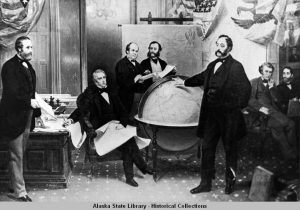
Signing of the Treaty of Cessation, March 30, 1867. Alaska Purchase Centennial Collection, ca. 1764-1967. ASL-PCA-20-181.
Residents started the new year off with a round of gala celebrations to kick off and celebrate Alaska’s centennial purchase from Russia, joining other cities around the state in commemoration. A few days later, Walter J. Hickel was inaugurated as Alaska’s second governor in another round of ceremonies and festivities, which saw up to 1,000 visitors descend on Juneau to participate in the grand events. From then on, the local centennial committee served up a full plate of commemorative events each month up to the centennial’s official close at the end of September, including gala dinners and dances, special art shows, concerts and plays, a special parade, and what was termed a centennial home-coming to invite Juneau area expatriates back for a special week of activities the end of July to honor Juneau ‘old-timers’ and to show off changes in the community. Although the centennial events were officially over by mid-October, Juneau’s Little Symphony Orchestra went on its own Centennial tour to Southeast towns by ferry, with each town hosting the members and organizing community concerts for the group. Juneau residents Carol and Fred Eastaugh had their Southeast Alaskan historical musical “Lucky for Us” premier in Juneau the end of November-early December to cap off a full year of arts and culture for the centennial.
During the centennial year, residents were encouraged to dress up in centennial costumes and make their purchases with special ‘centennial dollars”. Gun collectors could vie to purchase a special limited-edition Model 1894 Winchester rifle, created by Juneau gunsmith, Milton Brown. A special Tlingit and Haida Culture and Art Show in April exhibited many rare artifacts and unique treasures from northern Southeast Native families and communities; many of the items were displayed in public for the first time. Art collectors could also purchase special Centennial silver potlatch spoons, designed by Amos Wallace, a nationally known totem carver and an ambassador for Tlingit culture. Wallace, an active member of the Gastineau Centennial Commission, had played an important role in redevelopment of Indian arts and crafts. Juneau’s own Centennial Queen, Charlotte Rudolph, was named an Alaska Centennial Princess at the opening ceremony of Fairbanks’ A-67 Centennial Park in early May.
Other notable community events included the first annual Glacier Festival in mid-June at Camp 17 of the Juneau Icefield Program on the Lemon Glacier. Sunny skies greeted 120 skiers, photographers, and mountain enthusiasts for a program of skiing obstacle races, a centennial costume contest, and cross-country ski tours to various vistas, with transportation up and back provided by Livingston Helicopters, Inc. The following week the Juneau Amateurs Radio Club conducted a 24-hour field day in conjunction with the American Radio Relay League, an exercise to see how many stations can be contacted around the world under emergency conditions with low power transmitters and field generators. The Juneau group contacted over 400 stations in 46 states and some in Australia, New Zealand, Japan, and a few in Russia. In August, the Juneau Aviation Association sponsored a “fly-in” down to Taku Lodge for a day of renovating an old airstrip near the lodge, which included a delicious meal served at the lodge. The group hoped to reactivate the strip for reasons of pleasure, sport, and safety.
show more
In mid-June Juneau welcomed the crew of the guided missile cruiser USS Chicago, at 674 feet long one of the largest vessels to visit Juneau proper. Its 1200 complement of men and officers enjoyed a host of social activities, as they gave tours of the ship to local residents. Aside from one unfortunate assault incident by a crewman (noted below), Juneau Police Chief Pat Wellington complimented the personnel as “some of the finest visitors Juneau has ever had.”
The Juneau-based 910th Engineer Company of the Alaska Army National Guard constructed a 300-foot-long timber bridge across lower Eagle River in the spring as a field training exercise. The bridge will provide closer access to the Southeastern Alaska Boy Scout camp on the far side (no longer there, having washed away years ago). The project received considerable support from local and southeast firms, including lumber from five sawmills, construction supplies, and assistance in bridge pile driving.
This was a year for rapid changes in transportation connections from Juneau to the rest of the state and world. In early January, Alaska Coastal Airlines put its new turboprop Gruman Goose amphibian aircraft into regular scheduled use for its southeastern routes. It was a milestone for the company, which had taken 18 months and several hundred thousand dollars to develop and certify the new power system. In March, directors for the company announced a merger with Alaska Airlines, following an earlier merger Alaska Airlines made with Cordova Airlines. The merger was approved in December. The combined airlines routes will now extend from Seattle-Tacoma up into the Arctic as far as Kotzebue. In May the CAB approved a merger between Western Airlines and Pacific Northern Airlines with the first Western Airlines jet service to Juneau beginning at the end of that month. PNA crews and personnel will continue to service the Alaskan routes while the Western company colors and logos will be added to their aircraft and equipment. This merger will provide access to 12 western states and extend service from Mexico north to Anchorage. Meanwhile on the waterfront, Alaska Steamship Company added barge service along with its older freighters to provide increased service along its routes.
Juneau voters had earlier approved a one-cent sales tax to help to build a new museum as a centennial project to later turn over to the state to replace the aging state museum in the capitol building. Work proceeded apace for its construction this year. The city announced that the temporary 1% sales tax would sunset at the end of the year, as per the voter- approved proposition. Groundbreaking was held October 12 for the Juneau-Douglas Community College first buildings at its new Auke Lake campus – a library/classroom structure [later to become University of Alaska Southeast]. Auke Bay Elementary School was completed and opened for classes that fall and Marie Drake Junior High School was dedicated as one of the centennial homecoming events.
In city elections in June, Juneau voters approved the change to a city manager form of government ending the long-time mayor-council form and turning out Mayor Lauris Parker. The council then appointed a “ceremonial mayor” from their group and an acting manager until a permanent manager was selected in the fall. Herbert Lehfeldt from Palmdale, California stepped into position in mid-November. An audit in June had shown that city was in the hole for over $200,000 in debt, although things had improved somewhat by the time Lehfeldt arrived to take over city reins. He still had to deal with on-going issues of improving downtown parking, downtown ferry terminal dock repair, and urban renewal.
In a record turnout on October 3, area voters approved a proposal to form a volunteer commission to develop a charter for a home-rule unified borough government and elected an eleven-member commission tasked with that job. With its acceptance, the area wide electorate overwhelmingly approved the idea of unifying local governments into a single municipality, with “yeas” carrying each precinct, including Douglas (which would change its collective mind when the charter was up for ratification in the next few years). The commission would have a year to develop a charter, which then would be up for voter ratification. If initially rejected, a revised charter could be devised for another vote, and if rejected a second time, the process would terminate for that attempt. The commission quickly took up its assigned task and began a series of public hearings in November to learn what residents wanted in the charter.
A contract for the $50 million federal Snettisham hydroelectric project was signed in July; the price tag turned out to be $170 million (located 38 miles south of Juneau, it continues to supply the majority of Juneau power.) The state announced in August that it was purchasing property along Willoughby Avenue to connect with its proposed Telephone Hill capital campus area for construction of a new 8 to 10 story state office building, with construction expected to begin in 1969. Governor Walter Hickel announced in September that the state was in process of planning to construct a highway link between Juneau and Haines along the west side of Lynn Canal to be opened by 1974. The end of Glacier Highway at Yankee Cove would be extended to Echo Cove on Berner’s Bay, a ferry shuttle would cross the canal to Saint James Bay to connect to another highway link up to Haines (after the Echo Cove extension was built, the rest of the route has never been built, but has been proposed again many times over the years).
Juneau area businessmen and boosters were greatly disappointed in April when St. Regis Paper Co. backed out of their purchase of 8.75 billion board feet of timber in northern Southeast Alaska from the Forest Service. The sale in December 1965 was the largest single timber offering in Forest Service history, predicated on terms that the company would construct a pulp mill in the area and have it operational by August 1969. The company cited construction costs as a major limitation.
One of the last vestiges of Juneau’s gold mining history began disappearing in the spring when contractors began removing the equipment and framework of the old AJ mill above the waterfront. Usable equipment was being sold to other mining operations, and the steel was sold to various building projects, with scrap going to Japan. A local prospector was allowed to treat the residual tailings to recover what gold he could find. The mill had burned down in March 1965, but much was still salvageable. In May Alaska Senator Ernest Gruening announced that the Bureau of Mines would open a mineral research lab at the Bureau’s Alaska headquarters facility on Juneau Isle (AKA Mayflower Island) in Douglas. He said, “Mining in Alaska is going to get a new lease on life”, with renewed government support.
Three young Juneau fishermen on the black cod fishing vessel Sitka reported a harrowing incident in March when they were running some 20 miles off Sitka. They were next to a 10-vessel fleet of Russian trawlers at night when one 110-foot vessel suddenly turned directly towards them on a ramming course. Only by quickly reversing the engine was a collision averted, while the offending vessel then turned back on its original course without any acknowledgement. A Coast Guard incident report was made, without any further resolution.
This was another year with a variety of accidents capturing the headlines. At the end of January, a five-year-old boy playing with a .22 caliber handgun accidentally shot himself in the head, with the bullet lodging in his brain. Rushed to the hospital, he was not expected to survive, but within two weeks of intensive care there he had recovered and was up and about as any other 5-year-old.
Outdoor activities resulted in several deaths, but also some amazing survival tales. In early July a Sierra Club climber was descending from Juneau Icefield with his family along the upper reaches of the Salmon Creek valley. He fell 300 feet off a ledge, then rolled 300 more feet down to the creek. He died before a rescue helicopter arrived to transport him to safety. A Juneau-based Fish and Game aide was attacked and mauled by a brown bear high up a mountain above Hood Bay on Admiralty Island at the end of July. His hiking companion ran down the mountain to their research station to radio for aid. A helicopter and doctor were dispatched from Juneau but couldn’t land at the heavily brushed site. The victim was hoisted out in a stretcher sling and lowered down the mountain to the beach, where a diverted charter plane then flew him to Juneau for treatment.
Three Juneau youths became stranded August 7 on the face of the Perseverance (AJ) Glory Hole open pit after exploring AJ mine workings and trying to climb out of the excavation from a mine tunnel in failing light. Unable to go up or down safely, they remained on the rock face overnight. Rescue efforts located the boys the next morning, but rescuers were unable to reach them. After a two-day period of increased efforts, a Coast Guard helicopter from Annette Island station finally lifted them safely out August 9. Another Juneau teenager was successfully rescued near the Herbert Glacier in late August after he became stranded on a small rock prominence in the middle of a steep rockslide. The youth had been goat hunting with two other companions, who then sought help. Members of the Juneau Search and Rescue Council were able to lower a rope to him, which he ascended successfully before they all hiked out.
An old maritime casualty, Princess Kathleen, which hit and sunk off Lena Point in September 1952, was the object of a salvage operation this spring. Sylvia Dar Velle, president of Dar Velle South Eastern, Inc. a ship salvage company, had acquired salvage rights to the vessel from Lloyds of London and was in the process of gearing up to raise the vessel, tow it to Vancouver, B.C. where it would be rebuilt as a foundation for a new ship. After a few news releases, the operation disappeared from public notice and was apparently abandoned [the ship never was recovered and continues to be an object of attraction for local scuba divers].
Another cruise ship made the headlines in June when the Westours, Inc. vessel Glacier Queen collided with a freighter near Prince Rupert B.C. while touring the Inside Passage. A large hole was stove in near the bow above the waterline, so it was towed to Vancouver for repairs, The company estimated that it would be out of service for several of its scheduled cruises but anticipated returning to Alaska service for the rest of the season. It had already visited Juneau three times at the start of the season.
In July a 42-foot cabin cruiser suffered an explosion just after refueling at the Union Oil dock downtown. The operator had started the first engine and was trying to start the second one when fuel exploded in a big fireball. Juneau firemen rushed to the scene to extinguish the flames, after which the Coast Guard towed away the boat. The three people aboard suffered burns to varying extents. A few days later, a Kodiak-bound power barge Columbia struck a reef near Pt. Howard in lower Lynn Canal, taking on up to 600 gallons per minute of water. Nearby fishing vessels assisted keeping the barge afloat until the Coast Guard arrived to tow it to Juneau. It was beached near Douglas for temporary patching before a final tow to Northern Commercial shipways for full repairs.
Two Juneau teenagers drowned at Young’s Lake on Admiralty Island in early August when they were fishing on an overnight camping trip. One boy apparently fell out of their boat, and his brother was dragged into the water while attempting to save him. Neither boy could swim. Their bodies were recovered later that day by a search and rescue group.
A hunter was found dead in his small cabin boat at Oliver’s Inlet on Admiralty Island in mid-November, apparently caused by asphyxiation. A camp stove burning in the closed, air-tight cabin removed all the oxygen there, leading to his death.
An ill-fated hunting trip in late November along the northwest side of Douglas Island resulted in the death of one couple and an 18-hour period of exposure in cold weather for the surviving couple. The group had been returning by canoe along the shoreline when they were caught in heavy swells and their outboard motor quit. The canoe swamped near Outer Point and one couple was able to swim to Shaman Island, but the other couple drowned before reaching the beach. A babysitter for their children concerned with their delayed return contacted her mother who in turn notified the Coast Guard. The surviving couple spent the night in the woods on the island before being spotted and rescued by a helicopter searching the next day. Four children were orphaned but were taken into guardianship by grandparents.
Aircraft also figured into the accidents and casualty lists this year. An extensive search was initiated in June, when a Juneau man and his young daughter crashed in their small plane on a return flight from Teslin, B.C. Though injured when their plane crashed in a spongy muskeg, the couple took four days to hike out through the Canadian wilderness and were picked up by a motorist at an intersecting highway along their route. Unfortunately, one of the search planes, a U.S. Coast Guard Albatross amphibian aircraft crashed and burned by Sloko Lake south of Atlin, B.C. killing three of the six-man crew.
Two men also were injured while on a search and rescue mission for the Civil Air Patrol in September. Their single engine trainer aircraft went down just west of Juneau airport, crashing into a thickly wooded area just off the Engineer’s Cutoff Road on the Mendenhall Peninsula. The crash attracted quite a crowd, with some volunteers pitching in to cut a path to the scene and about ten men “bodily lifted the aircraft” to get one of the injured men out. The two suffered contusions and multiple lacerations but were reported in satisfactory condition following release from medical care the next day.
In October, a helicopter pilot working at the Snettisham power project was killed after a dynamite explosion was set off as he was flying away from the dam area. Rocks hurled out by the explosion struck the craft and caused it to plunge to earth killing the pilot. Subsequently a grand jury indicted the foreman of the blasting crew on a charge of negligent homicide for not following prescribed safety regulations. The next month a second fatal helicopter crash at the Snettisham project resulted in the deaths of the pilot, Chuck Gisel, and his four passengers. The flight left the base camp at sea level with the crash occurring in the alpine region near the dam site. Cause of the crash was unknown at the time of the crash report. Gisel, 41, was a well-known Juneau helicopter pilot and had many rescues to his record in his 15 years of flying in the region.
Fires during the year took out several historic buildings, destroyed a small business, reduced several residences to ashes and took the lives of several family members. The end of March the old AJ boarding house and bunkhouse at the end of Basin Road, which had been re-purposed as a tourist attraction for the summer “Hoochinoo n’ Hotcakes” melodrama play was totally destroyed the end of March. By July, however, the play and associated mine tour were back in operation, using the old compressor building uphill from the destroyed buildings for a new venue.
In April, tragedy struck a family in town when their house across from the high school caught fire, killing the mother and two children. A neighbor assisted saving two youngsters, while the father was out attending a meeting. In May students at the Fifth Street elementary school put their fire drill training to actual use when the school’s fire alarm sounded and all evacuated in good order to their assigned meeting places. A trash fire in the building’s incinerator had caught a wall on fire, but it was quickly extinguished by firemen, with little actual damage occurring. The news report surmised that the students must have been disappointed to have to return to classes, however, instead of getting the rest of the day off. A fire at a home on Gastineau Avenue in June, however, was more serious as one man suffered burns while three other men rooming there escaped injury although they lost most of their possessions. Crew members from the visiting USS Chicago donated clothing and personal items to the victims. Finally in July, the owner of a sheet metal shop at 1.5-mile Glacier Highway lost his shop and residence in a blaze that reduced everything to cinders.
In May Juneau police were investigating the theft of $1200 from a safe in the 20th Century Theatre by a ‘thoughtful’ safecracker, who left $68 in the safe, apparently enough so as not to inconvenience the theatre manager upon opening for business that night. The loot was removed without damaging the safe and the combination lock was thoughtfully twirled shut.
The next month a single engine plane was taken by a student of S & M Flight Training Center from their hanger at the airport early one morning, flown around the area for an hour, then wrecked in a crash-landing on return. In September, the company was confounded by repossession of three of their planes, which were flown to an Ohio airport by a company which claimed they had bought the loan-financing for the planes and that the company was “way in arrears”. One of the Juneau company partners said all their loan and insurance payments had been up to date and filed suit to reclaim the planes.
In June the FBI investigated a vandalism case out at the Forest Service Eagle River picnic area when an outhouse was destroyed by an apparent dynamite blast. The agency responded because the damage was caused to federal property. Vandalism in July also wrecked windows at the Eagle River Scout Camp and the half-million dollar experimental “riffle-sifter” mobile vehicle being tested by the Forest Service to enhance salmon spawning gravels at Fish Creek. Youths apparently drove the vehicle down to and overturned it in the intertidal area where it was subsequently immersed in saltwater damaging its electronic control system. In another unusual instance of vandalism, an 18-year-old youth was charged with malicious destruction of property and burglary after investigators linked him with entering Erwin’s Supermarket on South Franklin Street one August night and destroying up $200 worth of fresh produce and groceries and smearing foodstuffs all around, as well as stealing several other items. Entry was gained through a trapdoor connected to a tunnel to the intertidal area. Area buildings were originally built on pilings, and many had floor trapdoors before the area was filled in, and some had old tunnels to connect to the doors. A similar entry had been attempted earlier at the Ben Franklin store on Front Street.
In July a young sailor from the USS Chicago apparently ran berserk at a public dance held at the high school cafeteria given for the visiting crew and stabbed two local youths. They were just entering the school when the sailor ran out slashing them with a four-inch pocketknife. The boys were rushed to the hospital where they were treated for numerous stab wounds, from which they later recovered satisfactorily. The assailant was captured by a naval shore patrol and turned over to the ship for a military trial. In December a young man was picked up unconscious in a local café by city police and charged with being drunk in public. However, his alibi was that he had drunk seven cups of Devil’s Club juice, an old Tlingit remedy. The alibi worked – the jury found him innocent and the charge was dismissed.
The year’s report wouldn’t be complete without naming some local notables and their achievements. Starting off the first of the year, Juneau resident Coast Guard Lt. Commander John Cadigan was recognized for his “First Person Award” article for the Reader’s Digest magazine. The article described a gripping account of a rescue of crew from a sinking freighter, for which Cadigan and his rescue crew received commendations from the Coast Guard. Dr. Walter Soboleff was appointed to the state’s Board of Education, the second appointment by new Governor Walter Hickel. “We are pleased that a person of Dr. Soboleff’s character and stature has accepted this position,” said Hickel. “His deep understanding of Alaska’s Native people will be a valuable asset to the board.” In March Bureau of Mines engineer John Mulligan of Douglas was honored by having his name given to Mt. Mulligan in Antarctica for his studies, which resulted in discovery of coal fields there. In May Carol Beery Davis was named Poet Laurate of the State of Alaska by the state legislature, for her many years of writing and promoting Alaskan poetry and her founding of the Alaska Poetry Society. Elinor Dusenbury, composer of the music for Alaska’s official state song “Alaska’s Flag” was selected as a honorary member of the Alaska’s Century Club by the state Centennial Commission. The club is a fraternal organization whose members are selected for their deep care for Alaska and have contributed in some significant manner to its development and welfare. And for local sportsmen, Sandy Sturrock was the first to bowl a perfect 300 game at Channel Bowl.
show less