
- 1965
Juneau’s most visible landmark, the old Alaska Juneau mill just south of town, burned to the ground over several days in late March. The mill was being cleaned out by a salvage crew and the fire started from scrap burning that wasn’t adequately put out. Since the mill was in the process of being salvaged and the fire didn’t pose an immediate threat to the city, it was allowed to burn out by itself. Another old mining landmark, the Treadwell foundry building south of Douglas, caught fire in early April and burned to the ground, with arson suspected as the cause. Several months later, pioneer automotive business, Juneau Motors, near the city center caught fire in a major blaze May 8 and was extinguished in a hard-fought battle without injury or damage to nearby buildings. In August fire department and municipal efforts to improve equipment, beef up the city fire and building codes, and cleanup of fire hazards had their effect with insurance rates being reduced in recognition thereof. However, that would have been little comfort to residents that had lost their homes to fires during the year. In one case in January, a family escaped from the second story of their home as the downstairs was fully engulfed in flames. Clad only in nightclothes in minus five-degree weather, they watched from a neighbor’s home as the house was totally destroyed. At least five other homes were also consumed between March and December.
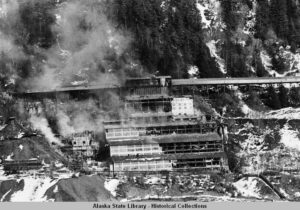
Alaska Juneau mill fire, 3-20-1965. Alaska State Library, Robert N. DeArmond Photo Collection, P258-III-35-0745.
The Federal Building construction proceeded on land owned by the fire department and previously used as the Firemen’s Ball Park. Sale of the property to the federal GSA earned the fire department over $172,000, which was to be invested and used for “worthy projects”, one of which was the redevelopment of the Evergreen Bowl recreation area (later named Cope Park for community leader and firefighter Bill Cope for his major efforts in promoting sports activities through the department.) The Island Development Corporation was awarded the contract in April to build a new Douglas post office building on 3rd Street next to their original building built to house the state highway department’s headquarters several years ago. Construction was slated to begin “as soon as weather permits.” The new Brotherhood Bridge over the Mendenhall River was completed and dedicated in October.
Sisters of St. Ann’s announced their intention to close their hospital due to its aging facilities and the increased burden of inadequate financing for its operation and needs for modernization. The borough agreed to take over the hospital’s operations and later a new facility was built at the hospital’s present location on Hospital Drive.
Air transport to Juneau saw some major changes this year. Pan American Airlines stopped serving Juneau after the Civil Aeronautics Board suspended its route between Seattle, Ketchikan, and Juneau and gave the route to Pacific Northern Airways instead, citing cost efficiencies by reducing “wasteful” competition. Despite appeals by the city, unions, and the state, the CAB upheld its decision. Pan Am had pioneered the route starting in the mid-1930s. PNA announced shortly afterwards that it would switch over to exclusive jet service to Juneau, but faced its own problems with the CAB. Its route from Portland was terminated, with Pan Am retaining their route from Portland to Alaska. Cordova Airlines also increased its service from Anchorage to Juneau to a 5-day weekly schedule. Southeast carrier Alaska Coastal-Ellis Airplanes began converting their mainstay Gruman Goose amphibian aircraft to propjet engines, increasing fuel efficiency, speed, and flight smoothness. It was also constructing new hanger facilities at the airport. Speaking of which, in September the city repealed its aviation fuel tax at the airport after Pan Am withdrew service, but to make up lost revenue it increased its landing fees to the highest in the state. While other carriers accepted the fees, PNA felt they now were too high.
show more
The last dairy, Snith Dairy owned by the Lee Smith family out by the airport, closed after its land was zoned prime commercial for which no future permits would be available for improvements and it was unable to compete with cheaper dairy products shipped up from down south. The dairy, one of four comprising Juneau Dairies, which obtained exclusive franchise for Carnation dairy products, will continue to operate by shipping and distributing them in the local markets. The land later became the commercial area centered around Nugget Mall and McDonald’s. Pioneer retailer and banking firm, B.M. Behrends Company, announced in April that it would be constructing a large new department store, costing almost a million dollars, on the site of its present downtown store plus buying out and expanding onto the site of several adjoining buildings. Expansions of several other local stores were also in the workings – historic Purity Bakery downtown and Horton’s Hardware at Auke Bay.
The long-discussed concept of a convention center and civic complex finally took a significant step forward in October when the Juneau planning commission approved plans drawn up by a committee of local architects for an elaborate complex in the Subport area, which included a convention hall, city hall, theater, and possibly a museum. [Centennial Hall and the Alaska State Museum were later put in place there, but we’re still waiting for a city hall…]
Work on the Outer Drive continued with property acquisitions between 10th Street and Norway Point proceeding in phase one of the project. End point of the drive would be on Fourth Street by the capital building but various route alternatives from there to connect up to the phase one roadway were still being debated by city leaders and the state highway department. Parallel to that development, urban renewal for the area between west 7th Street and the Harborview School area remained in contention between residents and businesses to be displaced and planners and the city. Property appraisals were being conducted, but valuation was in dispute. Meanwhile downtown, a temporary solution to an ongoing parking problem was resolved when the city opened up a block wide area between Front Street and Admiral Way and Main and Seward Streets in June. It will remain available until that end of Outer Drive was constructed.
One possible solution for relocating residents from the urban renewal area was suggested when the Alaska State Housing Authority announced that bids for a 25-unit low housing complex in West Juneau would be opened in December and construction would begin as soon as weather permitted. Occupancy could begin as early as January the following year. Plans for a $2 million, 10-story, 84-unit apartment building, called the “Tongass Apartments”, were advancing with construction slated to begin in the fall on a site adjacent to the new federal building [but never built]. Higher end housing was also being developed on the large “Capital View” subdivision adjoining the north end of Douglas city limits. Eighty plots were being advertised for housing development in the fall, with many of the lots having “outstanding views of the channel area”. An apartment complex was also to be included in the area, with 2nd Street being extended to access the lots.
Fourth of July this year provided a different competition for adventuresome contestants – the Jaycees sponsored a cross-channel 2-man raft race for teams using only oars or sails and rafts only constructed out of local timber. Rules specified that anyone caught gun-running or hitting competitors on the head with oars would be disqualified. Public talks on Tlingit culture were given throughout the year at various venues, and the high school inaugurated its first Alaska Native Arts and Crafts class in the fall, the first of its kind in Alaska. Dr. Walter Soboleff, the class’s first guest lecturer, described the background and history of early Tlingit arts and crafts and stressed the importance of young people knowing their beautiful heritage, which could be lost unless they learned about and nurtured it. Claudia Wenniger from Germany, Alaska’s first exchange student sponsored by the International Christian Youth Exchange and Juneau churches, arrived in Juneau in July to attend high school and learn about American culture. Juneau’s popular rock band, The Gatormen, released its third record this summer to honor Namu, the star attraction killer whale in a Seattle area aquarium. Capitalizing on the whale’s popularity, the record sold 10,000 copies in its first week of release in Seattle. At the end of the year, Douglas was planning a monster bonfire down at the ballfield to mark the twelfth night observance after Christmas, and as a side benefit to dispose of all Christmas trees as a civic cleanup program. Boy Scouts would help collect the discarded trees and the firemen would be on hand to control the blaze.
In club news around town, the Juneau Ski Club kicked off the year to celebrate its thirtieth anniversary. The club, formed in 1935 with a small group of winter volunteers “who recognized the value of organized skiing”, now boasted 100 fervent members “dedicated to the aim that skiing, area facilities, and apres ski fun will grow in the Juneau area.” In February twenty-five amateur radio enthusiasts formed the Juneau Amateur Radio Club to assist amateurs in obtaining licenses, providing workshops on the craft, setting up an emergency radio net, and promoting the ham radio fraternity. By May they were authorized by the FCC to participate in the state’s emergency radio net and were looking forward to their first amateur radio field day in June to connect with ham operators around the world. Officers of the Silver Bow Lodge of the Independent Order of Oddfellows spent several months reviewing early records of their lodge’s activities dating back to 1899 in preparation for their 66th anniversary celebration in April. Outstanding penmanship of the hand-written records was noted, now almost a lost art, and prices seemed ridiculously small compared to today. Big changes in local history were also described in a talk, long-time resident and government leader Waino Hendriksen gave before the Juneau Rotary Club in March. That month the Alaska Centennial Commission unveiled their first Alaska centennial historical plaque at the Elks Club, marking the site of the first Territorial Legislature in 1913.
In May, the Juneau camp of the ANB dedicated its new headquarters with special ceremonial dances, and Gov. William Egan delivered the keynote address. Over in Douglas in August, the Douglas Island Women’s Club celebrated fifty years of continuous service to the community in such varied activities as providing materials for the Douglas school, volunteering for Red Cross work in the world wars, developing and running the Douglas Library, and more recently numbering houses and buildings for the city and participating with the Douglas Lions Club in developing recreational facilities at Sandy Beach. At the end of the year, the Filipino Community announced that it had purchased a building on Willoughby Avenue and will begin remodeling it come springtime, while the Teen-Age Club revealed that it was ready to begin constructing a new $205,000 club house in the Subport area that will greatly expand recreational opportunities as well as provide space for hobbies and workshops for Juneau’s young people.
Juneau continued to seek areas to annex, including a long narrow strip mid- channel north of Norway Point to connect to the municipal airport property and submitted that plan to the Alaska Local Boundary Commission in January. The commission, however, rejected the city’s application for that parcel, noting that it “did not represent orderly development” and that the commission generally did not favor “spot” annexations. The city’s planning commission continued to study annexing a four-mile strip of land on both sides of the channel north of the city’s boundary and recommended such action to the city.
In May, Auke Bay residents and members of the Auke Bay Public Utility District had their own ideas about local government when they proposed to incorporate the district area as a second or first-class city. The district, formed in 1953, had been performing minimum city services such as fire protection, street lights, taxing, etc., and the group preferred to step up to a formal city government form rather than become merely a borough service area. However, the borough did take over the utility district as a borough service area in July, and the move to form a new city quietly faded away. In July the Juneau borough also sought to extend its boundary westward to annex Admiralty Island but ran up against opposition from the Sitka borough, which had a similar plan in mind. A compromise idea discussed was to divide the island in two, with Sitka claiming the western half and Juneau the eastern side. At stake for both boroughs was the possibility of benefitting from proposed large scale federal timber sales on the island. The Juneau City Council proposed that a vote be taken on the matter, but the issue apparently faded away and Admiralty Island is still unincorporated into any borough. If all these questions about who is going to govern where weren’t enough, earlier in February, Juneau state representative Elton Engstrom announced that he was introducing legislation to make all of Southeast Alaska into one organized borough to address “all these complaints about duplication of services” and encourage cities to expand their boundaries to the present borough ones. [well, that didn’t fly either]
The Greater Juneau Borough continued to feel its way along in administering its statutory duties and in coordinating with Juneau and Douglas municipalities. One big step was to start re-assessing property values for taxation purposes, with a three-year plan advanced. In the spring, the borough sought to increase the sales tax in non-municipal areas to equalize the area-wide tax at 3% for administrative purposes and provide rural area services not currently available. Another one was to start zoning areas outside the municipalities. Two service areas were created for the Mendenhall Valley and north of the Mendenhall River out to the south end of the Lena Loop Road. The borough also acquired several tracts of land for future sale and development. Conflicts arose between the borough and the school board in terms of budgeting and accounting functions. At year’s end, Juneau was preparing to sue the borough regarding the weighted vote concept applied to assembly representation, with Juneau asserting that they were under-represented in terms of “one-man, one vote” by population. A citizen’s watchdog group Citizens for Sound Government began circulating a petition in June to call for a vote on the borough to form a home rule government as a means to promote “more economical government, to consider local problems, and to take action where needed”. [This action gained traction quickly, which led to unification in 1970].
Voters approved of two education bond issues for new area schools – a new junior high school between the high school and Harborview school and a 10-classroom addition to the Gastineau Elementary School in Douglas. At year’s end, a contract was let to begin the Gastineau addition, with the junior high school work to begin later the following year. The school board also applied for a federal grant to begin planning for two additional schools – an elementary one at Auke Bay and a junior high school in the valley. The University of Alaska was moving ahead to acquire land at Auke Lake for a campus for southeastern Alaska. The high school suspended 13 students on the basketball varsity and junior varsity teams in February after they were found guilty of juvenile drinking and theft of commissary items about the ferry Taku, while returning from weekend games in Skagway. All admitted their part in the actions and almost all items were returned or restitution was being made. The students were additionally banned from all extra-curricular activities for the rest of the school year.
Drownings took a toll of several Juneau residents, but several near fatal accidents had positive endings. June was the tragic month as a 12-year-old Juneau boy drowned at Excursion Inlet in a boating accident. Two other men also drown off Lena Pt. when their skiff capsized. In April, however, a 2 ½ year old boy fell into the channel at the end of 8th Street. His mother quickly retrieved his apparently lifeless body, but she immediately began performing resuscitation. The effort was continued by a responding Juneau police officer and ambulance crew. The boy was successfully revived at St. Ann’s Hospital. A dramatic rescue occurred up Taku River in September when two hunters lost engine power on their skiff and were swept downstream to lodge against a set of pilings in the middle of the Tulsequah River. Efforts to free the skiff failed and the men survived 51 hours clinging to the pilings. A friend downstream noticed their failure to return, spotted debris from their skiff and was able to contact a helicopter in the area to search for and rescue the men.
Traffic accidents took one life in March, and one each month between October and December. In March a 9-year-old boy disappeared after being last seen walking down the Gold Creek flume. In July a 6-year-old boy from Juneau was accidently killed by a gunshot when he and his 13-year brother were playing with a gun at their father’s home in Utah. That same month, alerted by calls from bystanders, Juneau police were able to talk down two separate women in separate incidents from attempting suicide by jumping off the Douglas bridge. A young woman, however, was killed by a large boulder while on a hike on the Gold Creek flume trail. Her hiking companion noticed rock movement in the area and advised her to move, but before she responded a rock slide came crashing down and crushed her.
In March a young couple was reported missing after failing to return from a hike on the Pt. Bishop trail and an extensive search was mounted for them. The search turned into a bizarre manhunt, however, when it was discovered that the couple had broken into several cabins in the area and had stolen a large amount of supplies and a boat and were armed. Searchers traced them to Admiralty Island where they were captured after eluding pursuers for almost a month. They pleaded guilty to larceny and burglary, saying that they only wanted “to escape humanity” and live in the wilderness. Police also contended with an assassination threat at the Juneau airport late in the month when Sen. Robert Kennedy flew into Juneau while en route to begin a climb on newly-named Mt. Kennedy on the Alaskan-Canadian border. The FBI had received a threat that two men were already in Juneau awaiting his arrival to proceed with their threat. A massive security detachment was formed of local police, state troopers, the FBI, and the Secret Service personnel to halt the attempt. Kennedy apparently unaware of the threat disembarked from the jet and proceeded to greet and shake hands with the large crowd of Juneau admirers and Gov. William Egan. No assassins were found and Kennedy proceeded on the mountain climbing trip.
In other law enforcement reports, in April Juneau police solved a reported car theft in record time after they received a call from a watchman observing the action. Twelve minutes later they caught their man, who was charged with reckless driving and joyriding. In June police were investigating a complaint from a local washateria operator that someone had figured out that certain Japanese coins were able to operate his machines. Juneau police effectively slowed down summer traffic in town by employing a new radar device that was nailing speeders left and right. A record 16 citations were handed out one evening, with two dollars fines for each mile clocked above the posted speed limit. Up at the jail, however, the keepers seemed less vigilant as two sets of prisoners found ways to escape their cells for temporary freedom. In both cases it was short-lived as the felons were apprehended again in a few days or less. Auto owners were the targets of a new, but hopefully short-lived fad of local youngsters who were stealing, swapping, and wearing auto insignia. By October, police were questioning about 50 juveniles involved in the craze.
Enforcement personnel also had to contend with various animal-related complaints. Perhaps most serious was the growing problem of packs of roving dogs disturbing the peace or worse. With record snowfalls in the winter, deer were concentrating along roads and beaches, and dog packs were attacking and crippling or killing deer in the area. Most of the dogs apparently were family pets, and when wildlife agents attempted to ask pet owners to tie up their animals, most persons denied that their animals would do such a thing, claiming that they were just pets. Sea lions were also being used as live targets by shooters from the channel out to Auke Bay. An April duck dinner turned out very expensive for a shooter who was slapped with a whopping $1,000 fine for shooting waterfowl out of season with a pistol at mile 5 on the Thane Road. The problem of homeless dogs and cats that were abandoned by their owners was on-going even after the local Humane Society opened up a new pet shelter, funded by donations and some city and borough funding. The shelter quickly filled up and most animals eventually had to be euthanized when few people would choose to open up their homes for them. One case seemed to have a better ending when it was reported in September that jailers were nurturing their own real-life stool pigeon after an 11-year-old girl turned in an injured bird she’d found on the street to the police. At last report the bird seemed to be responding to tender treatment.
As people always like to talk about the weather, this year provided good topics. By early March, it was apparent that Juneau had experienced a very snowy winter. In fact, a record-breaking one with February setting the record for the heaviest snowfall for any month since records were kept at the airport in 1943 – 86.3 inches, compared to the average of only 46.2 inches – and the greatest winter snowfall to date – 189.3 inches – easily topping the old record of 155.1 inches set the winter of 1955-1956. However, unofficial records credit the winter of 1917-18 as the ultimately snowiest winter with 240 inches. Then residents enjoyed an unusually sunny summer and September lengthened the run as the driest month ever with only 2.3 inches of precipitation. All the same, no one was talking about climate change back then….
show less