
- 1959
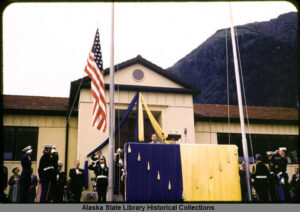
New 49-star American flag is raised, July 4th, 1959 in Juneau. Alaska State Library, Ann Pearson Wood Slide Collection, P534-42. 1959.
On January 3, President Dwight D. Eisenhower proclaimed Alaska the 49th state of the Union, “a moment after the stroke of noon.” Meanwhile, William A. Egan was sworn in as the first Governor of the State of Alaska, at 9:18 a.m. At 1 p.m., however, he was admitted to Juneau’s St. Ann’s Hospital to have surgery for removal of a gall stone. That surgery was successful but his internal condition worsened, and he was flown to Seattle January 19. Near-fatal complications arose, but Egan pulled through successfully after several months of recovery, during which time Hugh Wade, Alaska’s Secretary of State (title later changed to Lieutenant Governor), filled in as acting governor. Egan returned in mid-April to take over the governorship.
show more
During Egan’s absence, the first session of the First Alaska State Legislature convened at Juneau January 26 to start the process of creating a new state government. Quickly, 56 lobbyists were registered in Juneau. A “long” session of 70 days was planned. Within a few days, Gulkana, in the upper Copper River valley, was proposed as a site for a new state capital to replace Juneau, initiating a contentious movement that remains up to this day in various forms. In March, acting Governor Wade signed into law the bill creating the state court system. Other acts passed included the creation of 12 state executive departments, an Alaska lands act, minimum drinking age (21), a minimum wage ($1.50/hour), and prohibition of fish traps. On April 16, the first session of the First Alaska State Legislature adjourned after being in session 81 days, a few days after Egan’s return to Juneau. The new state was off and running.
Territorial buildings were transferred over to the new state government, including the federal capitol building, which continued to house the city’s main post office. Federal agencies scrambled to find new office locations. General Services Administration told the city that it needed roughly a city block area on level ground to construct a proposed $13 million federal building, with funds appropriated already by Congress. The old government hospital was closed mid-January with remaining patients transferred to St. Ann’s hospital, but then was remodeled for Bureau of Public Roads offices. The Park Service announced plans to build a supply center and support facility near Indian Point at Auke Bay for their operations. At the Subport, construction was started for a new National Guard armory and an Alaska Communications System communications center, while at Auke Bay, the new fisheries research lab construction was under way. The Juneau City Council proposed construction of new state legislative and court buildings and offered to donate the land. (The court building was eventually built in the 1970s, but the old federal building still serves as the state’s capitol). However, the legislature turned down the city’s capital site study proposal as premature.
Juneau celebrated Alaska’s new statehood with a grand 4th of July program, including raising the new 49-star flag and ringing the Liberty Bell at the state capitol building. Benny Benson, winner of the Alaska state flag design contest, led the parade, with national news media in attendance to cover and film the celebration. Even before then, an initiative to move the capital soon arose from Anchorage boosters, with petitions quickly circulating around the state. By late fall, Juneau’s Chamber of Commerce joined the effort too, but with the idea to put the measure quickly to vote and persuade a majority to defeat it. The governor and Alaska’s congressional delegation publicly opposed the capital move.
The chamber also commissioned a survey of available housing inventory and encouraged planning for expanded government and industry development here. Several projects were announced to increase the area’s housing and hotel capacity, including one to add two stories to Juneau’s largest hotel, the Baranof, another to build a $250,000 apartment complex near downtown, and one to specifically provide legislator housing. A California realtor announced plans in August for a $6 million tourist resort to be built on 47 acres at Salmon Creek (never built). The Bureau of Land Management auctioned off 59 small tracts in April to veterans – lots on several islands were most popular.
The bankrupt Alaska Plywood Corporation’s plant was bought by a local sawmill operator and put into operation mid-summer, but only to lose it in a tremendous fire a few weeks later on August 14, a $1 million loss. Georgia-Pacific Alaska continued planning for a newsprint paper mill in Juneau, after the city granted it a tax break in January for development, but it was still contingent on sourcing a new power supply. Senator Bartlett promised to introduce a bill for the Bureau of Reclamation to develop a large hydroelectric project at Port Snettisham, after their studies showed great potential. Alaska Electric Light & Power welcomed a public power project and requested an extension of a new 20-year city franchise for their power operations. That request was turned down in the city election October 6, but the company continued to lobby for reconsideration by stressing the area’s future power needs.
In the October election voters approved a bond issue for airport improvements, including extending the airport runway for jet service and putting in a new control tower. Water system improvements were in progress, although the installation of water meters produced an unexpected controversy when some residents questioned their need. A new gymnasium and auditorium were being added on to the new high school. Juneau voters also approved formation of a commission to develop a city charter for home rule status. A move to annex west Juneau to Juneau city proper produced mixed opinions for those affected, while another proposal called for a greater reach out along the North Douglas Highway, to Lawson Creek, and to Norway point. The city moved the police department over to the federal court house building July 1 and took over operation of the jail in contract with the state. The city also was considered contracting law enforcement with the state troopers.
Dredging of Mendenhall bar area was begun in early August, with some of the spoils to be used for the airport work. Work didn’t proceed too far, however, as the dredge sank October 3 and was salvaged and towed back to Seatte for extensive repairs. Plans called for it to return and resume work next April. Pan American Airways produced a film in October of the Juneau region for jet pilots training, and authorization for night landings and take-offs at the Juneau airport was given by the Federal Aviation Agency in November. The Juneau Chamber of Commerce recommended that a proposed Southeast Alaska ferry system be financed as part of the Federal Interstate Highway Network. In Douglas, Fourth Street was extended over Bear Creek, making access easier for school kids to walk to the new school on the north edge of town. Residents there also retained mayor William Boehl for a sixth term, and approved a bond in their election October 6 to add on additions to the new city hall.
At the airport, a Pan Am clipper came in too low April 11, resulting in a fiery crash, but without fatalities. A local landmark, the Juneau Opera House, which existed at Second and Seward Streets for more than 70 years – with a variety of names – was removed from the scene as the result of a spectacular fire April 23. Up Montana Creek, 17-year-old Lee Hagemier was attacked July 27 by a brown bear, receiving serious injuries that resulted in scarring and blinding him. The whole community responded quickly to set up a fund to help pay for medical treatment and a scholarship to enroll in a special school for the blind. A community meeting was held in response several weeks later, with some rural residents calling for complete elimination of bears here, but calmer heads prevailed.
In other community events, the Juneau Lions Club hosted a giant pancake feed in February to raise funds for high school athletic equipment, with over 2,500 attending. Special guest was Aunt Jemima herself, the “Pancake Queen of the World,” who toured the country aiding service club outreaches. Teenager Myrna Allen won both the local and statewide pancake making contests, winning the grand prize trip to Disneyland. At 107, Mary Johnson was recognized as the oldest Social Security recipient, having retired here only a few years earlier. A local water skier successfully completed a 7-hour non-stop 130 mile run to Sitka July 4, while the February issue of Holiday magazine rated Juneau as one of the top ski areas in the world – no lifts yet, but if you were willing to climb or helicopter, hundreds of runs awaited on top of the icefield.
show less