
- 1958
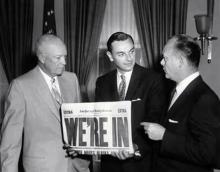
President Eisenhower with Governor Michael Stepovich, and Sec. Interior Fred Seaton after signing of the Alaska Statehood Bill, July7,1958. photo credit: www.eisenhowerlibrary.gov
The burning question of statehood for Alaska was the dominant news issue for the year, both in Juneau and Alaska in general. After decades of debate, voter referendums, lobbying, failed bills in Congress, and development and approval of a proposed state constitution, the final moves fell into place. On June 30 the U.S. Senate passed the Alaska Statehood bill 64-20 and sent it to President Dwight Eisenhower. He signed the Alaska Statehood Act into law July 7. By August 26, voters in the first Alaska state primary election approved the Statehood Enabling Act, 40,452 to 8,010, and nominated candidates for governor, Secretary of State, members of Congress and for the first state legislature to be decided upon in the November elections. Governor Michael Stepovich resigned his position to run unsuccessfully for U.S. Senator, leaving his Secretary of State, Waino Hendrickson, once again acting governor, until Governor-elect William A. Egan would take the reigns as the first governor of the new state of Alaska beginning in the new year.
show more
Before Juneau voters voted to approve the statehood act in the August primary, they celebrated the statehood bill with ringing the replica Liberty Bell at the capitol building 49 times signifying Alaska’s entry as the 49th state of the union, dancing in the streets, and setting off a huge bonfire, followed by a big fireworks display. They gave a great gala welcome to Egan and his family in December as they arrived to take up residence in the Governor’s Mansion and prepared an elaborate ceremony for the transfer of governance as soon as the President would certify the process in early January 1959. Expecting great attention and influx of visitors for the occasion, the Navy even planned on sending up a troopship to anchor in the harbor to house the overflow.
At the post office, half-million envelopes with the new statehood commemorative stamp were ready to be sent out to stamp collectors world-wide. Local officials and business people were also assured of support by the Democratic party and others that the capital was to remain in Juneau. Statehood attracted much attention from elsewhere, bringing a flood of letters to the Chamber of Commerce and local government offices inquiring about jobs, living conditions, etc. It also brought national political attention to the new state and the fall election campaigns saw party standard bearers, Republican Vice-President Richard Nixon and Democrat Senator John Kennedy, stop by Juneau briefly in November to rally the party faithful and curious alike and to discourse on their particular campaign themes.
In other federal government developments, Congressman-elect Ralph Rivers promised to aid Juneau in getting a new federal building as the old one would be transferred to the state. Several other government offices, however, were closed or transferred, including the immigration office, the civil defense headquarters, and the Federal Housing Administration office. The Bureau of Reclamation began a study assessing hydropower development at Port Snettisham. Plans were announced in April for construction of a fisheries research laboratory for the Bureau of Commercial Fisheries at Auke Bay, tentatively to be finished by end of 1959. A new 50-foot Coast Guard patrol boat was stationed at Tee Harbor, but later suffered an explosion on a patrol September 6; a fisheries research vessel also sunk December 10 during gale winds in Taku Inlet. No one was injured in either accident. Regional Fish & Wildlife Director Clarence Rhode of Juneau and two other passengers disappeared on an aerial wildlife survey in the Brooks Range August 5, setting off Alaska’s most intensive search efforts ever, but no trace had been found when the search was finally called off in December. (They never were found.)
Several other unusual accidents also made headlines. In May 16-year old girl fell 20 feet off a slippery trestle into creek bed while hiking along the Salmon Creek Dam trail, severely fracturing her spine in two places. She crawled and dragged herself nearly two miles in the dark and heavy rain to reach her home near the trailhead to get aid. The physician treating her was amazed that her spine wasn’t crushed and there was no paralysis. He cited her realization that help was only up to her and her courage and determination to seek help that led to her survival. A trestle on Basin Road collapsed September 23 while a loader was clearing debris from a rock slide, sending the machine down to Gold Creek, wrecking it and a water line, but the operator suffered only back strain after landing 20 feet below. The water line damage, however, forced closure of schools and offices downtown and residents were advised to boil water from an emergency source before the main line was restored half a day later.
The Juneau City Council announced a crackdown on delinquent taxpayers and auto thieves, and joined with merchants to act against a growing shoplifting problem. A new municipal airport terminal was opened November 15, while voters approved a large bond issue November 25 to address much-needed water system upgrades. To improve garbage disposal problems a sanitary landfill was proposed in May to replace the present open dump. The municipal swimming pool at Evergreen Bowl was cited in early August by health authorities as unsanitary, so a study was initiated to seek a solution. Fallout monitoring in the fall revealed higher levels of radiation detected than in previous years, apparently due to Soviet bomb tests in Siberia.
The new high school opened for classes January 20, while other lower classes were shuffled around elsewhere. The Fifth Street and Mt. Jumbo schools’ junior high classes moved into the old Juneau High school building, three classes from the Willoughby Avenue school moved to Mt. Jumbo and then the Willoughby and Mayflower school buildings were closed. The new Gastineau Elementary School in Douglas was completed in the spring and opened for the fall school year. School district superintendent Sterling Sears told a Chamber of Commerce meeting in February that education represented “big business” in Juneau, in terms of payroll, construction, and supply outlays, and offered that high school students’ academic work was much improved since moving into the new school. Voters passed another bond issue April 29 to add a gymnasium and auditorium not covered in the initial construction of the high school. The community college expanded its course offerings and had an enrollment of over 200 students.
The plywood plant went into bankruptcy proceedings in July and was foreclosed, but the spruce mill continued to provide good economic returns to the community. The Georgia-Pacific Alaska Corporation continued to assure local leaders that it was serious about developing a paper mill in the area and was planning for a north Douglas location. In turn, the company sought a tax break for its operations and was looking into a cooperative venture to develop adequate power sources.
In May the BLM auctioned eleven small land tracts for housing along Glacier Highway and patented 74 other sites around Juneau and other Southeast areas, while a private firm announced plans to construct 17 new housing units in a subdivision by the airport. The telephone company completed its new exchange building and began switching customers over to their new dial system in January. New trunk lines were added to the Douglas area and line service extended out to mile 11. A large earthquake shook up the city July 9, temporarily knocking out several power lines, and severed the ACS cable from stateside, but service was restored fairly quickly in both cases.
KJNO radio was bought by a local group of investors in May. The film industry added to Juneau’s economy briefly as film crews arrived in the area to film scenes for several productions. In April the producer/director for the Hollywood production of Alaska-themed “Ice Palace” arrived to “get acquainted” with Alaska in advance of next season’s arrival of their film crew, which will then be shooting local scenes for the movie. Lowell Thomas, a well-known Anchorage-based documentary film maker filmed various subjects in the area in June, while a crew from the Ed Sullivan Show staged scenes in October in the Red Dog Saloon for an Alaska statehood special for their television program.
The Douglas ANB camp launched a drive in mid-December to collect clothing for families in Southeast villages hard hit by a poor fishing season and to help a burned-out family in Yakutat. Well-known Tlingit carver Amos Wallace journeyed to New York city in September to carve a totem pole as part of a month-long display of Alaska Native heritage items in a Brooklyn department store and served as a culture ambassador in various media interviews. Juneau was also represented in national beauty contests In September when Stuart Johnson from Douglas represented Miss Alaska and Milly Sweet, from Juneau represented Miss Teenage Alaska. Neither made the final selections but reported having wonderful times.
On the entertainment scene, a hypnotist and a classical harmonica player both wowed audiences in separate appearances in September, while a local psychiatrist wrote a best seller, based on humorous observations collected over his career. Local duffers, organizing themselves in August as the “Juneau Sandblasters” club, created a new golf course amongst the obstacles at the AJ rock dump, and a trap shooting range was set up in May near Salmon Creek. A whale stranded itself in May on an Auke Bay beach, attracting widespread attention, but it failed to survive after being freed. Moose calves from the Cordova area were airlifted to Juneau May 28 and acclimated here several months before release in Berners Bay. A winter survey found them in good condition.
show less