
- 1960
In the first of many initiatives to move the state capital from Juneau northward, Juneau residents reacted and organized the ‘Alaskans United’ committee to garner statewide support against such a move and present facts about its potential cost and effects. The committee estimated the cost to be up to $150 million, which would greatly curtail state expenditures that would benefit the rest of the state. Their study also predicted over 7,000 total population loss to Juneau from the current census of almost 10,000 people. Alaska voters in the fall election, however, defeated the initiative to move the capital to Anchorage, but move supporters vowed to continue pressing the issue. Juneau voters cast a record number of votes, breathed a sigh of relief at the move’s defeat, and celebrated with a giant street dance, but quickly responded with civic soul-searching to find ways improve Juneau’s appearance and infrastructure to maintain its claim as the capital.
show more
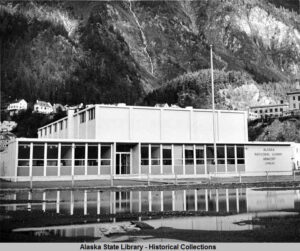
Alaska National Guard Armory, Juneau. Alaska State Library, ASL Place File Photos, ASL-Juneau-Buildings-28.
Shortly after the move defeat, Alaska Senator Ernest Gruening addressed the Juneau Chamber of Commerce to call on Juneau area residents to push toward growth and improvement of the area as an “investment in the future”. Stressing the need for Alaskans to work together for the betterment of the whole state, he pointed out the need for general highway improvements to better connect the state, including developing a coastal ferry system and even getting access roads to Juneau. Specific recommendations for the Gastineau Channel area included Juneau extending its boundaries to include the whole local road system, unification of Juneau and Douglas municipalities, and called for general house cleaning for Juneau by removing old buildings and other civic improvements. He also noted the need for increased power supply and expressed hope that the proposed Snettisham power project would win early approval, as well as that plans for new boat harbors in the area would receive this year’s appropriations, now being reviewed by Congress.
Responding in part to the senator’s address, various organizations announced activities and initiatives to better Juneau’s appearance and provide for its growth and infrastructure. Juneau’s newly-formed City Parks and Playgrounds Commission called for a city-wide cleanup and removal of scores of sub-standard “firetrap” buildings throughout the area. The Gastineau Channel Jaycees “broom brigade” took to the streets of Juneau one weekend in September to sweep and hose off downtown Juneau streets and called on residents to continue the process, while the city council vowed stricter enforcement of “anti-litter” laws.
Long-term planning before and after the capital move initiative continued to seek ways for area improvements. Early in the year, the city planning commission reviewed a report compiled by a Seattle consulting firm, which called for comprehensive new zoning and enforcing ordinances for Juneau to serve as a “blueprint for Juneau’s future”. One major component was a new Capital Center to build a campus for state offices and a new capitol structure. To that end, voters approved a million-dollar bond in May to purchase a 6.9-acre tract on Telephone Hill to then be turned over to the state for campus development. A second on-going project for urban renewal centered on an area from Willoughby Avenue, including the (Auke) Indian Village, past Gold Creek to 10th Street near the Douglas Bridge. Tidelands would be filled in and an “outer drive” expressway would enclose that area to extend out to Norway Point past the bridge and new high school. Representatives from the Indian Village met several times with city council members to express the need for city help in securing adequate housing and area maintenance.
Speaking of the high school, Juneau voters in the May election also approved a $590,000 bond to add an 18-classroom third story addition to the school for junior high classes, which were scattered over the area. At the end of the year, an earlier expansion of the high school, which included adding gymnasium and auditorium facilities, was finished, and the high school basketball team won victory over Sitka’s Sheldon Jackson High School in the gym’s inaugural game. The school board also announced in December that the school now is officially “Juneau-Douglas High School”, replacing the original Juneau High School name that remained in effect after the two cities’ schools were united in 1956 and the students moved into the new school in January 1958. Douglas residents probably wondered why the name change took so long.
In a special election in March, property owners in West Juneau across the Douglas Bridge voted to approve annexation by the city of Juneau, a section of land along the Douglas Highway from Cowee Creek in the north to a highway rock cut about a half mile south of the bridge. Juneau Planning Commission Chairman Robert Boochever expressed hope that the election was “a real step forward in giving Juneau the needed space for expansion.”
In another special election in June, voters in Juneau and Douglas handily approved 1% sales tax increases for both towns to help fund increased municipal operations expenses. For Juneau, this resulted in the abolition of the city’s personal property tax and being able to retire substantial operating loans. For Douglas, this paved the way for financing street improvements and a paving project.
In the regular October municipal elections, Juneau voters approved four bond issues for providing the city’s share for the outer drive project and approved support for airport, public works, and city maintenance facilities. The airport work would include lengthening the runway for jet service. The hot issue for voters was to adopt a new city home rule charter, which included a change from a mayor-council form of government to a city manager-council form. The charter passed, but a straw vote question asking voters preference for city government form gave a conflicting reply, with a significant majority voting satisfaction with the current mayor-council government. By the end of the year, the council was in the process of re-instituting the former mayor-council form.
Douglas also returned Mayor William “Bill” Boehl for a record eighth term (one-year terms) and elected their first women city councilwomen, F. Jeanne Downing.
In February Juneau bought Evergreen Bowl from A.J. Industries for $20,000 for city administration of the popular park. Douglas opened up its new city hall in the fall, with new quarters for its fire department and the volunteer-staffed city library. The National Guard Armory was opened in the fall in Juneau (now the Juneau Arts and Humanities Council building.) and model fallout shelters were displayed with civil defense information for the public soon after its opening. The new federal fisheries research center at Auke Bay was completed in December to be turned over to the Bureau of Commercial Fisheries for its operations.
The federal government bought the Fireman’s Park from the Juneau Fire Department in the fall as the site to construct a new $15.7 million-dollar federal building to replace the old building that had been turned over to the state in statehood transition. Several downtown property owners objected to the selection site, claiming the downtown area would be more convenient and would have adequate parking. However, the city council was already trying to cope with inadequate parking in the area and passed an ordinance to try and maintain a balance between public and residential parking, both in short supply.
Juneau area housing needs were opening up with the several new sub-divisions in planning or construction stages in the Mendenhall Valley. The Pleasant Gardens subdivision along the Mendenhall Loop Road began construction for 37 homes in June. A California development firm proposed a $4 million dollar program in February to construct up to 2,000 single family homes along with a large hotel resort complex, tentatively situated by Salmon Creek. That project was scaled back considerably to begin pre-construction sales in July for a first phase of 229 houses in the Mendenhall Valley for the newly dubbed Mendenhaven subdivision. In downtown Juneau, the new Gold Lodge apartments next to lower Gold Creek opened up in January specifically to provide preferential housing for legislators. Builders were also eyeing housing construction in West Juneau after the city’s annexation, provided adequate utilities were made available.
In other area infrastructure developments, dredging a channel over the Mendenhall Bar concluded in July, with navigation aids added by the fall. The $650,000 project was the second largest dredging operation in Alaska, with over 1.7 million cubic yards of material excavated. However, Army Corps of Engineers which conducted the project, admitted that the channel was not fully stable and was already beginning to fill in, and that it would take several more years of continuing maintenance to achieve a stable channel. The Corps also announced that funds for dredging the Douglas small boat harbor had been approved and appropriated, with the project slated to begin next spring. A retaining dike for dredge spoils behind the harbor had already been completed.
Mercury vapor lights were added along Glacier Highway from Juneau out to the airport, which increased permissible flying hours by providing pilots with visual landmarks during night operations. Communications improvements also included the completion of a new building near the Subport in January for the Alaska Communications System (now KTOO studios). ACS was also in the midst of building a new microwave transmission system in Juneau to improve long distance telephone service and handle both military and commercial radio-telephone traffic. A tower at Lena Point was completed in July, with a radio signal reflector installed on Mt. Roberts in the fall. The system would be a connecting link in the Ballistic Missile Early Warning System as well.
In commercial developments, Georgia-Pacific Alaska Co. President J.L. Buckley testified before a congressional sub-committee meeting in Juneau in September that their company’s plans to construct a pulp mill in the Juneau area hung solely on availability of low-cost power, and urged that a proposal to construct a large hydroelectric facility at Port Snettisham be advanced without delay. G-P earlier had purchased the largest timber sale ever advanced for the Tongass National Forest and was in process of site selection and construction planning. Buckley warned, however, that without such a power source, their development plans could be terminated.
Down at the waterfront, the Juneau Cold Storage began turning what previously had been waste into a high-level delicacy – salmon egg caviar. It was a first in the history of the company, after years of dumping tons of eggs into the channel, and almost 25,000 pounds were produced. Reportedly many company employees couldn’t resist sampling large quantities of the tasty eggs right out of the barrels.
Speaking of food, Juneau’s Foodland Super Market announced plans in September to construct a new half-million-dollar shopping center around their flagship building on West Willoughby Avenue. The first such development of its type in the area, the neighborhood center tentatively would also include eight stores and shops, featuring drug, variety, and clothing stores, barber shop, and a restaurant. And area residents flocked to the opening of Juneau’s first pancake house in January, located in the Gastineau Hotel downtown. The menu featured a wide variety of pancakes, waffles, and fritters – with all the trimmings!
The area also had its share of bad news. An early September storm caused sinking of a Seattle-based tugboat near Five-Finger Light in southern Stephens Passage, while another Juneau-based tug had a rough go off Yakutat and lost a cargo of lumber in tow. One fishing boat sank while another was disabled in Stephens Passage in the same storm but both operators were rescued. The storm also caused a large mudslide that blocked Glacier Highway south of Salmon Creek for several hours until passage was restored.
Fires also made headlines throughout the year, starting in March when three apartments in the Knight Apartment building along Calhoun Avenue were destroyed in a raging fire, causing an estimated $10,000 in damage. Later two young juvenile boys confessed to playing with matches, which caused the blaze. A few days later, Juneau City Councilman Tim O’Day responded to a house fire along Willoughby Avenue to break a window and rescue a seven-month-old girl. Other family members escaped in the blaze as well, but the house was gutted. In September, tragedy struck when 12-year-old Carolyn Martin died when a trash fire she was attending at the Juneau Children’s Home ignited her plastic apron and she suffered extensive burns over her body. In December, a teen-age babysitter saved her two charges from a $20,000 fire which gutted the family’s apartment in a three-unit business and apartment building on Tenth Street.
Personal tragedies were varied. A tragic drowning occurred in June when 10-year-old Gene Wruck, playing alone on his bicycle, skidded off the dock behind Northern Commercial Supply. His body was recovered in about 20 feet of water in the channel. In July Ralph Reichel, long-time guide and experienced woodsman, was lost in the vicinity of Seal Cove, Admiralty Island while serving as a stream guard for the state fish & game department. An extensive search failed to find him, and it was thought that he perhaps had suffered a heart attack in the wilderness. In August up Basin Road, 13-year-old Dexter Rusher was killed in a shooting accident when he and a companion were playing a “game” shooting at each other with .22 rifles while trying to remain concealed behind large trees. In October an 18-year-old Coast Guard man, Lester Francis Stine, was killed in a vehicle accident near 3-mile Glacier Highway when his companion driver swerved to avoid hitting a small bear on the highway. Closer to town in December, Dr. A.W. Stewart and his wife had the fourth vehicle in the last few years hop over the bank on a curve by their home and plunge down into their property, which cumulatively had suffered extensive and expensive damage to their house and yard. They requested the Bureau of Public Roads install railings on the road shoulder to remedy this unusual problem.
Quite a fuss was generated in February when state troopers raided the Daily Alaska Empire and the Juneau Drug Store to confiscate posters, tickets, and receipts for the historic Nenana Ice Classic non-profit lottery. Acting on a complaint by Juneau minister Richard K. Heacock, the troopers were making a case to enforce Alaska’s anti-gambling laws, although legislation was pending then to legalize the ice classic and other non-profit lotteries and raffles. One of the co-sponsors of the gambling bill stated, “we want to legalize what has been going on illegally for years”, a bill which Heacock bitterly opposed.
On a lighter vein, Juneau City Police Chief P.L. Severson was charged in April by a “complaint” filed by inmates of the city jail, to wit: “Plaintiffs charge that on the 30th of March, Chief Severson did with aforethought commit upon the plaintiffs below named an act of consideration, namely in the instrument of one General Electric TV, for which the plaintiffs seek relief in thanks sincerely given”, signed by 26 inmates. Severson had purchased and installed a television at the jail as a morale booster.
In other serious police cases, one man was beaten to death in June over a dispute regarding salvaging copper wire from a warehouse fire. In July, Walter Leathe, former principal of the Fifth Street Junior High School, was charged with grand larceny theft of school equipment valued at $1,200. Admitting that he “didn’t know why he did it”, he was sentenced to five years sentence, with four years suspended providing he undergo psychiatric treatment. In September, an argument between a fishing couple down at the city dock escalated to violence, when the young lady shot her male partner in the abdomen. He survived and she was convicted of assault with a deadly weapon and given a five-year sentence, with four years suspended. In November, the wife of a Coast Guardsman was charged with child neglect, after a babysitter reported finding an infant drowned in the kitchen sink. She and her husband reportedly were attending local bars and left their six-year-old daughter bathing her three younger siblings in the kitchen sink before the babysitter arrived. The children were subsequently transferred to foster homes.
In more positive community activities and projects, the Douglas Lions Club initiated their first hoped-to-be annual spring carnival in May featuring a day-long string of carnival games, races, and the crowning of Miss Spring Carnival from a field of eight teen-age bathing beauties. In July, the local police fraternal organization announced the formation of a Police Athletic League to provide organized training in boxing for boys 12 years and older. The club would emphasis good conduct, safety, as well as developing athletic skills. Skiers took interest in a proposal by local resident Gunnar Navjord to develop a “switchback road” up the Kowee Creek valley to the Douglas Ski Bowl area. He claimed the bowl area could become a great tourist attraction comparable to the Mendenhall Glacier and give residents and visitors alike a chance for more heathy exercise. This followed an April visit by famed ski photographer, John Jay, who filmed the ski bowl as well as several areas by the glacier and down at Endicott Arm to show future Alaska attractions to “southern skiers”. Swimmers were warned in June by the state health department against use of Dredge Lake for swimming because of high bacteria counts and dangerous conditions with broken glass along the beach. A civic group formed in August to promote development of an indoor swimming pool. The proposal gathered support when the city’s Parks and Playgrounds Commission fully endorsed it and recommended the formation of a Juneau Swimming Pool Committee to move ahead with the project. In December, the high school initiated its first Christmas Jamboree basketball tournament between the high school team and three visiting teams in the new gym, which was to provide area sports fans with three evenings of first-class amateur basketball competition.
Rounding out newsworthy items of interest, early in July KINY-TV announced the beginning of afternoon programming for the station. An additional four hours of news and miscellaneous film features would be presented on weekday afternoons. Hollywood’s version of author Edna Ferber’s Ice Palace, opened at the Capital Theatre in early August. The movie captured the nation’s attention on Alaska’s struggle for statehood in the epic plot. The film was the first big-budget film of Alaska shot by a major Hollywood studio, and involved filming scenes in the Juneau area as well as elsewhere in the state. Local lady Renee Guerin, also known to her friends as Penny Blood, drew rave reviews from critics when she stepped into the lead role in the Broadway musical “Sound of Music” as an understudy for ailing star Mary Martin. R.E. Robertson, one of Juneau’s six delegates to the Alaska State Constitution Convention in 1955-56, added his signature to the final document. He had been the only delegate who had failed to sign then, but now completed the historic declaration. Mary E. Johnson, 107, from the Auke Village Indian Community died May 18, 1960 at Sitka. She was 14 years old when the United States purchased Alaska from Russia in 1897, and was the oldest Social Security contributor when she finally retired from active employment several years ago.
And just in case you are wondering, the Weather Bureau confirmed that this summer had been just about the cloudiest, wettest, and coldest summer on record – only three days of sun between June and July. In addition, two well-known geologists, Fr. Bernard Hubbard and Dr. Maynard Miller, independently predicted, based on their previous studies of Alaska glaciers, that a colder climate cycle is due and glaciers will start advancing against in the next 25 – 50 years.
show less