
- 1957
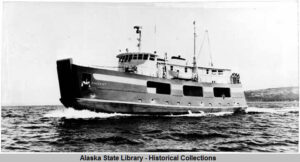
Territorial ferry M-V Chilkat under way (see more below.) Alaska State Library, Herbert J. “Red” Lockert Photo Collection, P452-104.
Governor Frank Heintzleman stepped down January 3 to pursue various Alaska development projects in his retirement, while Secretary of State Waino Hendrickson stepped up as acting governor until a new governor was appointed. His term lasted about six months until Michael A. Stepovich, a life-long Alaskan from Fairbanks, was sworn in at Juneau June 8 as the 15th and last appointed governor of Alaska. His arrival in the capital city June 6 was greeted by a massive civic parade viewed by over 2,500 residents, who turned out to greet the new first family.
show more
In other government actions, the federal BLM land office was re-located to Juneau in August to serve for panhandle developments, while concerns and protests were raised on hearing of a proposed move of the Public Health Service’s Indian Health Office out of Juneau. Hearings were held in April on the proposed Tracy Arm wilderness area. The U.S. Geological Survey initiated a three year project for geological mapping of the Juneau quadrant, useful in future mineral survey work. The Army’s Signal Corps towers at Lemon Creek were deactivated in August after an 18-month classified communications project, leaving only concrete tower bases in a Stonehenge-like formation on the tide flats.
Territorial government actions included the installation of new IBM punch card equipment in August to upgrade financial operations, while the public health office re-activated their fallout testing station downtown and reported in June ‘somewhat’ increased levels of fallout from previous years monitoring. This was attributed to British H-bomb tests in the South Pacific – nothing to be concerned about, however. In September, the health department also deactivated the last vessel of their so-called “health navy,” M/V Hygiene based in Juneau, which had served northern coastal communities in public health outreach. Civil defense authorities announced plans in January to set up an evacuation center at the Boy Scout camp at Eagle River as a contingency measure. The Scouts could also use the facilities otherwise.
In Juneau city actions, the police department opened a short course police school in January for its officers and other departments personnel, and it hired its first women October 21 for its office staff as a desk sergeant. In June the mayor warned swimmers against swimming in the ponds adjoining the airport due to health and safety concerns, and local hot-rodders against using the airport for a drag strip. In August the city made Franklin Street a permanent one-way street uphill from Front Street.
Various public works projects in process continued to improve local infrastructure. A two-year Alaska Public Works grant to improve Juneau city streets and upgrade water and sewer lines reached completion, while the new high school was almost ready for student occupancy. The Gold Creek channelization project got underway to provide flood control, but in the October 1 election Juneau voters failed to approve bond issues on 7 of 9 projects for various neighborhood improvements. In Douglas, the city hall was remodeled and expanded, while at the end of the North Douglas Highway a boat launch was made for improving recreational boating access. The road at Thane was extended a few miles beyond Sheep Creek as far as funds allowed. The Auke Bay Volunteer Fire Department broke ground in May to begin construction of a fire hall for their equipment. The University of Alaska announced long term plans to construct a branch campus along Auke Lake, possibly for a fisheries and forestry research center.
Economic boosters’ hopes for an area pulp mill and/or newsprint plant were cooled when Georgia-Pacific Alaska Corporation informed local officials that without a major economical source of power, their plans were on hold. An old 1947 government hydropower survey was dusted off and re-examined for potential sites that could meet the criteria necessary for attracting new industry and future development. Several project sites south of Juneau held the greatest potential, and community leaders organized study groups to investigate funding sources and to recommend a plan to attain project goals. Meanwhile the local plywood plant re-organization plan failed to get the plant going again and it looked headed for bankruptcy. Mining activity was restricted to exploratory work on one uranium claim and the Funter Bay nickel lode. The AJ mill was dismantled for scrap and the Tulsequah mine up Taku River closed September 12 due to low metal prices.
Business developments included introduction of Kodiak king crab to Juneau markets in April with whole crab on special at 69 cents a pound, the opening of Juneau’s first recording studio in September, and the Baranof Hotel receiving national recognition in December in Duncan Haines’ popular restaurant guide. A reporter for the Empire paper was investigated in February by a House committee in the territorial legislature for printing “unsubstantiated rumors,” while the weekly Juneau Independent was sold in May. A series of informative signs were placed around downtown in May to benefit Juneau’s tourist visitors.
In other community events, the new ferry M/V Chilkat arrived to take over the Juneau-Haines route and made its maiden voyage June 19, while a private vessel offered express mail/freight service starting in June for that route. Alaska Steamship Co. delivered its first refrigeration van here October 15 as part of its freight service upgrades. Local amateur radio operators picked up signals October 7 from the Russian satellite Sputnik, first successful space satellite, while it orbited above Alaska. The Coast Guard vessel Storis, previously based in Juneau, made an historic trip through the Arctic Northwest Passage, with one of the passengers being 13-year-old Timothy Wood from Juneau, whose father Commander Harold L. Wood was captain. A gala welcome was given December 11 to the crew when they arrived in Juneau while enroute to their new station at Kodiak. The phone company announced that this year no reservations would be necessary to place long distance calls during the winter holiday season.
Four Juneau-based victims of a Fish & Wildlife Service plane crash three years ago were honored in September by naming previously unnamed peaks after them, including Mt. Meek on northwest Douglas Island in honor of pilot J.R. Meek. A baby was born October 10 in a Juneau-bound Alaska Coastal Airlines plane, and was later given the first name of the pilot by the gratified mother. The local Alaska Native Brotherhood and Sisterhood camps presented Native dances in January for a March of Dimes fundraiser, while five non-Native local people were honored with Tlingit names at the November ANB and ANS convention in Kake. In Los Angeles, a Juneau girl, 21-year-old Renee Guerin, got her first break in November in a major musical “Annie, Get Your Gun,” subbing in for star Mary Martin, and received standing ovations for her performances. She later made a career in musical theater, including acting in major Broadway musicals.
Little League baseball players out the road benefitted from a new diamond built by the airport in June, while a midget race car track opened up in August by Salmon Creek for racing enthusiasts of all ages. Boaters could now shorten their trips into Seymour Canal on Admiralty Island when a tramway was opened for use in June at Oliver’s Inlet, although it only could handle small skiffs and rafts.
Weather records were set with record snowfalls in February (54.3 inches) and heat records in August, with a high of 87 degrees recorded downtown. Wildlife sightings also made news here with several rare sightings of snowy egrets and lynx. At the airport in July “millions” of tiny toads suddenly invaded the area, covering the runways and crawling inside buildings, reminiscent of a Biblical plague. One explanation forwarded was that their habitat had dried up and they were seeking wetter digs. And since they disappeared again after rains returned, that seemed a satisfactory cause.
show less