
- 1956
Juneau voters joined a majority of Alaskan voters April 24 to approve a state constitution adopted at Fairbanks in February and adopted a “Tennessee plan” to send an unofficial three-member delegation to Congress. Ernest Gruening and William Egan were named delegates to the Senate, Ralph J. Rivers to the House. The constitutional convention rejected moves to relocate the capital away from Juneau, but did provide avenues for future moves through constitutional amendments, initiatives, and legislative actions. Governor Heintzleman resigned mid-December, effective January 3 next year, citing a desire to pursue development promotion activities in the private sector, and Secretary of State Waino Hendrickson stepped in as acting governor.
show more
Celebrating Juneau’s 75th founding anniversary, a special edition of the Daily Alaska Empire November 25 contrasted the area’s history with its current progress, noting that government employment now contributed half of the area’s total payrolls, with the fishing industry second in importance. Juneau’s food prices were said to be the lowest in Alaska, although about 24 percent higher for comparable items in Seattle. Juneau was on track to have a record building season with two new schools under construction, cold storage plant reconstruction, construction of a new telephone exchange, many remodels both commercial and home, and new housing construction in anticipation of expanding forest industry.
Development of a Juneau area pulp mill or newsprint plant was apparently on track, with a permit given in February to Georgia-Pacific company to study Lemon Creek for a hydroelectric project for power. Juneau’s mayor pushed for hydropower development at Lake Dorothy along Taku Inlet. The two local sawmills were having record years, but the plywood plant was struggling financially and re-organized its management and operations. It opened for part of the season but closed later in the year under the specter of bankruptcy.
Uranium prospecting continued and one local group bought a helicopter in March to aid in their searches and claim development. The U.S. Bureau of Mines revealed their findings of a large iron ore deposit with high titanium values at Port Snettisham, that they posited could be developed into a large operation. Just south of there, the Forest Service proposed a wilderness area for Tracy Arm and Ford’s Terror areas to protect outstanding scenic and wilderness values.
Filipino Community Inc. was incorporated February 1 by Juneau area Filipino residents as a social non-profit corporation to “to foster better and harmonious relationships, understanding, and brotherhood among ourselves and with other ethnic groups, and to keep alive our Filipino heritage, culture, customs and traditions.” A junior chapter of the Alaska Native Brotherhood was formed in early January and quickly attracted many young people. Native residents also were very concerned about rumors of closing of the government Native hospital here, but no decision was made to date.
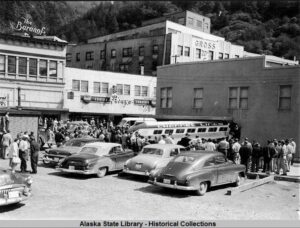
Channel Lines bus hits Rusher’s Hardware store; June 9, 1956. Alaska State Library, Brian Wallace Photo Collection, P533-1-2.
A Channel Bus Lines bus narrowly averted tragedy June 9 after losing its brakes going down Seward St. from Fifth Street. Slamming two thirds its length into Rusher’s Juneau-Young Hardware store on Front and Seward Streets, Juneau’s busiest intersection, only minor injuries were reported for the driver and one other person in the store. The Juneau Cold Storage fish house burned January 17 in a half million-dollar fire, but was rebuilt and resumed operations that season. A diver was lost July 15 near the cold storage dock and never found. Suspicions arose that he was attacked by an unknown creature, giving rise to a local monster legend. A warehouse collapse September 18 dumped 4,000 cases of beer into the channel but most were recovered before town imbibers could respond. Windstorms pummeled Douglas in January producing $25 thousand in damage, while power and telephone lines north of Auke Bay were laid low in December for several miles. Record rains in December produced flooding, landslides, and a washout of the power company’s hydropower flume. Community volunteers quickly responded to a family who had lost their house in a May fire at Fritz Cove, and rebuilt a new home within several weeks time for them.
In municipal operations, Juneau’s water system continued to be plagued with troubles, including line breaks, water shortages, and contamination. A water system improvement bond, however, was voted down April 24 and water rates were to increase 30%. Out the road, Duck Creek water was tapped in November to supply the airport, in part using an old Army base setup from WWII. The city’s fire main and alarm system passed inspection from a national inspection service in July, and Auke Bay volunteers organized in March to form their own fire department. In other public works projects, funding was approved to build two new boat harbors, one in Juneau and one in Douglas, which also included a dike project as part of the harbor development. Highway work to extend the North Douglas Highway out to Fish Creek was completed and the highway from Auke Bay to Tee Harbor was paved, giving motorists almost twenty miles of pavement to use, extending north from Juneau.
The cornerstone was laid for the new $2 million Juneau-Douglas High School August 1, which was scheduled for completion and opening next year. School tax issues continued controversial as Douglas was resisting their contributing to the new consolidated school district. Another controversy was raised over certain high school history textbooks deemed not patriotic by protestors. The lawsuit brought last year against the district regarding busing non-public school students on public school buses was tossed out by the judge in March. The district anticipated a record enrollment. A new community college was organized and scheduled to open for the next winter quarter.
In Douglas, the women’s club house-numbering project was completed in early February and received plaudits from the governor on down. The Douglas City Council bought rat poison in July to deal with a similar problem as Juneau had been doing the last few years.
Public safety and law enforcement drew more attention this year in several areas. In the annual civil defense exercise in mid-July, which supposed a mock nuclear bomb attack, residents responding to authorities’ directions demonstrated a speedy evacuation, which passed the test. A station set up on top of the federal/territorial building was ready in late May to monitor fallout from H-bomb testing elsewhere. As a public health measure, Juneau’s city council called in July for chest x-ray testing for all food handlers. In a domestic violence case, a man murdered his common-law wife in February but was caught, tried, convicted and given a life sentence. In the murder case of a territorial health department receptionist last fall, the assailant was found incompetent in February to stand trial, and was transferred to a mental treatment facility. A series of car thefts resulted in the juvenile joy riders caught and sent to juvenile correction facilities, while several burglaries, gambling raids, and curfew clamp-downs also enlivened the police blotter. Juneau’s police chief sparked community controversy in August by alleging municipal government corruption, particularly in regards to last year’s closure of the red-light district, and then announced his resignation, along with several other officers. The council was split in its reaction, and the resolution left hanging. Out of town, a federal Fish & Wildlife stream guard employee disappeared in August on a stake-out at Port Houghton, with an extensive search failing to find him. Suspicions were cast on a seine boat crew that was in the area at the time, but nothing came of it.
Residents were excited when KINY-TV signed on the air in February 16, though programing was limited to evening hours. The station provided opportunities for broadcasts of local live plays, discussion forums, and fundraising telethons. One viewer reported picking up clear broadcasts in May from Edmonton, Canada, while another local committee was formed in early February to seek out sources of TV interference and correct them. Completion of a new submarine telephone cable from Washington state to Skagway was completed and dedicated locally December 11 as a major improvement for Alaska communications. Pan American Airways initiated their new clipper service June 22 to Juneau, while Alaska Coastal Airlines added a helicopter in March to their local service in time to provide quick access to the Douglas ski bowl. Unique use was made of it to transport the governor and mayor to Juneau’s ball field May 30 to throw the first ball to open the season. About 15,000 tourists were anticipated for this season, and a volunteer group was organized to be official greeters for airplane arrivals.
show less