
- 1955
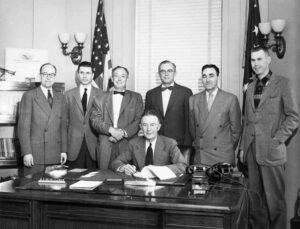
Gov. F. B. Heintzleman signing bill authorizing a constitutional convention starting November 8, 1955 at University of Alaska, Fairbanks. Juneau Rep. Tom Stewart (left), House Minority Leader Joseph McLean -Juneau (on rt.). University of Alaska Fairbanks, Elmer E. Rasmuson Library, Alaska and Polar Regions Collections, Constitutional Convention Delegate Photographs, UAF-1968-16-1.
The Alaska Constitutional Convention convened November 8 on the campus of the University of Alaska at Fairbanks. In a territorial special election, 55 delegates were chosen, of which Juneau provided seven delegates, three of whom were women. Douglas added one more delegate. Delegates were: R. Roland Armstrong, Douglas Gray (Douglas), Mildred Hermann, Katherine Nordale, R. E. Robertson, George Sundborg, Dora Sweeney, and H. R. Vanderleest.
Economic development boosters were greatly encouraged when Georgia-Pacific Plywood Co. won its bid in August for a 50-year, 7.5 billion board-foot timber sale from the Forest Service, as a required step to building a local area pulp mill. As much of the timber was to be harvested on Admiralty Island, a conflicting bill before Congress proposed making the island a national park, which drew vigorous protests from various groups as well as from the Forest Service itself. The bill did not go forward. G-P planners also were doing preliminary studies for plans to construct a two-dam hydroelectric power complex on Lemon Creek for the plant.
show more
A major power development was also being proposed by a Canadian firm to divert upper Yukon waters into proposed dams on several Taku River tributaries in conjunction with developing a large industrial mining-smelting complex in the Taku valley. However, proposals for a coastal highway connection between Juneau and Canada up the Taku River were no closer to fruition. Closer to home, news of several uranium deposit strikes in July and August north and east of town had local residents excited, with prospectors flocking to the hills with their detectors to try to cash in. The federal government was buying uranium, providing a ready market. At least one strike at William Henry Bay, northwest of Juneau on western Lynn Canal, had returned assay results with promising commercial values.
Loss of federal government positions in Juneau prompted a lengthy protest of a proposed transfer of most of the Bureau of Land Management engineering jobs to Anchorage. Late in the year a reorganization of BLM resulted in a transfer of their Anchorage-based headquarters staff to Juneau, although much of the lower-level engineering staff still was transferred to Anchorage, as it was more centrally located for field and administrative work. Local government had other concerns, with Juneau’s water system suffering several line breaks in December, one of which resulted in a dry reservoir near Starr Hill, and concerns of water contamination.
New roadwork this season was limited to extending the North Douglas highway about five miles to deep water just beyond Fish Creek; normal maintenance continued. Pacific Northern Airlines again started local service May 15 for Juneau – Anchorage, Seattle after receiving a permanent operation certification, denied earlier by the federal CAB agency.
Early in the year both Juneau and Douglas city councils prohibited the sale of trashy sex and horror comic books. In December Juneau motorists now could pay parking fines in “fine-o-meters”, while over in Douglas, the Douglas Island Women’s Club initiated a city-wide project to map and number all buildings, apparently never done before. Last year’s proposal to consolidate the separate school districts gained momentum and was approved by area voters in a special election March 8 and a new Juneau-Douglas school board was set up and board members elected. Within Douglas city limits, however, a great majority voted had against the proposition and a group formed subsequently to fight its formation. Special school taxes approved by both cities earlier became a new sticking point when the Douglas council re-interpreted its decision and refused to pay for the new district, at which point it was sued for failure to pay. Another lawsuit was filed in November by a Douglas resident seeking to ban school bus transportation of non-public school students (i.e., parochial school.)
Speaking of lawsuits, the Juneau Spruce Co. (local sawmill) finally received a $250,000 payment in June from the longshoremen’s union from their 1949 suit against the union, stemming from a union jurisdiction dispute in the company’s operation. The company had won a $750,000 judgement, but after all the appeal process finished, it settled for the lesser amount. In conclusion of another lawsuit in November, the Daily Alaska Empire newspaper lost a libel suit against it by former governor Ernest Gruening and two of his officials and was made to pay a bit over $5,000 to each plaintiff, a considerable reduction of the $400,000 initially demanded in the case. The suit stemmed from newspaper reports and editorials that claimed the territorial officials had mishandled funds used for paying the Juneau-Haines ferry operation.
Polio had been a national scourge since the start of the decade and last year, Alaska led the country in cases. With the development of the Salk vaccine, immunization had proven highly effective against spread of the disease, so the territorial health department initiated a program to immunize all Alaskan early elementary students. In Juneau the program began in mid-May to vaccinate all first and second grade students. However, in an unrelated case, Juneau was shocked to learn that a rifle-armed man strode into the territorial health department office September 14 and killed the first person he saw, the office receptionist. Apparently, he was disgruntled over judgments on previous health claims for his tuberculosis treatment by the department.
Juneau was excited to learn that KINY broadcasting company received a license November 2 to operate a television station in addition to its radio operation, and it announced that it should have the new station up and running by early next year. Operating on channel 8, its call letters would be KINY-TV. In the meantime, local merchants stocked up on new television sets to meet anticipated demand and offered them in a contest to promote various sales.
The city upgraded its Evergreen Bowl outdoor swimming pool by installing a heating system in August. Up to that point the pool had not been heated since it was opened in 1941 and temperatures had averaged 44 degrees, according to discussions in the city council in approving the action. Henceforth the heating plant would operate 24 hours a day during the summer season, with the pool filled with Gold Creek water on Sundays at ambient creek temperature (cold) and brought up to 62 degrees. Local hot-rod enthusiasts requested special permission in May from the city to use a section of the airport as a drag strip, but were turned down. They in turn organized a club to seek another venue.
Respected local Tlingit leader Walter Sobeloff brought attention to the community in May that action needed to be taken to record tribal customs and history from elders to preserve their heritage. Elizabeth Peratrovich was elected in September to the National Executive Council of the National Congress of American Indians. She was influential in revising their constitution to include all Alaskan Natives as members of the organization. Another local group also met in December to organize a local historical society and to revitalize the old Alaska Historical Society.
show less