
- 1954
The Daily Alaska Empire produced a special progress edition August 6 to celebrate Juneau area economic progress made in ten years since the demise of its previous major economic engine – the 1944 closing of the Alaska Juneau mine. Since then, it emphasized Juneau’s stabilization of its economy and social affairs with growth in government employment, local businesses, and new developments in other natural resource industries, particularly in forestry. Two local sawmills were operating and the new plywood plant was reaching full production with well-received products. Interest continued to build in developing a local pulp and/or newsprint manufacturing industry, with major corporation Georgia-Pacific announcing plans to site a newsprint plant on Douglas Island, if they could get access to a large block of Forest Service timber and develop a power supply at Lake Dorothy.
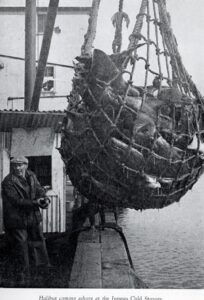
Halibut unloading at Juneau Cold Storage, ca. 1950s. photo credit: Juneau, a Study of the Gastineau Channel Area, Alaska Resources Bd. 1956, p. 72.
Regional salmon fisheries had been declining but a new cannery opened last year was operating with faith in federal run rebuilding efforts. Halibut landings had been close to record, and a new shrimp fishery and smaller crab fisheries contributed to fall and spring employment.
The federal Bureau of Public Roads completed a 26 mile preliminary road survey in August from Thane to upper Taku Inlet and along the lower Taku River to the Canadian boundary, to provide data for a potential highway development corridor linking the coast with the Alaska Highway in Canada. Actual road construction, however, would depend on Canadian actions to survey their portion to connect with the existing road system and provide funds for their share of the construction. No commitment on their part was forthcoming, although a Canadian firm was proposing a power development in the upper Yukon and middle Taku basins that might move the project forward.
Area mining activity was limited to production from the Tulsequah mine up Taku River, which used Juneau as a support and shipping base, but the firm cautioned that weakening metal prices may curtail operations in the next several years unless markets improve. Last year’s report of a rich ore find at a Funter Bay mine was evaluated by several experts, who foresaw good promise of commercial production.
show more
In municipal actions, Juneau’s sewer system was determined to need substantial upgrades to maintain its functioning. Likewise, the municipally-operated water system serving the Starr Hill and nearby uphill neighborhoods was found in April to be contaminated and a chlorinator was advised to be installed. Douglas installed its first two stop lights in early February to slow down speeders. Juneau’s historic red-light district, ‘the line’ was quietly closed in mid-July by city order, and several arrests made subsequent to the order. A gambling raid and renewed enforcement of a youth curfew were the only notable other law enforcement activities duly noted.
However, several fires produced tragic results, one family lost all four children in a house fire along Glacier Highway January 24, an 11-year old boy died in an apartment fire on South Franklin Street June 18, and two adults died August 1 in a house fire on Willoughby Avenue. A potentially serious fire May 17 at the downtown lumber mill was caught early and extinguished before much damage was done. The mill resumed normal operation within two days. Other Juneau residents found themselves victims in a series of airplane crashes outside the area, the most serious being the downing of a U.S. Fish & Wildlife Service plane September 1 south of Juneau in the King Salmon Bay area on Admiralty Island, with 5 persons killed and only two survivors. The Juneau-based mailboat Yakobi sunk March 4 after hitting a reef in Port Houghton 50 miles south of Juneau, but later was re-floated and salvaged. For area fishermen, the previous 1953 salmon season was declared a federal disaster, allowing for three winter food relief distributions made to their families.
A new 36-bed wing was opened April 10 at St. Ann’s Hospital, featuring a modern, up-to-date surgery and obstetrics ward. Following last year’s voter approval of school bond issues, land was purchased for the new Juneau high school, a large federal appropriation made, building plans approved by the school board, and collection of a new school tax begun. A proposal to consolidate the Juneau and Douglas school districts was set out for community discussion and a petition move started to advance the concept. Douglas High School received news in October that the spring edition of its paper The Breeze had won national honors from the National Scholastic Press Association.
In other news, local officials, the Chamber of Commerce, and other southeast Alaska mayors protested vigorously against various occasions of moving federal and territorial offices out of Juneau and other southeast towns. The Canadian Pacific Railroad Company announced the end of its winter steamship passenger service to Alaska with its last sailing September 23, although they will continue their summer tourist cruises. The Alaska Steamship Company, however, announced its decision to discontinue its passenger service completely, leaving no general ship passenger service to the territory, as airline transportation had effectively replaced that service. Juneauites crowded the dock October 3 to wave farewell to the S.S. Denali as it departed southbound on its last passenger service port of call here. Alaska Steam, however, announced the initiation of its new ‘unitized container’ freight service for better efficiency and economy. In perhaps ironic timing, the federal Civil Aeronautics Board agency drew tremendous fire for its December decision to deny Pacific Northern Airlines a permanent operation certificate for Alaska – stateside service, resulting in a big protest campaign reaching to President Eisenhower.
Radio station KINY moved August 18 to a new frequency, 800 kilocycles, making it the only clear channel station in the country, without other stations on that channel. The Empire upgraded its Associated Press wire September 1 to get the “latest news flashes.” The community was disappointed to learn in January that Juneau had been removed as a location for the national Soap Box Derby tryouts (held in Juneau since 1941) , due to not meeting the national organization’s required number of participants (50.) The historic “Old Witch” totem was donated to the city library and dedicated November 23. Tlingit culture classes were started in February by Rev. Walter Soboleff to educate community residents on Tlingit life and customs. Twenty new duplex housing units were opened in Douglas in the spring to help ease a chronic housing shortage. A small fish hatchery was constructed in May at Auke Creek by the Territorial Sportsmen conservation group, to raise trout for area sports fishing enhancement. A classified Army Signal Corps communications project began construction in June of several towers on the Lemon Creek flats.
Prominent visitors to the area in July and August included national Democratic Party head Adlai Stevenson on his tour of the territory to encourage party faithful; Secretary of the Interior Douglas McKay who outlined various federal local and Alaska developments, and was made an honorary Tlingit “chief;” and Philippine Consul General Nicanor Roxas who promoted mutual bonds between the Philippines-US and Alaskan Filipino communities. Mary Lee, born in Klukwan in 1867, died December 9. She was one of the last Alaskans in the territory when it was bought from Russia.
show less