
- 1953
With the election of President Eisenhower and change of administration last fall, B. Frank Heintzleman was appointed territorial governor and was sworn in April 10, replacing long-serving Ernest Gruening. Heintzleman in turn recommended Juneau mayor Waino Hendrickson as his Secretary of State for second-in-command, who was duly appointed. Both men were local residents, Heintzleman first arriving in Juneau in the 1920s to serve with the Forest Service, and Hendrickson being a life-long Juneauite. Previously as the regional forester, Heintzleman had been prominent in promoting the region’s forest and other natural resources, including hydro-power, and for advocating a ferry system for southeast Alaska.
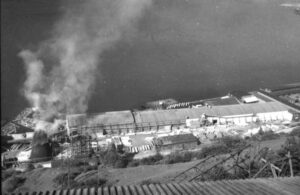
Juneau Spruce Mill and Alaska Plywood plant, Juneau (from AJmill), 1953. Alaska State Library, Trevor M. Davis Photo Collection, P97-0695.
This year saw the construction of Alaska’s first plywood mill which began operations in early July, next to Juneau’s waterfront spruce mill. Earlier in January Japanese investors toured the region seeking locations for one or more pulp mills, and Juneau was among the top choices for either a pulp mill or newsprint plant. Georgia-Pacific Plywood Company also announced plans in August to build a $56.5 million pulp and newsprint plant here, but cautioned that they were only in the beginning long term planning stage and not to expect construction any time soon.
show more
Mining activity was encouraged by report of a rich nickel-cobalt-copper strike in the summer at a small mine in Funter Bay, which could be subsidized by federal aid for mining strategic metals. Small amounts of gold and silver were also reported in the ore composition. Meanwhile the price of gold continued to discourage Alaskan mining operators, so the Alaska Juneau mining company was investigating possibilities to use their assets for possible pulp production, while continuing to sell power to the local private utility from their hydro-electric plants. In fisheries, several processors continued to utilize the local shrimp stocks, although one floating processor suffered a disastrous fire June 20 and closed. A new one-line salmon cannery was built and operated this season in Juneau near the Douglas Bridge, the first new local shore plant built since the 1920s.
Development continued apace to address other community needs as well. Culminating a five- year negotiation period, Juneau took over operation of the airport September 15 from the federal FAA, although that agency would still provide certain designated services. As part of the deal, the city would extend the runway and create an adjoining seaplane basin. Pacific Northern Airlines (aka PNA) started its new Seattle-Juneau flight connection May 21, providing competition to Pan American Airways, which had pioneered that route.
Juneau city government moved into a new municipal building (aka City Hall) on South Seward Street in late March, while the Territory took possession March 27 of the new $1.3 million Alaska Office Building for many of its offices. The telephone company won voter approval November 17 for a 20-year franchise and then announced plans to upgrade to a dial system, though it would not be in place for several years. Several civic groups pointed out a need for a civic center to provide sports facilities, including a gymnasium and indoor heated pool, and a gathering place for youth programs and other community events. One new winter youth program started in January was a well-attended youth rifle shooting and hunter safety program at the indoor small-bore rifle range in the Harborview School basement.
Juneau High School added a driver’s education class to its curriculum. Over in Douglas, the high school boys basketball team, the Huskies, won the SE Alaska championship in March for the first time in 21 years and flew north to Fairbanks for the all-Alaska championship tournament. The school only had 40 students, half of which were girls, so the town considered the championship to be a David vs. Goliath achievement and “was going basketball-dippy” according to a local sportswriter. Putting up fierce competition, they lost to Fairbanks in the final game. School overcrowding issues resulted in bond issues being passed in December for a new Juneau high school to be built near the new Harborview Elementary School and a new elementary school for Douglas, both to be partly funded by increased sales taxes. Construction began in late July in Douglas for 20 duplex housing units, some of which would replace surplus wartime Quonset hut temporary housing used in the interim post-war period. Douglas also completed paving Third Street in July, the main thoroughfare through town.
In other developments, the city’s contractor for its “war on rats” claimed hundreds of carcasses, but advised that he needed permission to operate at the main source of the rodents – the city dump – and stressed the need for better city-wide sanitation and elimination of food sources. Juneau’s mayor warned drivers in January that they could be fined for splashing pedestrians while speeding by on wet or slushy streets. Fires also threatened public safety with one fire threatening the lower downtown business district until it was controlled, while a privately-operated children’s home suffered loss of a dormitory, and the new box factory was destroyed. It, however, would be rebuilt into a concrete products plant. The town was shocked to learn of a gruesome murder in which a depressed mother drowned her two of her four children by throwing them off the steamship dock into the channel on March 20. She was sentenced to 40 years imprisonment.
On a more positive note, the Douglas Lions Club Halloween “Ghost Walk” after its second year was said to have significantly reduced that holiday’s vandalism. Late in the year the U.S. Coast Guard replaced its 83-foot. patrol vessel with a new 95-foot craft. The Air Force used the Taku Glacier in October for survival training. Juneau authorities participated in a west coast civil defense exercise in June, in which Juneau was to be hit with a “small atomic bomb.” A mock bombing was indeed made and various local civil defense units apparently did their best to respond and were commended. Passengers from the Princess Kathleen sinking sued the company in January, while a couple of local divers began salvage of artifacts aboard it in July. Local fisheries authorities assured the public that there was no danger from oil pollution leaking from the sunken vessel. A local dairy farmer declared a successful potato harvest in October in his efforts to develop a commercial farm. After retiring from the dairy business two years ago, Joe Kendler started raising potatoes last season with encouraging results and this year harvested 35 tons for the local market as well as selling them in other Southeast towns. The Capitol Theatre announced September 25 that it had installed the first 3-D movie screen in Alaska and offered suitable films and special viewing glasses for its patrons .
show less