
- 1993
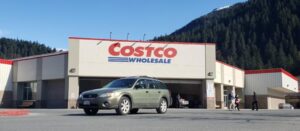
Juneau’s Costco store (read more below.) (Photo by Jeremy Hsieh/KTOO) https://www.ktoo.org/2019/03/28/does-juneau-really-have-the-smallest-costco-in-the-world/
Once again Juneau was faced with the perennial threat of a potential capital move, this time beginning with two legislative bills filed in January by Railbelt legislators. One bill proposed the Legislature move north to hold its sessions “to bring government closer to the people,” but leave the governor and executive branch in Juneau as the capital. The other aimed to move the capital to Wasilla, home of the bill’s sponsor. One Southeast state senator noted that capital move bills come up in the legislature every year, but increased representation of pro-move legislators in the majority this year might make some version actually pop out as law. The bills died, but supporters began signature-gathering drives to put both bills as initiatives on next year’s November ballot.
show more
Countering the capital movers’ initiative movements, Juneau opponents once again geared up with their own signature drive to place another FRANK (Frustrated Responsible Alaskans Needing Knowledge) initiative on the same ballot as a means to let voters know full-disclosure costs of a capital move. That strategy was used successfully in 1982 to defeat a similar capital move initiative then. As this year closed, the drive for the Wasilla move initiative looked like it would succeed in getting the required number of signatures for the legislature to approve the initiative, while the legislature-only move looked to come up short. Juneau-based FRANK initiative proponents lagged in required signatures at year’s end, but vowed to barnstorm the state in the time remaining to collect the necessary numbers likewise needed for their counter-initiative. The deadline for all groups would be the opening of the legislature mid-January 1994.
In another action to try to anchor Juneau’s position as capital city, city business owners and political leaders worked up a plan in May to build a new capitol building downtown on Telephone Hill. But lack of a lease on state-owned land there and other concerns resulted in municipal voters defeating an October ballot measure for a 2 percent tax increase to fund the proposed $50 million structure.
Greens Creek Mine closed in April due to low silver, zinc, and lead prices, although a small crew remained for maintenance and exploration of future ore bodies. Municipal permits to re-open the Berners Bay Kensington project and the downtown AJ mine were approved, but another set of decisions by the federal Environmental Protection Agency and the Army Corps of Engineers were challenged by a coalition of environmental, neighborhood, and other groups, which filed suit against the agencies for not complying with the federal Clean Water Act of 1971. The agencies had determined that neither developer needed permits to discharge waste water and tailings behind impoundment dams. At year’s end, the cases had yet to be scheduled, but both sets of developers promised to keep on planning in confidence that the permits would be upheld.
Price-Costco Co., a nation-wide bulk quantity store chain, opened its first Southeast Alaska warehouse store in the Lemon Creek area. Local state ferry personnel noticed a large upswing in traffic to Juneau after Costco’s opening in November compared to the previous year, with traffic reminiscent to the peak summer tourist season. Two personal shopping services also sprung up since the Costco opening to provide out-of-Juneau residents opportunity to get discount and bulk merchandise orders shipped to them. Meanwhile, late in the year the two local Domino’s franchise pizza stores scrubbed the national chain’s earlier marketing guarantee to deliver their pizzas to customers within 30 minutes. This was following headquarters’ response to losing several large liability lawsuits down south where plaintiffs held that the claim resulted in reckless driving and subsequent accidents by some delivery drivers. Local franchise owners noted that local weather conditions didn’t always allow that guarantee to hold anyway, which they had regularly suspended the guarantee earlier for safety reasons, so they were glad to drop it as per headquarters request.
New technology continued to be introduced in various sectors to upgrade communications and infrastructure, but not without some hiccups. The new upgraded state telephone system set up late last year for direct-dialing to state employees, initially caused more confusion than help early in the year when the public found it impossible to connect with state operators, and employees found it difficult to make call transfers and use fax communications. Within the first week installers fixed most of the problems. For the city water system, several major pipe bursts just before Christmas resulted in scores of residences incurring water damage with large damage claims filed. The city’s new computerized, radio-controlled water operation had been plagued with problems and cost-overruns, but at year’s end the city water operations supervisor assured the public that most of the bugs had been worked out of the control system and that new stronger valves would take care of the pipe bursts. The new automated weather observation equipment at the airport failed to live up to expectations for improving flight services. Alaska Airlines, in particular, complained that the equipment did not see the whole picture as would a trained human weather observer, and had caused unnecessary flight delays and disruptions. In mid-December they requested FAA to continue using human observers until the system problems were fixed. The local National Weather Service spokesperson hoped that the $100,000 machines could be adjusted to remedy the problem.
The university announced in October that for a low monthly subscription, the public could now tap into the internet through its system, previously limited to university staff and students and government workers. The university also offered a two-credit course on how to use the internet.
Placement of “Daddy’s Roommate” (a children’s book about gay relationships) in school libraries provoked a storm of controversy, swelling from parent groups to public libraries and into public hearings before the school board. The final decision of the board was to accept it for school libraries, but place it in sections less likely to be frequented by young children. Tolerance for diversity was also addressed by the Assembly when it approved formation early in January of a borough Human Rights Commission to address discrimination, after several years of planning, hearings, and efforts by human rights activists to bring attention to the subject. As formulated, the commission appeared to be long on education and short on enforcement, a move proponents found disappointing, after proposing a strong human rights law and a high-powered commission to enforce it.
Juneau enjoyed the warmest year on record, with all twelve months having above-normal temperatures, and set a new average yearly temperature of 44.2 degrees. El Nino conditions off the western South American coast were attributed for the warm conditions, even as far as Alaska. A warm spring and summer resulted in gardeners enjoying harvests of corn and pumpkins, unusual for the area. Outdoor recreationalists, however, noted a downside to the warm conditions, which seemed to result in an explosion of insects, particularly no-see-ums and biting flies. And extra-dry conditions may also have caused power line grounding around the Snettisham power towers, which seemed to be correlated to an unusual number of mystery power outages that plagued Juneau over the season. The warm spring and summer seasons were bookended by more precipitation than usual – in fact it was the third wettest season on record, only behind 1991 and 1992.
show less