
- 1980
Juneau celebrated its centennial year from its founding as a gold camp in 1880, culminating in special events centered around the traditional 4th of July activities. Foremost was the presentation of “Happy Birthday Juneau,” a community-produced show featuring scenes and songs commemorating Juneau’s 100-year history through the years. Local baker Joe Behar created a 34-foot eight-inch high, six-ton birthday cake (a world record to that point) for the October founding day celebration October 4. After he’d spent four months planning and preparing the cake, appreciative party-goers reduced it to crumbs in a few hours. After several decades of discussion, the proposal to build a true community center moved into the serious planning stage, including the commissioning of two totem poles to be erected at the soon-to-be-built Centennial Hall.
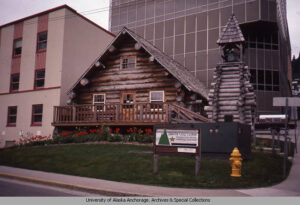
Davis Log Cabin, built as a 1980 centennial celebration project to house a visitor center, Juneau. Ruth A.M. Schmidt papers, Archives & Special Collections, Consortium Library, University of Alaska Anchorage. UAA-HMC-0792-b6-f52-sheet1-04.
Another major centennial project was the building of an exact replica of an iconic early Juneau building – the log cabin church cum carpenter shop, school, and brewery office. The completed building, situated close to the original location on Third Street, opened October 11 and became the headquarters for the Juneau Chamber of Commerce and visitor center.
show more
Besides focusing on its centennial year, several other topics became major concerns for residents. Probably the most fractious debate ended up dividing the community as few other issues, all over the matter of time. Last year, the U.S. Department of Transportation, which sets national time zone boundaries, declared that it would move northern southeast Alaska towns to Yukon Time April 27 from the present Pacific Time zone, ostensibly to link the area closer to westward Alaska connections and the Yukon itself. An anti-time change citizens group formed to oppose the change and got an initiative on the ballot for a special borough election to keep the borough on Pacific Time and forbid it to seek any changes. The initiative passed overwhelmingly March 28 but the federal change still went into effect. Despite the official change 40 or 50 local businesses continued to use Pacific Time, adding to the confusion and contention. In July, the federal DOT held public hearings to find evidence for reversing their decision, primarily if the change had adverse effects on commerce and transportation. The borough assembly agreed to support the Yukon Time change, but immediately ran afoul of the anti-time change group that ended up calling for recall of opponent assembly members and the mayor. In the meantime, U.S. DOT kept the change, the city protested (not hard enough for the recall group), a recall election was held August 26, the mayor and assembly survived the vote, and finally the feds reversed their decision and all went back to the original Pacific Time with the normal change from daylights savings time October 26 (later to be changed again to Alaska Time).
The perennial issue of housing shortages once again became a hot topic, particularly after the state housing agency proposed to convert some of the apartments in one of its low-rent apartment buildings to office space and started eviction proceedings in July. Tenants sued for an injunction against the evictions, but it was denied in August. Housing reforms were proposed, the city resolved to seek more funding for more low and moderate cost housing, but the issue remained unresolved by year’s end. (Housing shortages and insufficient office space have been cited as major obstacles to Juneau’s growth and added fuel to the fire for pro-capital movers.)
Firewood availability was another unexpected but burning issue. Wood heating had grown considerably and suitable accessible timber for cutting into firewood was steadily decreasing, so the Forest Service and the borough set up areas last fall to provide downed timber for residents to use, with an inexpensive permit system. Shortly thereafter, the system was abused with rampant timber thefts and vandalism, and the issue continued to smolder. Rat control surfaced again in April as a perennial issue as city and state agencies publicized the problem with education on control by eliminating food sources and habitat. Neither the borough or the state had a specific control program in place, but several private pest control firms provided that service for clients.
In other borough/municipal issues, the year started out with the downtown area going dry as pipe leaks, pumping issues and water reservoir drainage combined to shut off the water supply temporarily. Water flow was quickly restored, but water issues remained for some time. One solution was the completion of a city water reservoir made from an abandoned AJ mine tunnel, a project which started three years earlier, but had been plagued with leakage issues. The tunnel was filled in November from well water pumped up from Gold Creek, then distributed through the city main system. A comprehensive water system designed to deliver water to the valley and other outlying areas was delayed by voter rejection of two bond issues October 7, due to perceived tax increases, but the city resolved to continue planning to implement it. The city had also filed for water rights in April on Nugget Creek near the glacier as a potential source for valley water.
Juneau-Douglas Community College downtown and the SE Senior College in Auke Bay merged in July to become the University of Alaska Juneau. Auke Bay Elementary School was closed in the spring after engineers determined that the foundations were resting on unstable soil, resulting in “severe (building) distress,” which could lead to potential catastrophic structural damage and collapse. Classes were shifted to other locations and would continue into the next school term as necessary until repairs were completed. The new school year also started with threat of a teacher’s strike, which was averted when the union and school board agreed to a compromise contract through professional mediation.
In January the borough approved of a sales tax exemption for seniors as a way to help them cope with the high cost of living and to enable them to remain in the area. An alcoholic treatment center was opened.in April and a center for youth in crisis was opened in December. The borough and state agencies raised concerns over Native corporation land selections by asking for public access easements for certain areas of long-time public use. Land use permits were granted by the borough for a rock quarry near Douglas for material for the new Douglas bridge construction work, for a mining development at Sheep Creek for working old mine tailings by the beach, and for exploration of the historic Treadwell ore deposits. Some excitement was raised from the announcement in December of discovery of new potentially rich ore deposits in the Tulsequah district up Taku River, last worked in 1957.
Douglas Island Pink and Chum (DIPAC) expanded to construct and operate a new salmon hatchery by Sheep Creek at Thane. Northern Southeast Regional Aquaculture Association (NSERAA), the regional hatchery association based in Sitka, also built a new hatchery at Salmon Creek and dedicated it November 25 to raise chum salmon for commercial fisheries and a facility at Twin Lakes to raise coho for sport fishing. Speaking of fishing, fishermen, broadcasters, and listeners alike were incredulous to learn in mid-June that the FCC determined that traditional radio coverage of the salmon derby would be illegal henceforth because of their rule banning “discussion of lotteries,” even for charitable purposes. (Since the derby is a fund-raiser for scholarships, for which prizes are awarded, the normal derby radio banter would somehow be promoting “lotteries.”)
Businesses expanding or re-locating in the airport area to serve the growing population along Glacier Highway and in the valley had been a growing trend, with a reduction of businesses in the Juneau downtown. For example, Don Abel hardware store closed its older downtown store September 1 to move to its other valley location, and the historic Behrend’s Department Store closed permanently in September, citing lack of a need for a full-time retail department store in Juneau. The building instead was leased to the state Legislative Affairs Agency to be remodeled for state legislative offices, well illustrating how downtown locations were being taken up by government offices and tourist businesses. In a similar development the Taku Twins theater was sold in November to be re-purposed into another state office building for the fish and game department. The closure would leave downtown Juneau without a major movie theater, so owners of the old Twentieth Century Theatre, which had closed nearly a year before, were considering re-opening it (they did.) Owners of the Taku Twin Theatre, however, indicated that they would open a theater in the valley, although no details were forthcoming. With downtown development limited, growth naturally was extending north along the highway corridor and valley areas. National chains were also taking note of opportunities, including Fred Meyer and McDonald’s corporations which were scouting the area for locations to open.
One of the largest maritime disasters in Alaska occurred when the Prinsendam, a frequent cruise ship visitor to Juneau, caught fire October 4 in the Gulf of Alaska while home-bound on its final tour of the season. In the biggest rescue of U.S. Coast Guard history, all 529 passengers and crew were safely rescued, but the ship later sank while under tow for salvage.
Alaska’s first Filipino leadership conference was held April 21-26 for community representatives across the state gathering to not only share Filipino cultural heritage and activities but to learn how to step up into leadership positions in community and governmental affairs and influence local and state government. Over 200 people attended from Alaska, Hawaii, and other stateside communities to listen to state and national leaders share their expertise. Sealaska Corporation sponsored the creation of the non-profit Sealaska Heritage Foundation in November, (now the Sealaska Heritage Institute), in Juneau to manage its cultural and educational programs.
In other news, KTOO FM radio initiated live satellite broadcasting locally on a New Years Eve jazz program. Using new technology, the broadcast quality was equal to stereo recordings used earlier as the standard, but few listeners were probably aware of the change. Capital City Weekly was born October 8 as the eight-page Thrifty Nickel.
show less