
- 1961
As noted last year, the capital move issue continued on with a life of its own, as Anchorage boosters’ petition to move the state capital westward from Juneau was certified in November. They now must gather signatures from 10% of state voters from the last election (when the move initiative was defeated) for an initiative to be placed on the 1962 state ballot. The main provision was to move the capital from Juneau to a to-be-determined location west of 141st longitude, but no closer than 30 miles from Anchorage. Juneau was thus served notice not to slack in their determination to improve their community image and infrastructure to retain their favored position.
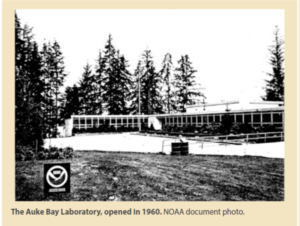
Auke Bay Biological Laboratory, U.S. Bureau of Commercial Fisheries, NOAA document photo, from ‘A History of Federal Marine Fisheries Research in Alaska1725-2010’, p. 30.
Early in the year, the Juneau Chamber of Commerce outlined a six-point plan to “bring the capital back to Juneau in fact, as well as in name”, referring to the transfer of government jobs to Anchorage in the past few years. Chamber President Pete Warner stressed that, “It is no longer just enough to hold on to what we’ve got, we must reach out to build and create a much bigger, better, and more prosperous channel area.” Under the slogan “Get’er done in ’61”, the organization’s plan called for creation of more housing and office facilities, airport improvements, increase power development through the Snettisham project, development of new tourist attractions, support for the state ferry and highway systems, creation of adequate parking facilities, and get approval for new boat harbor funds.
.
show more
In June Juneau voters approved re-amending the city’s charter back to a “strong mayor” form of government and passed a bond issue for $240,000 to pay off city indebtedness. In last year’s city election, the city’s charter was amended to change the government form from a mayor/council form to city manager/mayor/council form, but it proved unpopular and seemingly unworkable, during which time the council appointed two temporary mayors: J. Wayne Johnson and A.W. Boddy. This time, Larry Parker was re-elected again in a special election as mayor. Parker had been elected previous to the government changeover as mayor, then appointed as city manager by the council with the charter changeover, before regaining the primary office. The “strong mayor” will have strong administrative powers for city operations, while the council advises on policy.
Airport improvements completed this season included runway lengthening and installation of improved navigation aids in anticipation of new jet service in the coming year. The Juneau City Council also pushed for the development of the federal Snettisham power project and passed an ordinance to renew Alaska Electric Light & Power’s electrical franchise, which was subsequently approved by the voters November 7. Mayor Parker also announced in October that the main AJ mine tunnel was being evaluated for use as a fall-out shelter, in local civil defense planning. Civil defense training for residents was provided in December, and record high fallout (14.37 microcuries/m³ of air) in the Juneau area was recorded shortly thereafter, although not at a critical level. Monitoring had begun in 1958 in response to international atmospheric nuclear testing.
Juneau also switched to a new water supply system in late August when two wells at the lower end of Last Chance Basin were connected to an old mining tunnel between there and Evergreen Bowl. Water flowing through the sealed Jualpa tunnel to the chlorination plant was pumped up to city reservoir tanks above the city to connect to the regular distribution system. The million-dollar project took months of torn up streets and water mains, but Mayor A.W. Boddy said at its completion, “Juneau now has the finest water obtainable.”
Transportation developments included the Alaska Steamship Company announcement in February that they were now providing through van service between Seattle and southeastern Alaska for increased cargo-handling efficiency. In late February Pan American World Airways closed its Alaska operations pending settlement of a strike by its flight engineers. Passengers with reservations were to be transferred over to Pacific Northern Airlines, which was unaffected by the strike. In July, directors for Alaska Coastal Airlines and Ellis Airplanes approved a merger to unite service in Southeast Alaska. Together they will be operating the largest airline in the world exclusively using amphibious aircraft.
In April, the Alaska Communications System announced the completion of a four-year program to upgrade its long-distance telephone switching network from local manual operator-assist to automatic switch connections. The system cut the time in half to place calls with much better- quality connections. The end of May, KJNO radio began 24-hour operation to better serve the area, with continued coverage of its format of “good music, news, weather, and sports coverage, in addition to special events.” In August, two electronic engineers were in Juneau to survey the area to provide better radio and tv output for KINY. New equipment being purchased should provide adequate coverage for the airport and Mendenhall Valley areas. Anticipated completion of the new installations was expected by the end of the year.
The U.S. Bureau of Commercial Fisheries opened its new Auke Bay Biological Laboratory in February as a center for Alaskan fisheries research. The University of Alaska was also planning to open a marine research station in Douglas, using the old Mayflower School building for their first shore station. Federal offices began moving into the old 5th Street School building for temporary offices, until the new federal building is built on the site of the old Fireman’s Ball Park. Local Juneau architect firms of Olsen, Sands, and Linn Forrest got contracts to design the $15.7 million federal building. Residents outside of Juneau on the Glacier Highway out to Tee Harbor began receiving daily mail delivery service in July. Over in Douglas, a local investment group, the Island Development Corporation, financed and built a large office building on the site of the city old ballfield to provide office space for the state’s department of highways. Corporation president Val Poor exclaimed, “It means new life for Douglas. It will completely change the area.”
In June Georgia-Pacific Corporation abandoned plans to build a pulp mill/newsprint plant in the area and dropped its lease of Admiralty Island timber, acquired in 1955. Local supporters of the proposal had great hopes that a new primary industry would locate to the area for a major boost to the economy, but G-P finally bowed out, citing poor economics for the project.
In other commercial developments in the area, Ronald and Larry Hurlock announced in September that their family’s “Hurlocks Happy Henery” would remain open to supply the area with fresh eggs. After their father, Roger Hurlock, stepped down from the business to join a Hollywood studio firm, the business was due to close, but merchants prevailed on the family to continue to supply local needs. In November, B.M. Behrends Bank announced the opening of the first drive-in bank window in Southeast Alaska. Notice to would-be bank robbers – the structure was reinforced concrete and the teller window had 1 ½ inch bullet-proof glass.
In January Steep Creek basin was recommended for development as a ski area for its “ideal skiing conditions and scenic value without peer” by an international expert on winter snow and ice conditions in a survey commissioned by the Forest Service. The Forest Service also sought a bid for a Mendenhall resort with a 130-room hotel (never developed). A gondola lift to Steep Creek was also proposed. Recreational improvement projects for the district covered a wide scope of activities for this fiscal year, including construction of a large visitor center by the glacier, major campground and picnic area improvements, and extensive trail maintenance and development projects.
Tourism development also figured in as an important contributor to the local economy. In early May, Juneau, in conjunction with the state, hosted a travel agent convention to promote increased tourism for benefitting the economy, and a local “Tourist Host School” was conducted to acquaint volunteers with the value of tourism, help them better understand visitors’ needs, and provide training in hosting them. In another step to welcome visitors, 125 flower baskets were displayed by mid-summer from local shops to beautify Juneau, with hopes to make it an annual event. A total of 58 vessel sailings were made during the season from mid-May through late September, with a local greeter service welcoming each ship. By the end of the year, a special tourist committee of the chamber of commerce was seriously planning a tourist attraction at the old A-J mine camp off Basin Road to combine a theatre performance with a mine tour.
Mendenhaven in the Mendenhall Valley opened in February as the valley’s first major suburban housing development, with FHA financed two-bedroom homes selling for $23,875. A total of 262 new homes were constructed this year, most of them in the airport area, Loop Road, and Douglas. Construction of an apartment building on tidelands in Juneau was halted in June by restraining order. In August, work to construct homes in West Juneau was put on indefinite hold by the developer, who claimed the city failed to deliver on its promises to provide utilities and streets there. The city pleaded lack of money to follow through, but felt that they would be able to budget adequately for it in the next year.
Sub-standard “fire-trap” housing was decried in several Empire newspaper editorials following a tragic fire in the “Indian Village” in May, which claimed six lives. The city officials said the problem (poor housing) was an old one, but one obstacle to obtaining government funding to provide adequate housing was that villagers had no title to their land and dwellings. Originally the land was occupied before the city was founded and it was given to them by the government, then handed down through families, without the benefit of titles. Village spokesmen have requested city help in obtaining titles and in providing housing assistance and municipal services. City officials were sympathetic in their response, but the issue remained unsolved.
The Juneau Receiving Home was organized in January to provide housing and care for children in need and received a 5-year lease of city property in July. Out in Berners Bay, the McMurchie family willed their 247-acre ranch at the mouth of Cowee Creek to the Gospel Missionary Union to develop as a retreat and youth training center (now Echo Ranch).
School enrollment for Juneau-Douglas set a new record, 2,462 students. The high school’s basketball team won the state’s Alaska Gold Medal Championship in March and were welcomed back to town by hundreds of well-wishers. The new additions to the high school building were dedicated in May, which included a third story addition, auditorium, and gymnasium. The school board also announced that a half-million-dollar elementary school was to be built in the airport area as the school population from there on out had increased greatly. A special survey of J-D High students by the school’s journalism class showed that the students collectively grossed over $380,000 in earnings last year, averaging $600 per student, with the highest spending category being a surprising 29% going into their savings accounts. Purpose of the study was to show advertisers in the J-Bird, the school’s paper, how teenagers earn and spend their money. At the junior high level, a photo story in a Japanese school magazine, that featured two Juneau students at the Mt. Jumbo School, resulted in a flood of 1,800 letters from Japanese students asking for Alaskan pen pals. Mt. Jumbo students at last report were hard at work responding to each and every letter.
In community cultural events, the annual Rizal Day banquet in January, celebrated by Juneau’s Filipino community to honor the Philippine Republic’s nation hero, has become a major Juneau event attended by many local notables. Alaska Secretary of State, Hugh Wade, in his talk there summarized the community’s contribution well: “you are an important and influential part of our schools, churches, our social organizations, and our business and industrial life”. Mt. St. Elias Dancers from Yakutat drew large enthusiastic crowds in April to view their performances of authentic tribal dances. In a concluding ceremony, Gov. and Mrs. Egan were then adopted into the Tlingit tribe.
A residential fire in the Willoughby Avenue (Áak’w K’waan village district) in May claimed the lives of a young mother and five of her seven children. In June, the 52-foot troller, Josephine I, was destroyed in a spectacular fire while crossing the Mendenhall Bar channel, en route to the fishing grounds. The operator-owner, Philip Lesher, escaped uninjured. Juneauites Gale Good and Roger Morris fell eighty feet into a crevasse as they were crossing the Mendenhall Glacier and spent 24 hours there before being rescued by helicopter. Flooding in September washed out a Back Loop home and residents responded to help in restoring it. A Juneau family of five was lost in October when their 42-foot troller sank in Icy Straits near Lemiseur Island.
The Juneau Police Department was certainly surprised and probably rather embarrassed in early March when state troopers cited two city patrol cars for operating without valid license plate tags. The complaint was dismissed after the state magistrate’s court was satisfied that the department had subsequently remedied the problem. In April state troopers investigated a mysterious case of a shooting of a mother of three children at their Lemon Creek residence. Upon arrival, the woman was incoherent with a bullet wound in her side, while her three children lay sleeping. Rushed to the hospital, her condition was found non-critical. Investigators found half dozen bullet holes in the wall of the house. Her husband was not at home at the time, and police concluded that the wound was probably self-inflicted. In July, Douglas contracted with the state’s department of safety to pay for services of a state trooper to provide patrol and other police services. In November, Juneau police reminded parents that children were prohibited from playing with sleds, skis, and other such devices on snowy or icy streets to prevent accidents.
Vandals also made the police blotter in several cases. In April two youths confessed to shotting at an insulator on the power line at Thane, causing several thousand dollars in damage to the system and plunging the area into darkness for several hours. Two persons were trapped in an elevator at the Baranof Hotel after the power failed, but were rescued shortly afterward. “Man, it was dark in there,” exclaimed one of the involuntary occupants. A month later, vandals also burned a car left in the Dredge Lake area after the engine had broken down. Police had checked a party of juveniles in the area earlier, and were investigating a possible link to the vehicle destruction.
Juneau area sport fishermen were advised by the Alaska Dept. of Fish & Game in early August that 13 streams along the Juneau road system were thereby closed to salmon fishing to protect spawners, because dry stream conditions hindered spawning. They could still fish for trout and char, however. The department had good news as well when they reported the successful stocking of 20,000 small steelhead trout into Peterson Lake, about 20 miles north of Juneau. After they finish freshwater rearing, they’ll head out to sea, hopefully to return later as sportsman’s trophies (the run succeeded, but low returns in recent years have kept the fishing season closed for them.). The Lena area garbage dump also made the news as the dump had been attracting quite a few scavenging bears, which in turn attracted large numbers of bear-viewers. Wildlife biologist Jim Brooks advised people to remain in their vehicles while bears were nearby, that it was illegal to shoot bears there, and in general people need to leave unburned garbage indoors at night so as not to attract bears.
On the lighter side, KINY sportscaster Bill Hess apparently set a world record in February for theater marque sitting in his attempt to raise funds for paying off the debt for the city basketball league. The league’s recent attendance had been deplorable, and Hess vowed to continue to remain at his perch above the 20th Century Theatre until $2,000 had been raised. In May, Foodland and the 20th Century Market displayed the largest hot dog in Juneau, a six-footer made by Bar-S meats, to promote their weekend hot dog sales at the stores. In mid-September, two adventurers drove to Juneau in their amphibious jeep on their way north. The pair, one from Germany, the other from Austria, say that they are the first to “drive” the Alaska Marine Highway in such a manner and had logged 332 nautical miles so far. They had explored Central and South America in previous expeditions with the stout vehicle.
show less