
- 1973
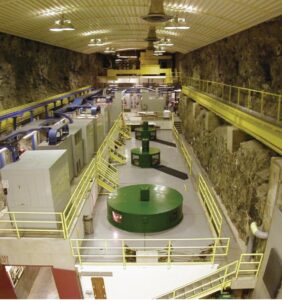
Snettisham hydroelectric facility – interior view of generation plant. photo credit: https://www.aidea.org/Programs/Infrastructure-Development/Snettisham-Hydroelectric-Project
The federal Snettisham Hydroelectric Project was completed, which tapped alpine Long Lake to feed the sea level power plant and was connected to Juneau via a 44-mile transmission line (later nearby Crater Lake was tapped as an additional hydro source). Power was sold to AEL&P, which in turn distributed it in the Juneau area. A-J Industries (successor to the Alaska Juneau Gold Mining Co.) sold Juneau property holdings and hydroelectric facilities to Alaska Electric Light & Power and the City and Borough of Juneau.
The airport expansion added a ramp extension and additional terminal space. In response to a flurry of airline hijackings around the nation, increased security measures were implemented early in the year at the airport following new federal regulations. Actions included inspections of all hand-carried packages and luggage, and passengers had to pass through a metal detector before being allowed to board an aircraft. Local small passenger aircraft flights were exempted.
In December Sealaska Corporation received its first installment of the act’s monetary provisions, initially investing it in various financial securities.
Augustus Brown (indoor) Swimming Pool opened the winter of 1973. Floyd Dryden Junior High School, in the Mendenhall Valley, opened in late February. Juneau had its first world premiere of a first run motion picture opening in January when local filmmaker Chuck Keen presented his original movie Timber Tramps, a story of loggers, filmed entirely in Alaska locales with minor Hollywood actors. Keen had premiered at least one earlier movie of his, Jonico and the Kush-Da-Ka in 1969, but it was not considered to be a “first run” category movie.