
- 1932
Juneau’s first bank robbery occurred January 23 when the B.M. Behrends Bank was held up, but the robber was shot and killed in trying to make his escape.
Four men narrowly escaped with their lives April 17 when a snowslide swept down upon the messhouse and drying house of the Alaska Juneau Camp No. 1 in the Gold Creek Valley. The three buildings were totally destroyed. William Black, cook, was working in the messhouse and three others were asleep in the bunkhouse until aroused by George Bacon who was carrying supplies to the camp and saw the slide coming.The compressor house and blacksmith shop, about 300 feet from the bunkhouse, were not touched. Camp No. 1 is about half way between the Alaska Juneau boarding house in Last Chance Basin and the Perseverance mine camp.
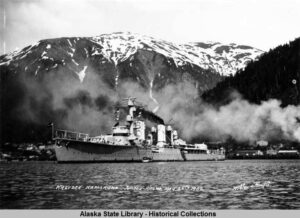
KREUZER KARLSRUHE, Juneau, Alaska, May 25th, 1932. Alaska State Library, Winter & Pond Photo Collection, P87-1625.
The German cruiser Karlsruhe, with a complement of 560 officers, cadets and enlisted men, dropped anchor in Juneau’s harbor May 19 for a visit of 11 days. Welcoming festivities included concerts by the ship’s band, and tours, receptions, and dances for the crew hosted by local groups.
With the arrival from Seattle of the seaplane Chichagof April 5, belonging to Alaska Southern Airways, Juneau was established as a commercial air base. The Baranof, a seven-place sister ship of the Chichagof, arrived about six weeks later. The German flying boat Groenland Wal landed in Juneau August 22 on an around-the-world flight.
show more
The Juneau City Council voted June 3 to issue a warning to all steamship companies that stowaways won’t be allowed to land.
The Pacific Steamship Company’s private roadway, which ran from Carroll Way north alongside its wharf, was offered to the city for a street by the company October 7. The city accepted the gift and named it Marine Way. The erection of an overpass over Calhoun Avenue at the end of Fifth Street was completed by the city crew December 13 to afford school children a safe passage over a thoroughfare with heavy auto traffic. The new (wooden) bridge over Lawson Creek passed final inspection October 15 and was formally accepted by the U. S. Bureau of Public Roads (It was subsequently replaced with a concrete bridge in 1935 in conjunction with the building of the Douglas cross-channel bridge). Auto license fees in Juneau for 1933 were reduced in December from $10 to $5. The city license was in addition to the territorial license fee which was $10 for cars and trucks except those carrying passengers for hire, which was $15.
The Juneau Business College opened August 29 on the top floor of the Goldstein Building. Courses included bookkeeping, accounting, shorthand, typing, business English, spelling, and penmanship.
U.S. Signal Corps telegraph service began 24-hour continuous service March 1.
Ten thousand eastern brook trout fry arrived September 19 from the government hatchery at Yes Bay, near Ketchikan, and were planted in local lakes. including Auke Lake, where trout had been planted in past years, and several smaller lakes in the Mendenhall Valley which had been barren of fish life. Others were to be planted in Dorothy Lake and Lake Hasselborg.
Taku Harbor cannery of Libby, McNeil, & Libby was destroyed by fire May 9 with a loss estimated at $250,000. Preparations were under way at the cannery for the opening of the season. (but it was re-built and operated until 1947).
show less