
- 1969
Alaska Secretary of State Keith H. Miller was sworn in the capitol as Alaska’s third Governor January 24, the same day that former Governor Walter J. Hickel was sworn in as Secretary of the Interior in President Richard Nixon’s administration. Hickel had just resigned to accept Nixon’s offer to join him in Washington D.C. Richard W. Ward was then sworn in to replace Miller as his new secretary of state.
A Japanese fishing vessel was apprehended in the channel February 7 as it came into town seeking fuel and provisions. Its unexpected arrival caused a flurry of action as Coast Guard and fisheries officials boarded it to find out how it had arrived here unannounced and inspected it for fisheries violations. Not having sought permission to enter U.S. waters and having 500 pounds halibut aboard taken from the Gulf of Alaska violated U.S. navigation and international fishing treaty regulations, so the boat and crew were detained several days until it was sent back to Tokyo for their government to deal with the violations.
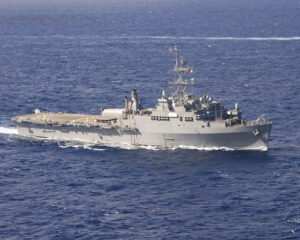
USS Juneau, LPD-10, underway at sea on 22 April 2005. source – U.S. Navy photo, Navsource.org. public domain.
The USS Juneau (LPD-10), the third U.S. Navy vessel to be named after Alaska’s capital city, was commissioned July 12 at Bremerton Naval Yard, Washington state. Serving in many deployments over the years, including assisting in the Exxon Valdez oil spill cleanup in 1989, the ship was decommissioned in 2008.
Five people were dumped into the water when their 18-foot skiff collided with a whale off Coghlan Island June 10. The whale escaped unharmed but one person was injured, the skiff’s keel and planking were broken and it had to be towed back to Auke Bay by the Coast Guard.
show more
A charter proposal for unification of the “home rule” cities of Juneau and Douglas and the Greater Juneau Borough was flatly rejected almost 2 to 1 by the voters April 15. A charter commission had labored over a year to craft a suitable document but was basically told by citizenry “back to the drawing board”. They then had another year to do so before another vote in the spring of 1970.
A job study for the period 1961-1968 showed that while Juneau gained 374 state and federal jobs and had more than Anchorage initially, Anchorage gained 1,087 more in the period and had more of these jobs than Juneau. Government jobs altogether comprised about two thirds of Juneau’s total payroll. The study concluded that with continued threats to move the capital from Juneau, residents should renew efforts to provide “a favorable climate in the Juneau area for government.”
Juneau’s city election October 7 produced historic firsts with the election of Robert Loescher and Carl Nelson, both Alaska Natives, to the city council, the first time any Alaska Natives won council election and now could provide direct input into city governing affairs. Loescher, 20, was also the youngest council member ever elected. Judy Franklet, a local Alaska Native teacher, was also elected to the school board, again a first for Alaska Natives. Franklet had earlier been an advocate for introducing Native culture and language studies into the area’s school curriculum.
Juneau earlier had been named as one of 150 “Model Cities” in the country to receive considerable grant funding to improve living conditions, particularly for lower income and minority residents. Neighborhood councils were organized for residents to determine planning and funding priorities and to increase minority representation in those efforts. Urban renewal continued forward when a funding contract was signed in March for federal grant funding from the Department of Housing and Urban Development (DHUD) to acquire properties in the area between the federal building, bridge and harbor area. Condemnation proceedings were then initiated in the fall to buy out properties in that area. The first phase of the Outer Drive project was dedicated July 15 to open up the expressway from Main Street to Twelfth Street. Planning continued for the extension out to the airport, with several hearings held on proposed routing of the project. The borough revised their zoning July 2 of the Indian Point area in Auke Bay from a proposed residential zone to a recreation zone, based in part by testimony from local Tlingit people as to its importance in their history and culture, including a burial area there.
The Southeast Regional Correctional Institution (now Lemon Creek Correctional Center) was dedicated at Lemon Creek July 1 for short-term offenders. Those with longer sentences were still sent to federal institutions in the lower 48 states. Shortly after its opening, prisoners there complained about lack of recreational facilities, including lack of an outdoor area for fresh air, and lack of communication with correction staff. State of Alaska’s two-level parking garage opened up in September in Juneau with a net gain of 30 parking spaces at a cost of $345,708, or $11,523 per space. The old state jail in the federal courthouse atop Telephone Hill was torn down in December in preparation for construction of a new state office building.
U.S. Plywood-Champion Papers Corporation announced plans in December to construct a $100 million pulp/sawmill at Echo Cove in Berners Bay. Graduate courses were added to Juneau Community College curriculum. Deserted buildings at the AJ mine were destroyed by fire. Juneau hosted the world premiere February 5 of local filmmaker Chuck Keen’s movie Jonico and the Kush-Da-Ka, a story based on Alaska Native legends that he filmed in Southeastern locations with local actors. The state museum hosted a five day workshop the end of March on NW Coast Indian Arts featuring several leading craftsmen and artists, including carvers and a blanket weaver. Lectures would be supplemented with hands-on workshops at the high school in conjunction with the school’s Indian Arts and Crafts class. In August the museum partnered with ANB to begin a program to video record “The Way Things Were” from tribal elders about Tlingit and Haida legends and old customs.
show less