
- 1963
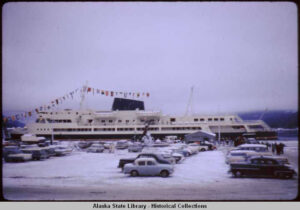
Inauguration of Alaska Marine Highway ferry Malaspina, Juneau, 1963. Alaska State Library, Caroline Jensen. Photographs, P417-131.
The M/V Malaspina, the first of the Alaska Marine Highway System’s ferries, arrived in Juneau January 24 on its maiden voyage to inaugurate the opening of the system with appropriate ceremony and a large crowd of welcomers. A new downtown ferry terminal was constructed and opened in October for operation, giving Juneau an additional port to the original Auke Bay terminal. In May a large group of travel writers and photographers visited Juneau on the Malaspina to commemorate and publicize the new ferry system and promote regional tourism.
Promotion of Juneau area tourism spurred development of new attractions and accommodations this year. The Gold Creek mine tour begun last season, with a local theatre group melodrama play, expanded to a full-season tour complete with a narrated mine train tour through the mountain from Last Chance Basin to an overlook above the old AJ mill. The new Forest Service Mendenhall Glacier Visitor Center, featuring the only glacier-interpretation center in the country, attracted world-wide attention from the thousands of visitors from all points of the compass since it opened last season. With the inauguration of the ferry system, visitors also have made full use of the newly expanded camping facilities as well as the many hiking trails the area has to offer. The Forest Service continued planning for a large hotel-recreation complex by the visitor center with a gondola lift to access the Steep Creek basin for a ski area development and a summer alpine experience. Plans were also being advanced to break ground next year for a million-dollar luxury lodge-resort along the banks of the Mendenhall River near the Glacier Highway crossing.
show more
In July the U.S. Navy visited Juneau with a group of two destroyers, a submarine, and an aircraft carrier. The 3,200-man contingent spent three days liberty in town while hosting thousands of area residents to vessel tours. Three of the carrier’s jet helicopters made a side trip to deliver supplies to a scientific research group on the Juneau icecap. The Navy’s visit was preceded by a March visit of two Canadian frigates on a combined good-will tour, shakedown cruise, and cadet training mission.
Juneau area mariners were benefitting from two boat harbor projects. The long-planned Douglas small boat harbor was finished in the summer and the city was taking applications for stall rentals. Juneau’s harbor expansion was well underway with dredging proceeding to carve out boat basin no. 2 (the future Aurora Harbor) adjacent to Harris harbor, which will provide moorage for 550 boats when completed. Both cities reminded parents that children under 16 years of age were prohibited on the harbor floats, unless accompanied by those over that age. Problems had occurred in Harris Harbor with juveniles trespassing on vessels, sometimes causing damage or theft or falling into the water.
In other transportation news, stray dogs running along the airport runways had become a problem, with airline personnel having to chase them off before takeoffs and landings. The airport manager warned the public to control their animals and said all loose dogs would henceforth be impounded at their owners’ expense. In August a chartered United Airlines flight from Anchorage to Seattle was diverted to Juneau after an engine failure. Passengers were treated to local tours and fed and housed at the Baranof Hotel. Many described their unexpected visit as a trip highlight. Wien Alaska Airlines announced in December that it had taken over the Juneau-Whitehorse-Fairbanks route from Pan American World Airways and would be providing Fairchild F-27 propjet service three times weekly at the same fares. Down at the waterfront, the Alaska Steamship Company announced their plans for a half million-dollar terminal expansion to ensure more efficient freight handling and deliveries.
Groundbreaking ceremonies were held July 8 for the new $15 million, 300,000 square-foot, nine-story Federal Building to be built on the former firemen’s baseball field. Completion was scheduled for the summer of 1965. The Mendenhall Glacier Visitor Center, opened last year, was dedicated in July, with dignitaries predicting it to be a key attraction for ever-increasing tourist visitation. The post office announced in June that it would extend mail delivery service out the North Douglas Highway to mile 5.7 and patrons were urged to install mail boxes for their service.
The first design stages of a new Outer Drive began this year with a route survey from downtown to Norway Point, the first of several phases of work for the project to eventually connect to the airport area to facilitate traffic interchanges to and from Juneau’s downtown area. One highway project completed this year was paving a six-mile stretch of the Loop Road to the Mendenhall Glacier Visitor Center, while other highway improvement projects were at various stages for Douglas, Glacier Highway, North Douglas, and Fritz Cove. State Highway Commissioner Donald McKinnon told a Juneau Rotary Club audience in October that long-discussed proposals for a Taku highway connection to Canada were a “tough go”, and the department is now proposing to study an alternate connection up Lynn Canal. That route would extend the highway north from Juneau to Berner’s Bay, make a cross-channel ferry connection, then continue up the west side to Haines and beyond.
Juneau was incorporated as a First-Class Borough after voter approval September 24, the first and only one to-date in the state. Claude Millsap, Jr. was elected as borough chairman. The borough has power of area-wide assessment and collection of taxes and levies for all cities and service districts within its area. Monies thus collected by the borough under this authority are then returned in full to the appropriate entities. The borough assembly agreed in December to allow a transition period before exercising that authority beginning June 1, 1964.
Prior to borough incorporation, the Juneau city council approved a $1.7 million contract in May for street and sewer improvements, construction then proceeded that season. In other municipal business, dump issues surfaced around the area. The airport dump was officially closed in March as a safety measure, since bird flocks there posed a danger to aircraft operation. The old city dump south of the rock dump was closed in May when the Lemon Creek landfill operation began. Rat control at the old dump began soon after its closure to prevent a general migration of vermin into Juneau. Dumping was still allowed by the Lena Loop Road intersection dump, but pressure mounted by city and state health authorities to close it after the Lemon Creek landfill opened. One citizen proposed that the dump remain open as a tourist attraction as people “could drive in and park and see bears when they ordinarily couldn’t see them.”
Local civil defense authorities announced in February that nine large buildings downtown were now marked and supplied with food and other supplies for use as public fallout shelters, with an additional six buildings also available, but without the federally-supplied supplies. In addition to the public shelters, an emergency civil defense command camp was now situated remotely in the Mendenhall Valley. The local civil defense program also emphasized the great need for private and commercial initiative to build shelters in suburban and rural areas, and the office could supply technical assistance for doing so.
The local telephone system added a new exchange from the airport and Mendenhall Valley area to “out the road”, responding to the ever-increasing development north of Juneau’s downtown area. Subscribers now had a 789-prefix added to their individual phone numbers, and users throughout the area now needed to dial the prefixes when calling outside their own prefix areas. The phone company also responded to an unusual weather event in January, when a very rare thunder and lightning storm apparently disrupted phone service between Juneau and Douglas. A human disruption also made the papers in June, when a resident along the North Douglas highway attempted to report a residential fire, but was refused access to their party line by another person calling on the line. Fortunately, the resident was able to access another neighbor’s phone on a different party line and summon help. The fire was controlled by a bucket brigade by the time the fire department arrived and damage was limited.
In media developments, the Juneau Empire announced in October that it now was part of a new system that provided double the rate of outside news as previously, comparable to their lower 48 counterparts. Television reception from Lemon Creek out to Lena Point promised to be improved with the installation of a TV translator or booster on top of the Mendenhall Peninsula. A non-profit organization, Beacon TV, Inc., was formed this year to apply for the license needed and raise funds for its installation. Approval was granted by the FCC in the fall, but funding shortages and work delays put off the installation until next summer.
Two big fires took out the large Foodland supermarket January 5 and the 10-0-8 Club downtown on May 21, for an estimated combined damage of $350,000. In August, Foodland re-opened its new expanded half-million-dollar ultra-modern shopping center on Willoughby Avenue and a large drug store, Simpsons Super Rexall Drug, was also built and opened in the shopping center October 4 to add the services and variety of products found in large chain stores down south. Responding to new population growth by the airport and Mendenhall Valley, a large grocery store, the Glacier Village Supermarket, was opened May 28 near the airport entrance road with a somewhat smaller shopping center designed for convenience for Mendenhall Valley and “out the road” residents. Over in Douglas, Bob’s Discount Market opened in March to provide area grocery shoppers low prices for quality goods, claiming many features that reduced operating costs while passing savings onto customers.
Other new businesses also made the news, including a new Chevron service station by the Glacier Village shopping center, and for sportsmen, Merle Seguine was now producing quality hand-made knives downtown, and Brownie’s Gun Shop opened up on Willoughby Avenue to supply a wide variety of firearms and provide professional gunsmithing services. The Baranof Hotel was undergoing a $200,000 renovation project after becoming one of the Western Hotel properties this year. Work was also nearing completion in December for an expansion of the Columbia Lumber retail building next to the downtown ferry terminal. The $50,000 project would substantially enlarge the floor space, which was designed as a “supermarket-type operation” to expedite customer service. The outside of the building would also feature a large “Welcome to Juneau” sign facing the ferry terminal to welcome capital city visitors. However, one of Juneau’s sawmills, Juneau Lumber Co., shut down operations.
Fisheries at all levels contributed an important base to Juneau’s economy and lifestyle throughout the year. The Juneau Cold Storage remained the largest area processor, contributing an average of over a million and a half dollars to the economy. In Douglas, voters approved the sale of the city-owned cannery building to Northwest Fisheries, Inc., whose owners planned to renovate the 10-year-old building for crab, shrimp, and other fish processing. AJ Industries was seriously investigating developing a two-million-dollar freeze-drying plant on their waterfront property for shellfish for the institutional trade. On the fishing grounds, however, local gillnetters bemoaned a poor season they attributed to interception of salmon by purse seine fisheries west on Icy Straits and proposed that they be allowed to fish further out as well. For sports fishermen, the annual Golden North Salmon Derby saw nearly 4,000 anglers participate to target king and coho salmon. Basic life history studies and environmental research was conducted by scientists at the new federal Bureau of Commercial Fisheries Auke Bay Laboratory and at University of Alaska’s Douglas Marine Laboratory to provide the information needed for sustainable management of Alaska’s valuable aquatic resources.
Housing development moved forward during the year, with many additional units being added to various subdivisions, primarily in the airport-Mendenhall Valley area. Douglas voters approved sale of city land next to the old Mayflower School building for a proposed 35-unit apartment building (but it never went through). However, on the north side of Douglas, the largest single land sale in the capital city area’s history was the purchase of the 220-acre Ross Estate property between the north boundary of the city and Lawson Creek by a partnership of three private investors. The group intended to use the property to “contribute to the development of the Juneau-Douglas area more rapidly”. Since then, the property has been largely developed over the years for apartment and condominium complexes. The Juneau “Indian Village” took heart when Congress passed an act in June to authorize the surveying and establishment of the village townsite. Residents could then acquire title and ownership to their housing lots. The city of Juneau was also preparing for possible annexation of the Basin Road area and extending city limits from West Juneau along Douglas Highway to Lawson Creek.
A pilot program for a day camp for exceptional children was hosted this summer for children that would otherwise not have opportunity to participate in similar activities. Sponsored by the Alaska Crippled Children’s Association and the school district, the volunteer-run camp was deemed a success, with plans made to continue it as an annual event. The new Glacier Valley school opened September 12 in the Mendenhall Valley for fall classes and officially dedicated November 17 to serve valley and “out the road” students. A demonstration day care program for lower-income working families funded by federal and state monies was opened in the fall at a downtown church and a similar program was started for after-school daycare at Glacier Valley school.
Juneau area police had a diverse array of cases to deal with over the year. A couple of bodies were recovered from the channel, one of which was never identified while the other apparently had accidentally fallen off a dock while inebriated. May was a particularly busy month. Picnickers found a human skeleton along a beach on Portland Island. Investigation indicated the deceased was most likely a Sitka man missing from an earlier ferry ride between Sitka and Juneau. A burglar, that had hit apartments in the 20th Century Theatre building three times in a row, was finally caught by police on his fourth attempt. Police also captured a fugitive wanted by the FBI, and re-captured a local jail inmate trustee who went AWOL in search of a drink. In June, city police responded to reports of missing beer from a waterfront warehouse, and subsequently nabbed two juveniles in action in a successful stakeout. Another prisoner escaped from the city jail, but action by an alert citizen cut short that attempt. A sad situation resulted in an arrest of a mother for negligent homicide for the death of her 5-month-old son. Juneau Police Chief P.L. Severson resigned from the force in October to take up new duties as chief of correction services for the state. Patrick Wellington of the city force stepped up to take over the position. At the state jail, volunteer inmates spent summer months on service crews to maintain trails and recreational facilities, a program that had benefitted both them and the community.
The first civil rights case in Southeast Alaska since statehood occurred in September when a Juneau barber was fined and given a suspended sentence for violating the state’s civil rights code. The case arose when a Negro man (as described by the newspaper) was refused a haircut by the barber and he retaliated by punching the barber. He was also fined and given a 30-day sentence for assault. The barber said he was sorry and that the incident arose from a misunderstanding between the two men
In March a woman patient at St. Ann’s Hospital died from an accidental fall from a third story window. She apparently was trying to open the window to relieve her feverish condition. In April a coroner’s jury found that a woman, recovered from the channel below the city dock, had died from drowning, but apparently had been beaten before hand and had had a very high blood alcohol content. The case was under investigation. Seven-year-old Melvin Hobbs was lost in a drowning accident when he fell off a footbridge into the Mendenhall River the end of May. A bystander attempted an unsuccessful rescue before the boy disappeared from sight (the Hobbs family donated nearby land to the city in his memory to later become Melvin Park). In November three hunters traveling to Barlow Cove disappeared in stormy weather. Their capsized boat was found and recovered but no trace of the missing men was found after an intensive search.
Several special community events were noted during the year. In sports and other competitions, two Juneau teams captured the gold in their categories in the classic Lions Gold Medal Basketball Tourney in March – McKlean & Kristin in the Class A and the Arctic Knights for Masters. This was the first time in the tournament’s 17-year history that two Juneau teams “brought in all the marbles” in a single season. Local basketball fans were also thrilled when the Juneau-Douglas High School “Crimson Bears” captured the state championship for the second year in a row after a thrilling 52-50 victory over the Eilson “Ravens” from Fairbanks. The end of March saw 71 participants from Juneau and elsewhere in the state compete in the Juneau Gun Club’s first Capital City Trap Shoot, which was deemed a great success with hopes for it to become an annual event. In May hundreds of bridge players arrived from around the state and the rest of the U.S. to participate in Alaska’s first regional contract bridge tournament. The winner for this year’s annual salmon derby surprised everyone when 5-year-old Jody Pasquan submitted a bright 43 pound, 15-ounce king salmon, almost two pounds heavier than himself. At last report, he needed the help of his father, Jack Pasquan, to drive home the grand prize, a brand-new car.
In other events, model railroad fans and the general public had a chance to view one of Juneau’s newest tourist attractions and recreational activities when the Southeastern Alaska Model Railroad Club opened its first annual show downtown in October. The HO-scale layout covered a 35’ x 20’ area with a variety of rolling stock representing everything from frontier mining and logging equipment to the big diesel engines operating on the eastern roads. That month, the local Pioneers of Alaska Igloo No. 6 also celebrated its fiftieth-year anniversary in a gala old-time celebration, with old-timer and charter member Trevor Davis also reminiscing about Juneau’s development over the period. Juneau audiences were treated to a performance by Tlingit baritone James B. Thomas, who presented a varied repertoire for a benefit concert in November. The Yakutat resident last year had been noted as one of the top ten college orators in the nation and has performed at many venues across the country since beginning his singing-acting career. The Poetry Society of Alaska recently incorporated with its headquarters in Juneau, with its goal to foster an interest and awareness in poetry and promote more writing and advance its quality in the state.
Several rare weather phenomena occurred in the area over the course of the year. Three large icebergs found their way into Auke Bay the middle of May, prompting warnings to mariners and their vessels to avoid them. In July a rare noctilucent cloud formation, never before reported here, was spotted by the Juneau weather station. The formation normally occurs at an altitude of about 50 miles high and is thought to be composed of cosmic dust coated with ice particles. In December the finest display of meteors ever seen in Juneau’s history was spotted as Biela’s Comet passed by. The comet actually had broken down into a mass of meteors, and locally over 40 meteors were seen within an hour’s time.
show less