
- 1942
The Army activated its Juneau post at Duck Creek March 1 with 20 officers and 547 enlisted men, a sub-port (of the primary Army port of embarkation at Seattle) for military supplies transport to Juneau and transshipment westward to northern and western areas of operation, and defense installations in the area. Entertainer Al Jolson performed for the local military In June, and other popular entertainers followed. The airport expansion work was completed, and the airfield was operated as an Army Air Corp base (until the end of WWII). The Excursion Inlet Army Post was activated with five officers and 218 enlisted men and construction began in September for a shipping port for the Aleutian campaign.
Aleut residents from the Pribilof Islands and Atka Island were evacuated in June and re-settled at internment camps in abandoned canneries and a mining camp at Funter Bay and Killisnoo (an island near Angoon on Admiralty Island). (The hasty operation resulted in pathological living conditions and many people died before the survivors were allowed to return to their homeland after the war).
All residents of Japanese origin or descent in the territory were ordered to be evacuated from their homes by special government executive war order and to be transferred to isolated internment camps in the continental U.S. Those affected had little time to settle their affairs, and many lost their homes and businesses before the order was later rescinded towards the end of World War II.
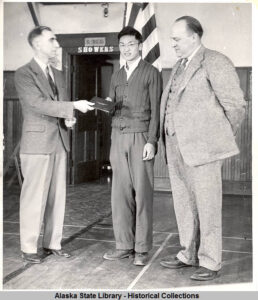
John Tanaka receiving Juneau High School Diploma, April 1942 (prior to federal Japanese-American families internment). Alaska State Library, Japanese-American Incarceration, Juneau Families, bulk 1940s, M286-11-10.
Likewise affecting Juneau area residents, a graduation exercise was held at the Juneau High School in April, with only one student graduating. He was class Valedictorian John Tanaka, who was Japanese-American and thus had to be evacuated with other family members by April 20. In May 1942, the seniors at Juneau High School left an empty chair during their graduation ceremony to underscore his absence. By extension, the empty chair honored all of the Japanese uprooted from their homes and communities. (To honor this act, an Empty Chair Memorial was placed in the corner of the Capitol School Park and dedicated on July 12, 2014).
All Juneau fishermen and other owners of boats of more than five net tons were requested by the local defense director to meet January 2 and organize a Civilian Defense Marine Patrol. Alaska’s first air raid shelter, constructed in the back yard of the Dr. W. M. Whitehead home on Sixth Street, was pictured in Life Magazine January 26. The shelter was designed from a British Air Ministry plan. Area rationing began in February for tires and gasoline.
After being in business for nearly 27 years, Dave Femmer was forced to move from his old location in mid-August on the Femmer Dock, off Willoughby Avenue, to a South Franklin address in the Connor Motor Company building. The property around the Femmer Dock location, as well as the dock itself, had been taken over by the government (which was then expanded into the Subport military staging area.)
Juneau – Sitka airmail service was inaugurated March 2. Star Airways of Anchorage began a once-a-week service in April between Anchorage and Juneau (Star Airways later merged to become part of Alaska Airlines.)
October 8 the War Production Board issued Order L-208 to close down all non-essential mines (read gold mines), but the AJ mine was allowed to remain open as the primary employer in town (and also a significant producer of lead as a by-product). However, manpower at the mine dropped by almost half from the beginning to the end of the year, cutting production significantly while costs continued increasing.
Tony Simin, longtime Douglas storekeeper, died in St. Ann’s Hospital at Juneau August 15 as a result of wounds received the previous night when he was shot down by a holdup man in his store. Officers were holding William Paddy, 31, in connection with the shooting. Before he died, Simin made a statement in which he named Paddy as his assailant. The Juneau Police Department hired Isobel Hartung, its first female police officer (matron) in its history. That position, however, was abolished in 1948 by the city in an effort to cut its expenses.