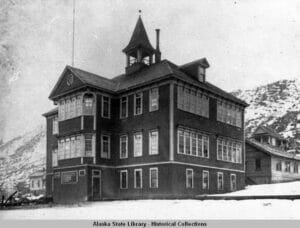
The Early American Era: 1867 through the end of the 19th century
As in pre-contact history, the Juneau area from Windham Bay north to Berner’s Bay continued to be the province and under control of the Aak’w, T’aaku, and S’awdaan Kwaans of Linget Aani peoples, the area’s original Native inhabitants, for much of the 19th century, (1). All of southeast Alaska was nominally claimed by Russia through the administration of the Russian America Company, but their personnel made little attempt to penetrate into this area, even for their main objective of fur trading. Other Euroamerican adventurers, primarily British and Americans, slowly increased their visits into the area seeking to gain from fur trading under agreements with the Russians. The Russians had established a trading post at Fort Wrangell, near the outlet of the Stikine River, then leased it in 1840 to the British Hudson’s Bay Company, from which their traders continued dealing with the Tlingit peoples in what we now refer to as the Juneau area. After the 1867 purchase of Alaska from Russia by the United States, Americans visiting the area were more interested in seeking mineral resources, primarily gold. Seeking to benefit from a gold-induced cash economy, an Aak’w leader, Kaawa.ée led prospectors Richard Harris and Joe Juneau to a stream at the head of Gastineau Channel north of Taku Inlet, where they found gold and staked a townsite. This marked the beginning of Juneau and the first new town founded in Alaska after the American takeover. From then on, development in the area proceeded to follow the classic American west mining development pattern, At this point, our timeline will elaborate into summaries by decades..
show footnotes
1. Carstensen, Richard, Discovery Southeast, Juneau City & Borough, Parks & Recreation Department. 2013. Natural History of Juneau Trails, a Watershed Approach. Juneau AK. Discovery Southeast: 29 – 36. http://juneaunature.discoverysoutheast.org/content_item/people-on-the-land/
Goldschmidt, Walter R. and Theodore R. Haas. 1998. Haa Aani, Our Land: Tlingit and Haida Land Rights and Use. Edited with an introduction by Thomas F. Thorton. Seattle: University of Washington Press; Juneau AK: Sealaska Heritage Foundation. Original report titled “Possessory Rights of the Natives of Southeastern Alaska: A Report to the Commissioner of Indian Affairs,” 1946.
Thorton, Thomas F. 2008. Being and Place Among the Tlingit. 45. Seattle: University of Washington.
show less
1867-1880 Early American Era (1)
1867-84 Alaska transferred from Russia to US. Southeast initially under martial law by Army, then Navy. Sitka remains headquarters for the limited federal presence in Alaska as a military district.
1868 Commander Meade on USS Saginaw encounters Áak’w people in Young Bay, which he names Auk Bay. Name later transferred to present location.
July 27 Congress approves an act making Alaska a Customs District. (2)
1869 Prospectors from Wrangell discover placer gold in Windham Bay, first gold mining operations begin in the later-named Juneau Goldbelt region (a mineralized geologic formation which extends northerly from there about 100 miles to Berner’s Bay).
1879 Áak’w villagers show gold quartz from Gastineau Channel to Captain Beardslee in Sitka. Stikine elder Toyatte reluctantly guides naturalist John Muir and missionary S. Hall Young through Áak’w territory, including Gastineau Channel. Muir notes promising mineralization and Young views mission opportunities. John Lemon prospects Lemon Creek.
1. Carstensen, R., ibid. 31.
2. Juneau 1980 Centennial Calendar, Scott Foster, researcher/writer, 1980. A calendar with Juneau events from 1880 – 1980 published for the centennial of Juneau’s founding.
The 1880s – Juneau’s First Decade of Colonization
Read the full decade summary…
In Sitka, mining engineer George Pilz sought information on gold deposits in the region that might be turned into paying propositions and had put out word to indigenous Native people that he would give up to 100 pairs of Hudson Bay blankets if gold specimens were brought to him that showed good promise for mining. Pilz heard of the specimens that Captain Beardslee had received earlier from Áak’w villagers from their territory along the Gastineau Channel and mainland near the Taku River area. The summer of 1880, Pilz sent out several two-man groups of prospectors to search eastern areas from Sitka, including Richard Harris and Joe Juneau who were to check out the area of the Áak’w Kwáan territory. Guided by Áak’w leader Kaawa.ée, they found rich placer and lode deposits on Dzantik’i Héeni stream, which they re-named Gold Creek. They staked claims in October 1880, forming the Harris Mining District, and staked a townsite nearby which was initially named Harrisburg. The nascent gold camp quickly attracted a small rush of gold-seekers to the area, becoming the first new settlement in Alaska after American purchase from Russia (for which the original indigenous peoples were never consulted or remunerated).
By the following year, the camp had been formally re-named three times (with other nicknames as well) before the final name Juneau stuck, in honor of Joe Juneau, co-discoverer of the area’s gold deposits (although led to the original discovery site by Kaawa.ée whose people had long known about and even used gold for their own purposes before then). As typical of western mining discoveries, the fledgling camp quickly attracted a small population of miners and attendant camp suppliers and builders to exploit the placer deposits on Gold Creek and adjoining areas. Native Tlingit peoples also flocked to the new townsite in hopes to get wage jobs to acquire white men’s goods and to provide fish, game, furs, and wood for trade and sale. Within the decade, neighboring traditional native villages were gradually abandoned with Áak’w people moving to a native village site west and around the corner from the core Juneau townsite and T’aakú people establishing themselves first on the shoreline just south of the core downtown area, then moving across the channel to a village site along the beach between Douglas and Treadwell.
Within a few years the relatively easy-to-work placer gravel deposits were mostly worked out, with individual claims being consolidated to be re-worked by larger scale industrial placer mining techniques (and much more environmentally destructive, but not a consideration in that unenlightened era). The source of gold lay in bedrock lode deposits, discovered concurrently with the placer gravels, which was to provide the real foundation of the area’s development. Extraction of gold from the “hard rock” lode deposits, however, required much greater capitalization than an average individual could access to provide the technology, materials, and labor needed to mine and mill the ore to release the values. Prospectors fanned out along the whole length of the Juneau Gold Belt formation discovering numerous small placer and lode claims, few of which became paying mines. Late in this decade two major mining promotion failures blackened the area’s mining reputation, however, which cooled international investment interest for several years.
On Douglas Island, across the channel from Juneau, John Treadwell, a carpenter with California mining experience who represented San Francisco investors, bought up a series of lode claims which turned out to provide a massive low grade gold ore body. With the means provided by his California backers, he presided over the buildup of his Treadwell Mine to create the first large scale industrial project in the north. By the time he sold out his interest in 1889, the Treadwell was becoming known as a world-class operation and putting Juneau on the map as a major mining center. Treadwell brought the first locomotive to Alaska for the mine’s hauling system and pioneered the first use of electric lights for its operation. The adjoining town of Douglas grew in the mid-1880s as a suburb community to provide housing, services, and entertainment lacking in the company town of Treadwell. With the rapid growth of the Treadwell operation, transportation and mail service increased rapidly from once-a-month limited steamship service to multiple weekly sailings to the area by multiple companies and vessels. By 1883, the area was visited by its first tourists on their way to see the wonders of Glacier Bay and by the end of the decade Juneau was firmly established on the nascent tour route.
Ferry service provided cross-channel connections. In Juneau, several newspapers were started, churches, fraternal and cultural organizations sprang up along with a multitude of businesses to provide most needs and wants of the ever-growing population, including at least one brewery to supply numerous local saloons and entertainment establishments. Limited local government began with miners’ meetings but no land laws provided for private ownership, although the town had staked a townsite, and informal ownership was locally recognized and properties bought and sold. A street committee was formed to plot out streets and begin rudimentary street layout and construction of planked walks and streets. Federal presence included a commissioner, deputy marshal, customs collector, and a visiting circuit judge using a rented courthouse. Schools and a hospital were started, sawmills provided building materials, wharfs were constructed, a private water system set up, a volunteer fire department and Board of Public Safety established, and the first telephone line strung to connect the Perseverance Mine near the headwaters of Gold Creek to mine offices in Juneau. Juneau become the main supply center for outlying settlements, primarily small mining camps. A salmon saltery in Taku Inlet provided the start of the area’s commercial fisheries and local waters provide salmon and herring for processing plants outside the immediate Juneau area. A dairy started up late in the decade and homesteaders provided limited amounts of seasonal farm products. Juneau’s future held fair promise.
One blot on this picture, however, was increased racial discrimination first against Native Tlingit peoples, which saw them relegated to underclass treatment and displacement from their traditional use areas. By mid-decade anti-Chinese sentiment was pandemic on the west coast of the continental U.S. and those tensions also were transplanted north with many new Caucasian arrivals. This culminated with a mob action with over 100 Juneau residents storming over to the Treadwell mine to oust over 80 Chinese workers and force them to leave the area on two overcrowded vessels.
Close the full decade summary…
1880
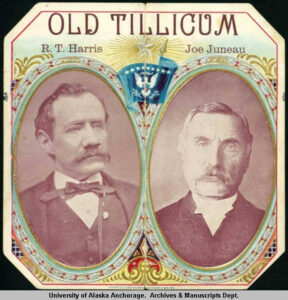
Portrait of R.T. Harris and Joe Juneau. Old Tillicum cigar box picture, ca. 1900. Richard Tighe-Harris family papers,Archives & Special Collections, Consortium Library, University of Alaska Anchorage. UAA-hmc-0131-series5b-59-2.
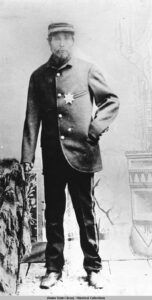
Kaawa.ee in later years after Juneau’s founding. Alaska State Library, Alaska State Library Portrait File. Photographs ASL-Cowee-01; P01-1155
Sitka mining engineer George Pilz employed prospectors Richard Harris and Joe Juneau that summer to check out reports of gold from Áak’w leader Kaawa.ée (aka Kowee or Cowee) in the Gastineau Channel area. Kaawa.ée with 2 other tribal people showed them gold in Silverbow Basin. Harris and Juneau staked the first placer and lode claims October 4 and Harris established the Harris Mining District the same day. Harris also named the Silver Bow Basin at the head of the Gold Creek watershed for the Silver Bow mining district in Montana.
On October 18, he and Juneau claimed a 160-acre townsite at Miner’s Cove near the outlet of Dzantik’i Héeni stream, which they named Gold Creek. The site was by a traditional Áak’w summer fishing location. Word quickly spread and the first real gold rush in Alaska saw about 40 miners in the new townsite by year’s end, now known as Harrisburg(h) (spelled both ways).[3] It was the first town established in Alaska after the American purchase.
1881
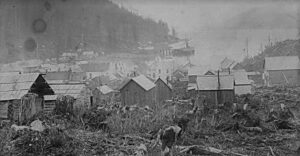
Juneau; view south over rooftops, ca. 1882. Alaska State Library, Edward DeGroff. Photographs, ca. 1886-1890, P91-65.
U.S. Navy Commander Rockwell arrived from Sitka to establish a military post to “preserve order” amongst the miners and Indians, but with little action, the post was closed in November. Gold mining in Silver Bow Basin and on Douglas Island, across the channel, proved very productive and the camp flourished with mercantile stores, service establishments, saloons, etc. springing up to provide all the necessary needs. On September 13, John Treadwell bought the “Parris” mining lode claim on Douglas Island from Pierre “French Pete” Erussard for a quit-claim deed of $5, plus up to $400 (estimates vary) to pay a pending freight bill Erussard needed for the next shipment of goods for his store. This claim Treadwell was soon able to develop into the eventual world class Treadwell mine. The first house in Douglas was log cabin reportedly built by William Newcomber, located west of the Treadwell claims although the area was not called Douglas until the mid-1880s..
By May, 150 whites and 450 Indians were reported on site by naval Commander Glass. Áak’w and T’aakú people migrated there with their respective villages springing up on either side of what was first called Pilzburg, then Fliptown, Harrisburg, Rockwell, and ultimately Juneau, to take advantage of economic opportunities there. Settlers began displacing Tlingit people from their lands and areas of traditional use. Going rate for indigenous workers was $1/day, usually for packing supplies to the mining claims.
The first political convention convened August 16 to call for the need for a form of government in Alaska and representation in Congress and the first election was held in Alaska September 5 to elect a delegate (who was not received by Congress late that year). By the end of 1881, the town had a code of local laws, a townsite survey, a Board of Public Safety, and a post office. The mining code was amended to close the mining season October 1, so that miners wouldn’t have to work their claims in the off-season in order to hold them. Heavy snowfall often precluded claim work into May or beyond. Regular monthly mail steamer service began the end of March, greatly reducing the cost of supplies.
1882
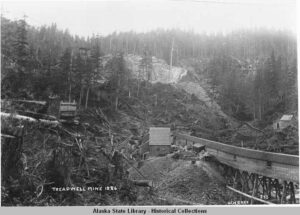
Treadwell mine showing original 5 stamp mill (center) and open pit (glory hole) up hillside, ca. 1886.Alaska State Library, William Norton Photo Collection, W.H. Case, P226-306.
Placer mining provided most of the gold production, but lode claims also began to be worked (placer referring to the practice of separating gold from gravel deposits by water action versus lode mining in which valuable metals are separated from bedrock deposits by blasting and crushing the host rock.) On Douglas Island, John Treadwell had learned that samples from his “Parris” (soon shortened to Paris) claim assayed well, so that spring he returned to set up his first 5 stamp mill (machinery used to crush and separate gold from the ore) to begin developing the eventual world-class Treadwell mine complex. Work began on Treadwell Ditch along the northeast side of Douglas Island, to deliver water to mines for hydropower. Another 5-stamp mill began operation in Last Chance Basin, while most gold production was still being mined from small placer claims.
January 10 the local post office name was changed from “Harrisburgh” to Juneau City. The camp’s name change had previously been voted and approved in a miner’s meeting December 15 the previous year, so the Post Office Department was notified and went along with the local wishes. It was subsequently shortened to just “Juneau”, to which it remains to this day.
A salmon saltery began operation on Taku Inlet, the first commercial fisheries operation in the area.
1883
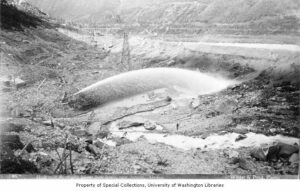
Hydraulic mining in Silver Bow Basin, Juneau, Alaska, between 1888 and 1898. University of Washington, Special Collections, Winter & Pond Collection, PH Coll 308.63.
Placer miners of the Harris District had their best season yet and lode mining made a favorable showing. Total gold production for the district was estimated at $400,000 for the season, most of it from the placers.
Catholic Church now had regular weekly services, with Protestant services offered less frequently.
The first murder was committed over a theft of liquor and the perpetrator was hung July 30.
Tourists began visiting Juneau on Alaska trips promoted by steamers, a main attraction being a stop-over in Glacier Bay.
1884
On May 13, Congress passed an Organic Act to establish Alaska as a civil and judicial district, with a commissioner and a marshal assigned to Juneau, but still no land laws and mining claim litigation was a frequent occurrence. With no clear judicial system in place, a vigilance committee began to quell violence.
Gold mining accelerated on Treadwell side of channel with the addition of a 120-stamp mill, a chlorination plant to treat concentrates, housing for workers, and a wharf.
1885
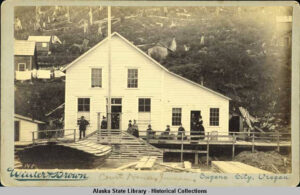
First Court House in Juneau. Alaska State Library, Wickersham State Historic Sites Photo Collection, Winter & Brown, P277-018-088.
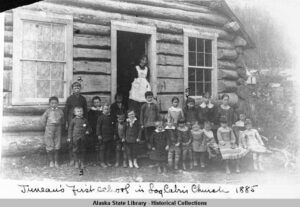
Juneau’s first school in Log Cabin Church, 1885. Alaska State Library, ASL Place File Photos, ASL-Juneau-Schools-01, P01-2208.
In Juneau a rented building served as the first courthouse and occasional church services and other civic events were held there too. The Juneau Public School System began as a one teacher, one-room school in a log cabin starting May 25, although missionaries had already held schools for Native children.
The Treadwell 120-stamp mill reached full production, producing over $280,000 that year. The company also located a sawmill for its operations north of the property in the future townsite of Douglas (now the site of the Juneau Montessori School).
The U.S. Land Office granted a townsite north of the Treadwell property, a survey was made, and lots were ready to be sold for the new town of “Edwardsville”, named for H.H. “Dad” Edwards, one of the first White settlers there in 1881. By the next year, the town was generally referred to as “Douglas City,” which stuck, although later shortened to just plain Douglas (in reference its location on Douglas Island).
New gold discoveries in Berners Bay were creating excitement. A huge landslide in the Gold Creek basin killed 5 men, the worst disaster in local history to date.
1886
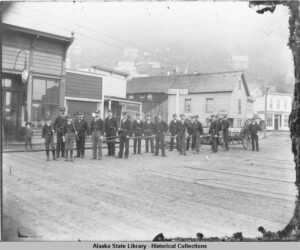
Juneau Fire Department on Front Street with hose cart, ca. 1890. Alaska State Library, Winter & Pond Photo Collection, P87-1186.
A volunteer fire department was organized in Juneau. Sisters of St. Ann established a hospital and school in Juneau. The one judge in Alaska, based in Sitka, agreed to hold a court term once a year in Juneau.
In August, anti-Chinese sentiment induced a mob from Juneau to cross over to Treadwell to oust Chinese working at the mine. Eighty-seven men were forced aboard two small sailboats and ordered to leave. Old-time miners protected “China Joe,” a Chinese baker who remained the only Chinese person left in town. They remembered his generosity in sharing his food supplies with them one winter at Dease Lake during the Cassiar gold rush, which had prevented starvation for area miners. Deported workers were replaced with mainly Native workers.
The steam ferry Marion provided regular service between Juneau and Douglas Island. Douglas City experienced a building boom as the town site was surveyed and lots were going for $25 – $250 each. Petition by local citizens asking to increase mail service from once to twice a month was turned down in Washington D.C.
1887
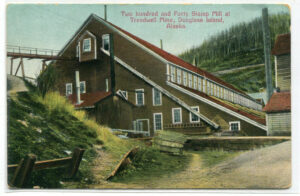
240 Stamp Mill at Treadwell Mine, Douglass [sic] Island, Alaska.
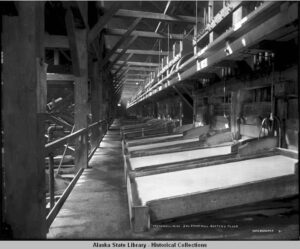
Treadwell Mine. 240 Stamp Mill. Battery Floor. Alaska State Library, William Norton Photo Collection, Case & Draper, P226-324.
Treadwell mine added 120 stamps to its mill, making the 240 mill the largest stamp mill in the world under one roof. Protesting “damp and disagreeable conditions” Treadwell miners struck, beginning March 5, and demanded a $3/day wage and board. Miners complained in general about the high cost of living in Juneau for the winter: wood at $4.50 a cord (now between $250-$350 a cord), coal at $13/ton, and coal oil (kerosene) at $2.50 for five gallons. Up Silver Bow Basin, the first burro pack train was employed in the spring to carry out ore from the Perseverance claims group for shipping to San Francisco for testing.
Douglas post office established September 28, which also served Treadwell.
Juneau’s first newspaper, the Alaska Free Press started on January 15.
As enrollment increased, a new Juneau school house was built on 5th street to replace the original log cabin and opened in the fall.
1888
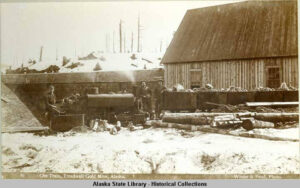
Ore Train, Treadwell Gold Mine, Alaska, ca. 1893. Alaska State Library, Winter & Pond Photo Collection, P87-2981.
Treadwell installed electric lights in its facilities, and took delivery of a small locomotive for hauling ore cars, the first in Alaska.
The Alaska Union mine and mill at Eagle Creek on Douglas Island (north of the present Juneau-Douglas bridge), constructed the year before to great expectations, was abandoned after the first run of ore through its 80-stamp mill only produced $40. Over $300,000 had been expended by eastern investors excited by reports of over 75 million tons of ore at $13/ton and the short-lived town of New Boston was set up by the beach below the mine. The mined ore only produced a few cents a ton, and the resulting failure was a hard lesson to learn for its investors and promoters.
The Juneau City Mining Record was established April 5. A free reading room was established September 6 by the ladies in Juneau.
1889
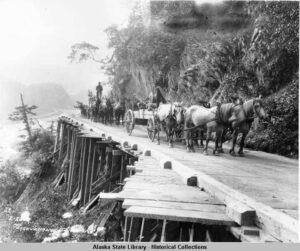
Basin road up to Perseverance mine. Alask State Library, ASL Place File Photos, ASL-Juneau-Vicinity-Perseverance-20a
A 10-stamp mill began operation in Silver Bow Basin for the Eastern Alaska Mining & Milling Company, the predecessor of the later world-class Alaska Gastineau Mine at Perseverance.
A road completed to the area was then the longest road (4 miles) in Alaska. The first horse and buggy arrived in Juneau to provide transportation to the Perseverance site. The first telephone line in Alaska was installed to connect the Perseverance mine with its office in Juneau.
Since the first discovery of gold in Silver Bow Basin in 1880, it was estimated that $3 million worth of the metal has been taken out of the placers and lodes along Gold Creek. John Treadwell sold his interest in the Treadwell mine for $1.4 million to a group of international investors which formed the Alaska Treadwell Gold Mining Co. Two other mining promotion failures, however, give Alaska mining a black eye to potential investors, the Alaska Union Mining Company and the Bear’s Nest Mine, both on Douglas Island.
Quaker missionaries from Oregon established a school in Douglas for Native children and the Treadwell company opened a school near the Mexican Mine for employees’ children.
Local newspaper editorial bemoaned record rainfall as having given “a false impression of our average weather” to the large number of summer tourists.
The 1890s –Juneau’s Second Decade Appears Promising
Read the full decade summary…
Though still basically a booming mining camp, Juneau’s future looked promising as it entered its second decade. Across the channel, the Treadwell mine was steadily increasing its production with two new mining companies formed to work a massive contiguous low-grade ore body. The Alaska Mexican Gold Mining Company and the Alaska United Gold Mining Company opened up three separate mine operations – the Mexican, 700 Foot, and Ready Bullion mines southeast of the Treadwell mine, but worked under a united management, shared common support facilities, and operated year around. It was the largest operation in the Juneau Gold Belt; in fact, it was the largest gold mine complex in the world by the decade’s end and drew employees from around the world – primarily immigrants from Scandinavia, the Balkan countries, but also from the British Isles, Russia, Australian, South America, and Japan. Considered a progressive company town for its time, employees were drawn by its high wages and associated amenities such as good room and board, a mercantile store with prices competitive with Puget Sound, and a hospital and associated injury and death benefits.
Up the Gold Creek Valley, placer mining continued primarily with consolidated claims being worked on an industrial scale with hydraulic technology, but the gravels were mostly worked out by the end of the decade. A few lode mines containing large ore deposits showed more promise, including the Perseverance Mine and the Alaska Juneau mine, and additional investment aided their increased development and economic returns. Elsewhere, lode mining activity also showed promise in camps from Berners Bay to the north and to Port Snettisham, Endicott Arm, and Windham Bay in the south. Sheep Creek valley mines across the mountains from Gold Creek also were producing tantalizing amounts of silver as well as gold. The promise of future riches seemed to affect the general population as one editor observed early on, that the town seemed to empty out on weekends in the summer as most of the population (male anyway) was off in the hills prospecting for the next big strike. A mining boom was underway.
Around town, development continued apace with the addition of more stores and services, including the development of a telephone system to connect Juneau and Douglas, expansion of the water system, development of a private electric utility – powered originally by a mining hydroelectric plant but expanded to run its own system, and a new ferry company formed to provide regular service between Juneau, Douglas, Treadwell, and Sheep Creek. A new courthouse was built in 1892 to house the court, prosecutor’s office, and jail, which also served as a community center from time to time, until it was destroyed in Juneau’s largest fire to that point in 1898. Churches were added, cultural and musical groups formed, theatrical and various entertainment affairs held, and a free lending library opened by a Juneau women’s club. Halibut fishermen operating out of Juneau began expanding their markets by packing their catches in Taku Glacier ice and shipping them down to Puget Sound and other west coast ports.
Government still was lacking through Congress’ lack of attention to its northern territory, and people still could not get title to their property. Restive residents raised money for a townsite survey to apply to Washington D.C. for a patent to remedy the situation. About then in 1894, a local merchant family bought an undeveloped gold claim (the “Bonanza Lode”) in the middle of the townsite and proceeded apply for the claim patent. If successful, they would get title for both mineral and surface rights. This would conflict with the townsite patent and the family threatened eviction suits for anyone living on their claim – most of the core downtown area. This controversy threatened to stall further downtown development and the battle then proceeded in a series of court cases, until it was finally rejected and laid to rest about 10 years later.
Liquor in Alaska had been officially banned since the Alaska Purchase in 1867, but its importation and manufacture had basically been ignored since then, with the exception of the prohibition of sales of liquor to Native peoples. Indeed, some of the earliest establishments in the new camp were saloons and one was even in operation next to Juneau’s first court house, apparently suffering no enforcement of the letter of the law. A few attempts to enforce the law by customs officers did little to stop the trade and 3 breweries were in full operation by the 1890s. Finally in 1899 Congress passed a licensing act for Alaska and saloon licenses set at a rate depending on population size. For Juneau the fee was $1,000 for each establishment and with its passage, the number of saloons dropped from 30 to 14, still apparently enough to quench residents’ thirsts.
Juneau not only continued to serve as the region’s hub for supplies, but served as an outfitting point for prospectors heading north to check out rumors of gold in the Yukon region. What started out as a trickle of men penetrating the coastal range at the head of Lynn Canal became a flood when the big strike on the Klondike River became known in 1896-97 and then drew tens of thousands of gold seekers from around the world in 1898. Juneau merchants tried to vie with larger west coast ports down south to attract gold rushers to outfit in Juneau, but most already had their outfits as they passed by enroute. The craze afflicted locals as well, and mine operators and businessmen bemoaned the loss of employees and lack of replacements for their operations. At least one expedition was attempted to explore and create a new route (following traditional Tlingit trading routes) to the northern gold fields via going up the Taku River watershed and then down the headwaters of the Yukon. With the new discovery of the Atlin BC gold fields along that proposed trail about that time, it seemed like a worthwhile venture, but few parties ended up going that way.
To properly end the decade and welcome the new century, Juneau also entered the aviation era – at least for one day. That was when Juneauites were treated to Alaska’s first hot air balloon ascension and parachute jump as part of the 1899 4th of July program.
Close the full decade summary…
1890
A census of the channel area showed that Juneau had a population of 1,253, plus an Indian population of 527. There were 378 houses in town. Douglas City’s population was 402, and this included the Treadwell mine. Of these, 356 were white. There were 122 houses in Douglas.

Douglas School, Alaska. Alaska State Library, ASL Place File Photos, ASL-Douglas-02, P01-2092.
The Douglas City School was built and began classes in late January. Daily mail service between Juneau and Douglas was established by early June. The 14-mile Treadwell Ditch was completed to bring water to Treadwell from streams as far away as upper Fish Creek on northern Douglas Island.
A road into Sheep Creek basin south of Juneau was completed to service the mines there.
The post office of Berners was opened to serve miners in the Berners Bay area.
1891
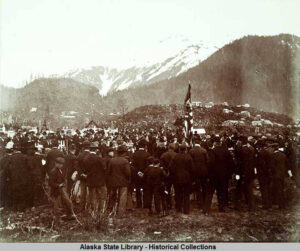
Decoration Day, ceremony at cemetary, Juneau, 1899. Alaska State Library, William L. Whitaker Photo Collection, ca. 1899-1903, P32-084.
A new cemetery opened up on the west side of Gold Creek and by May a road and bridge were in place for access.
A new water reservoir was constructed on Chicken Ridge and work began to lay out service lines for the town.
St. Ann’s Catholic School opened in a new building.
A corrected census showed Juneau’s population to be 1,567 residents, but it was believed that the population was actually much larger as many residents were out prospecting at the time the count was made.
1892
Áak’w leader Kaawa.ée died at age 75 on February 27 and was cremated and buried in the new Evergreen Cemetery.
Mendenhall Glacier was named by the U. S. Coast & Geodetic Survey after its leader, Thomas Corwin Mendenhall. John Muir had called it Auk Glacier in his visit to the area in 1879, and Richard Harris and others also referred to it as such in the 1880s.
The first electric generator in Alaska to furnish power (not just for lighting) was installed at the Perseverance Mine to power its compressor.
“Kin-dashon’s Wife,” by Caroline McCoy White Willard, wife of a Presbyterian missionary, was written in Juneau and published in New York, the first novel about Alaska and by an Alaskan.
1893
The “telephone craze” hit Juneau with several private wires installed and plans to connect Juneau and Douglas were being made. Alaska Electric Light & Power was formed in October to provide electric lights to subscribers in Juneau with power generated by the Nowell mining company. Power was turned on to Juneau city street lights for the first time November 21 and many residents came out just to view the new novelty. Juneau’s first bank was opened late in the year by the Harrison Brothers; previously, merchants provided informal banking services. The Juneau townsite survey began in November and, once completed, lot owners could get title to their property. New federal court house was built on the naval reserve hill (aka Telephone Hill) to house district court offices and jail, with room for other federal employees.
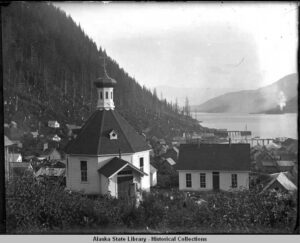
Russian Orthodox Church and vestry, Juneau. Alaska State Library, William Norton Photo Collection, P226-225.
The St. Nichols Russian Orthodox Church was completed August 5.
A phonograph concert September 9 impressed locals with the new musical technology.
The Mexican mine, part of the Treadwell complex, began operation with 60-stamp mill late in the fall. A short railroad was built to connect the Comet mine on Sherman Creek just north of Berners Bay to the beach camp known as Seward City or Comet, which served mines in the area.
1894
Telephone service connected Juneau and Douglas. The electric company built a hydroelectric power generation plant by the Gold Creek delta in the spring, producing its first power September 20. The charge was $1.50 a month for each 16-candlepower light bulb, with service until 10 p.m. If all night service was wanted the charge was $2.
Dr. William Hammond who had been practicing medicine in Juneau, left on a steamer in February and was reported to be a bigamist. Three of his wives had gotten together and were waiting for him on the dock in Seattle (no report of what subsequently prevailed.)
February was also a month for a couple of spectacular snow slides. February 9 there was an immense snow slide half a mile up Basin Road filling the valley and breaking off trees and telephone and electric light poles and pushing 400 feet up the opposite side of the valley. There was a whirlwind of blowing snow over Juneau for some time. A week later another immense snow slide occurred south of town. The water in the channel was thrown into the air and churned into foam and floating snow made a bridge clear across the channel until the tide swept it away.
A school house was built along Calhoun Avenue for Alaska Native students, which served until 1912 when the new Governor’s Mansion was built on the site.
In August Pinkerton detectives arrested thieves who had stolen gold precipitates from the Treadwell chlorination works, worth $10 – $12,000. By mid-August about $8,600 of the values had been recovered.The Douglas sawmill, owned by the Treadwell company, burned to the ground August 13. The company planned to rebuilt it immediately.
A territorial convention held in Juneau in November elected T. S. Nowell as an unofficial delegate to Congress. Among the measures he was to seek from Congress were: a fully accredited delegate, an amended code of laws more suited to the needs of Alaska, a high license and local option system for liquor control, the right of Alaskans to homestead land, and better mail service to the Yukon.
The Alaska Search Light newspaper was established in Juneau December 17. The Juneau Ferry & Navigation Company incorporated in December with 4 steamers to carry passengers between Juneau, Douglas, Treadwell, and Sheep Creek.
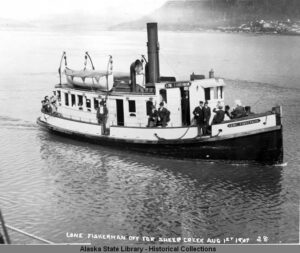
LONE FISHERMAN off for Sheep Creek, August 1st, 1907. Alaska State Library, ASL Place File Photos, ASL-Juneau-Ferries-03 P01-1085.
1895
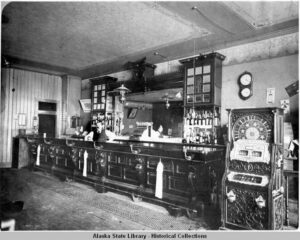
The Louvre Saloon with bartender and slot machine, Juneau, Alaska. Alaska State Library, Skinner Foundation Photo Collection, P44-03-178.
In June all the local saloon keepers were arrested and placed under $500 bond each, as a crackdown of a prohibition law dating to the purchase of Alaska (but hardly enforced). A test was to be made in District Court regarding the validity of the prohibition law. One saloon had just opened prior to the raid. Things must have settled down by September when the Star Brewery in Douglas announced its production of lager beer was now available, the first in Alaska.
A lawsuit, Bonanza Mining Claim vs. Juneau Town site, was filed in May alleging that town site occupants were trespassing on the claim and sought payment for damages. After about 10 years of legal proceedings the claimant’s suit was dismissed to the relief of the city.
Early in the season mining seemed to be going strong with several mines pleading for more workers and that anyone who wanted to work had plenty of opportunities. Over in Douglas it was reported that a number of residents were mining on the beach in front of town, using rockers and making more than wages.
The arrival in March of the newly organized Alaska Steamship Company’s vessel Willapa induced its competitor long-time shipper Pacific Coast Steamship Company to start a rate war in which it reduced its Seattle-Juneau fare from $40 to $12 and promised local merchants big freight discounts if they signed up for exclusive freighting with that line.
In August, Adlai E. Stevenson, vice president of the United States, his wife, two daughters and two brothers are among those making a tour of Alaska on the steamer Queen. While the vessel was in port here they visited some of the mines and talked with residents.
A large snowslide December 28 destroyed the mill and buildings at the Perseverance Mine in Silver Bow Basin.
1896
As this gold camp ended its 16th year, a survey of local business houses showed the following: 30 saloons, 2 variety theaters, 2 breweries, 3 newspapers and printing plants, 6 lodging houses, 10 attorneys, 9 general merchandise stores, 2 steam laundries, 8 miscellaneous merchandise stores, 1 cigar factories, 3 draying and freighting services, 4 tailors, 3 dentists, 3 physicians, 5 milliners and dressmakers, 5 hotels, 8 restaurants, 5 bakeries, 3 drug stores, 3 jewelers, 3 hardware stores, and 3 butcher shops.
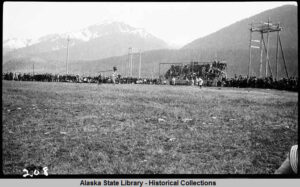
Baseball game on 1st Juneau field by lower Gold Creek. Alaska State Library, J. Simpson MacKinnon Photo Collection, ca. 1880-1945. P14-II-208.
First baseball game was reported to have been held on John Calhoun’s cow pasture near the mouth of Gold Creek.
The Mexican mine added 60 stamps for a 120 stamp mill. Early in the year a government school was established at Treadwell when the Sisters of St. Ann opened a school in the Bear’s Nest boarding house in Douglas, near the Treadwell mine. It was expected that most pupils would be from Treadwell as they would be able to avoid the long walk to the Douglas public school. The old boarding house was owned by the Treadwell Company.
Steamship rate war reduced tickets Juneau – San Francisco to $5. Local fishermen began shipping halibut packed in glacier ice south to Puget Sound ports.
The electric company added a steam plant to its Gold Creek hydro plant to overcome winter water shortages. A big avalanche swept away the mill and several other buildings at the Perseverance mine in Silver Bow Basin. One person was lost.
1897
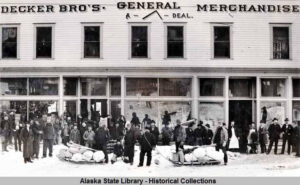
Preparing for the trail; prospectors outfitting in Juneau, Alaska, 1898. Alaska State Library, Winter and Pond Photo Collection, 1893-1943. P21-01.
Juneau merchants competed to attract business to outfit stampeders rushing to the Klondike gold fields. Local mines and businesses lose personnel who are also joining the gold rush.
In January, the entire camp was shocked by the shooting death of a deputy U. S. Marshal and the wounding of two other members of a posse during a gun battle on Admiralty Island. Earlier “Slim” Birch was in the federal jail awaiting transfer to Sitka for trial when he was freed by masked men who surprised the jail guard. They escaped by boat and were later found holed up in a cabin on the island. When approached by a posse they opened fire to kill deputy William C. Watts and wounded another deputy and jail guard, who later recovered. Birch was later captured at Funter Bay without further shooting and was then tried for murder.
Bicycling was becoming popular in Juneau as the planked streets were nice to ride upon. Sisters of St. Ann opened up a new school and hospital in Douglas. The federal district court was moved from Sitka to Juneau.
Alaska Juneau Gold Mining Company incorporated early in the year and included some of the first discovery claims (This was the official beginning of the company which grew to become the largest low-grade gold mine in the world at the peak of its production in the mid-1930s.)
For some time the Treadwell Company had issued green cardboard checks, worth $2 each in trade at its store but also used in general circulation on both sides of the channel. Local merchants were startled to learn in March that some of the checks have been counterfeited and the counterfeits circulated locally. The bogus checks are a little lighter green than the genuine ones and the signature of Superintendent Duncan was poorly reproduced.
Juneau’s first “sightseeing vehicle,” a 14-seat wagonette brought up in March, would be used to show visitors points of interest in the vicinity, including the mines along Basin Road.”
A post office was established September 16 at the mining camp of Sumdum, on Endicott Arm. A Tlingit Indian village near there had a population of 150 people in 1868.
1898
The Juneau federal court house and jail burned to the ground January 25 after an office lamp exploded. The Douglas Volunteer Fire Department was organized February 28 with twenty five residents as original members.
On February 5,the steamer Clara Nevada blew up in a fiery explosion near Eldred Rock in Lynn Canal. All aboard were lost. The ship was heading southbound from Skagway and reportedly was carrying a large amount of Klondike gold, but was also rumored to be carrying an illegal cargo of dynamite.
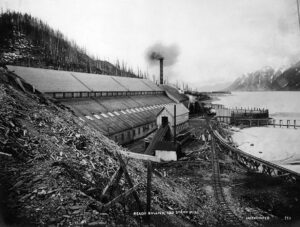
Ready Bullion 120 stamp mill. Case & Draper photograph.
Alaska United Mining Company began operation of a 120-stamp mill at the Ready Bullion mine, as part of the Treadwell complex. Treadwell company constructed its first hydroelectric plant at the mine complex to power its operations.
Juneau Chamber of Commerce sponsored a crew to reconnoiter a trail from mouth of the Taku River to Atlin BC for a future transportation route beneficial to Juneau commerce. A few parties used the route as a winter sled route to the Canadian gold fields. Indigenous peoples traditionally had used the trail for trading between coast and interior tribal people.
Douglas Island News newspaper started in Douglas November 23. Douglas began work to establish a new cemetery.
1899
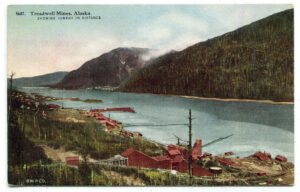
Treadwell Mines, showing Juneau in the distance. Winter & Pond Co. tinted postcard.
The Treadwell 300 stamp mill began operation in May and was the largest stamp mill in the world, crushing nearly 1,000 tons of ore a day. Alaska United Gold Mining Company’s 700 Ft. mine began operation of its 100-stamp mill. The Treadwell complex now was one of the world’s largest gold mines with 4 mines operating 5 mills totaling 880 stamps. The Alaska Treadwell and Mexican mines had paid dividends totaling $1,566,931 by this time. Enough ore was in sight to keep the mines going for 20 years.
In June Congress passed a liquor licensing act for Alaska, fees depending on population of the area. Juneau’s fee was $1,000; subsequently the number of saloons dropped from around 30 to 14. Juneau was the first city in Alaska to furnish an armory for her home troops and a regimental band was being organized for Company B. In November Juneau acquired an up-to-date hand fire engine which had 300 feet of hose and would throw a stream of water 100 feet.
Joe Juneau, a co-founder of Juneau, died of pneumonia March 1 in Dawson City, Yukon. He was running a restaurant at the time of his death. His body was later brought back to Juneau and interred in Evergreen Cemetary in 1903.
The first balloon ascension and parachute jump from about 1000 feet up, the first to be seen in Alaska, was made on the 4th of July by “Professor Leonard.”
Another decent also made news and the reputation of a Treadwell miner, Charles Johnson. On April 24 he was being hoisted to the surface in the main shaft of the Treadwell, when, apparently out of sheer absent mindedness, he stepped off the skip and plunged down the shaft. A party of the miners went down expecting to gather Johnson’s remains but instead, they found him standing in two feet of water at the bottom of the shaft. He was examined by the company physician, who found a bruise on his leg and another on one arm, and some signs of shock. Johnson said he remembered passing the 110-foot level in the shaft going down, but remembered nothing after that. The first newspaper report of Johnson’s fall gave the distance as 250 feet, but some of the miners got a steel tape and measured it exactly to be 256 feet. Now and then his name appeared in the newspapers, but it was never again just plain Charles Johnson. He was known thereafter as 256-foot Johnson.